Letter to NDP MPs Jenny Kwan, Peter Julian, Daniel Blake re CERB and MRN Priorities
Migrant Rights Network – Letter re Income Supports for Migrant and Undocumented Residents
Letter to Prime Minister Justin Trudeau and Members of Canada’s COVID-19 Cabinet Committee
This letter is an update to our letters from March 26th and March 16th.
There are at least 1.8 million migrant and undocumented residents in Canada, or 1 in 22 people. This includes seasonal agricultural workers who are essential to Canada’s food supply, care workers in long term care homes, and taking care of children, sick and the elderly. It includes cleaners in hospitals and homes, and it includes many warehouse, food delivery and grocery store workers. Many of Canada’s essential workers are migrant and undocumented and deserve income support. They deserve to stay home if they are sick, and they deserve income if they have lost work or have had hours of work reduced.
This week, we urge you to make the following changes:
1. Ensure residents without Social Insurance Numbers have access to Canada Emergency Response Benefit through the provision of accessible Individual Tax Numbers where information is not shared with immigration authorities. We reiterate our request for a meeting to develop a dedicated delivery mechanism to ensure that all migrants are aware of and able to apply for income supports.
2. Extend access to CERB for those whose SIN has expired. Many workers in implied status or recently out of immigration status have been unable to renew Social Insurance Numbers because of delays from Immigration, Refugee and Citizenship Canada. This particularly impacts workers on study permits, who are struggling to make ends meet.
3. The government rightly decided to ensure seasonal workers affected by COVID-19 can access CERB. This measure should be extended to seasonal migrant workers. Seasonal TFWP and SAWP workers should have access to income supports for delays in contracts, both inside and outside the country.Many agricultural workers have been delayed from starting their contracts due to border closures. Most have still not arrived. These workers must be able to apply for income supports for lost wages in this period.
4. Ensure that migrant workers who are forced to leave jobs or those that aren’t starting contracts right now are not deemed to have “quit voluntarily” and receive income supports.Many migrant care workers have been forced by their employers to move in with them. While their work hours have greatly increased, they are not being remunerated. Some migrant agricultural workers are choosing not to come for health and safety reasons, because of lack of protections while traveling or working in Canada. Migrant workers on employer dependent work permits are uniquely vulnerable to exploitation, and most cannot leave bad jobs easily. When they do leave, they are often in egregious conditions, and need income supports to transition to safety.
5. Extend income supports to migrant and undocumented residents who did not earn at least $5,000 in the previous 12 months.Many workers had lost jobs, or seen their hours cut in the months prior to CERB becoming available. Others have just arrived in Canada – an average of 48,000 new migrants arrive in Canada each month. Many workers have clung to jobs, even as hours have been reduced. Migrant workers on employer dependent visas who have left one job, but have not been able to secure an alternative LMIA approved employer are falling just below the $5,000 mark. Recently arrived refugee claimants have not earned $5,000.
Care Workers’ Rights During #COVID19: Immigration Applications
Care Workers, let’s support each other and share the right information during the #coronavirus crisis!
Are you worried about your immigration applications? Read below for more information!
 SHARE this post with your friends and other Care Workers!
JOIN US on Sunday, April 12th at 12pm for our next online workshop to learn more about our rights! RSVP here: https://bit.ly/3aFNSxh
If you are a Care Worker with questions about your rights, call, text or WhatsApp the Caregivers’ Action Centre at (647) 782-6633. 

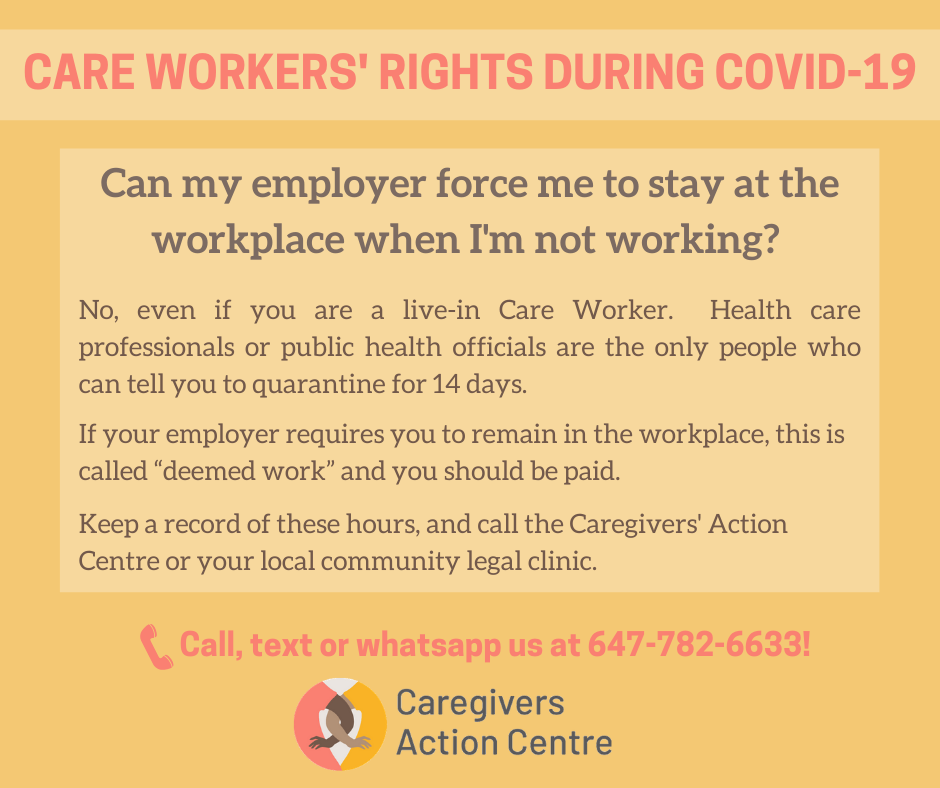
Care Workers’ Rights During #COVID19: Work
Care Workers, we need to stand up for our rights during the #coronavirus crisis! Is your employer forcing you to stay at home? You have the right to say NO or be paid!
Share this post with other Care Workers – let’s share the right information with each other!
Join us on Sunday, April 12th at 12pm for our next online workshop to learn more about our rights! RSVP here: https://bit.ly/3aFNSxh
If you are a Care Worker with questions about your rights, call, text or WhatsApp the Caregivers’ Action Centre at (647) 782-6633.
Migrant Rights Network – Letter re Migrant Worker Quarantine
Re: Guidance for Employers of Temporary Foreign Workers Regarding COVID-19
These guidelines must be mandatory requirements, and monitoring and enforcement mechanisms to ensure employer compliance must be established:
- These requirements must be adapted with a view to giving workers the ability to enforce their rights and thus protect public health. Employers already have inordinate control over workers’ lives, including over their working conditions, housing, transportation, and access to services and groceries. As such, it is essential that these proposals be deemed as requirements,not as ‘guidelines’ – failure to meet them will endanger the health and well-being of workers and the communities in which they live.
- Employers must be required to enable self-isolation and quarantining, provide healthcare information in a worker’s language of choice, and connect workers to local public health services.
- Employers must provide wages to workers during the quarantine period, even if they are not working. Federal income supports must be available to workers who cannot come to Canada, or who have been delayed in their arrival.
- These requirements must apply from the moment workers depart their home countries, throughout their travel to Canada, and through travel from airports to workplaces. If workers are housed in hotels, these requirements must extend to travel from hotels to workplaces.
- A responsive monitoring and enforcement system must be set up, in consultation with migrant worker organizations like ourselves. At a minimum this enforcement and monitoring system must include:
- A dedicated enforcement unit established between federal and provincial authorities, building on Employment and Social Development Canada’s compliance unit. Contact information about the enforcement unit must be shared with migrant worker organizations.
- The enforcement unit must assess work and housing conditions prior to workers arrival to ensure physical distancing is possible and health and safety rights protected. This pre-assessment should be done via a safety plan checklist that employers must submit.○
- The enforcement division must do swift, unannounced inspections on employers where complaints have been made, in coordination with local public health officials.
- Non-compliance should be met with fines and suspensions as per the pre-existing employer compliance regimes. In addition, specific measures must be enacted to ensure workers are appropriately compensated where employers put their lives at risk through non-compliance.
- A 24-hour accessible telephone hotline and web interface for workers to confidentially and anonymously make complaints about employer non-compliance in their own languages, or through third parties such as migrant worker support organizations, including through photos and videos.
Public health, not enforcement
- Employers are not equipped to assess the health of migrant workers. All health assessmentand follow-up support must be done by public health officials. Where workers are symptomatic, and with worker permission, public health officials can coordinate with employers to ensure workplace health and safety is upheld.
- There should be no sharing of information or contacting of law enforcement or consulates, either by employers or by compliance units in cases where workers make complaints. The possibility of health information being shared with non-health related authorities will dissuade workers from taking necessary steps to protect themselves and others from the spread of COVID-19.
- Workers who are sick must be provided healthcare in Canada, not deported.
- Employers must ensure adequate hygiene products and meals for workers during theirquarantine period without deductions. These must be extended to the entire course of the crisis, if workers request it, also without deductions. These meals must be prepared by an unrelated third party catering company and the meal plan must be reviewed and approved by a qualified nutritionist (as outlined in existing SAWP contracts).
- Workers’ ability to reach social supports must be facilitated through guaranteed wireless internet access, and connecting workers to local support organizations.
- Healthcare must be guaranteed in all provinces, without the need for a health card, through emergency changes to Interim Federal Health program or expanded provincial health transfers.
Communication with workers is essential
- These requirements must be made available to workers and worker rights organizations inadvance of workers travelling to Canada and at the port of entry, with information on how workers can assert their rights and make anonymous complaints, available in appropriate languages.
- Employers must be required to share information on the safety plan with workers immediately upon arrival, and update on changes regularly.
- Workers should also be provided with public health guidelines on hand-washing and physical distancing during the COVID-19 pandemic in appropriate languages.
- All workers at a workplace must be informed about the results of inspections following anonymous tips.
Migrant Rights Network – Letter re Income Supports for Migrants
Letter to Prime Minister Justin Trudeau and Members of Canada’s Federal Cabinet Re: Regulatory changes to ensure Canada Emergency Response Benefit is available to migrants and undocumented residents
As you discuss developing regulations to implement the Canada Emergency Response Benefit (CERB), we urge you to ensure that all residents of Canada, regardless of immigration status or previous work entitlements, are able to get income supports.
- The benefit is currently defined as available to “residents”. ‘Resident’ must be broadly defined to include any resident of Canada, regardless of immigration status, including undocumented residents, refugee claimants, temporary foreign workers, study permit holders and others.
- There were 874,770 new temporary work, study or humanitarian permits issued in 2019. In addition, there are at least 500,000 undocumented residents in Canada.
- The benefit is limited to residents who have earned at least $5,000 in the previous 12 months. Specific measures need to be enacted to ensure workers who have not earned as much, have not been able to report their earnings and/or have not been in Canada that long, are protected.
- An average of 48,000 new residents arrived each month in the first quarter of 2019. The numbers are similar in Canada for January and February 2020.
- Many temporary foreign workers have been laid off from their jobs or seen their hours reduced in care work, retail, and tourism industries. Study permit holders have lost on-campus jobs, and seen hours reduced.
- Workers who have seen their hours of work or wages reduced – which is many of our members – must be able to get income supports.
- Specific tools should be developed to ensure that undocumented residents and other informal economy workers are able to access income supports.
- There should be no requirement for Social Insurance Numbers.
- Guarantees should be created so that information is not shared with immigration enforcement.
- Proof of income should be interpreted widely, as cash economy workers do not receivepaystubs, have bank accounts or pay regular taxes.
- A dedicated delivery mechanism must be created in coordination with our groups to ensure that migrants are aware of and able to apply for income supports.
- All workers who are facing job loss or a cut to hours of work should receive $2000/month whetherthrough CERB or Employment Insurance, including workers outside Canada, who are unable to come because of health concerns or border closures, and those in quarantine.
- Benefits should be available to those who due to disability or other reason are unable to work.
Migrant Worker Policy Priorities – May 2019
DOWNLOAD OUR POLICY POSITION HERE.
There are a number of issues of key concern to migrant workers and their support organizations across Canada at this moment. These include:
- Employment and Social Development Canada proposals for an occupation specific work permit;
- Interim Pathway for Caregivers, set to expire on June 4th, 2019;
- Proposal for the creation of permanent residency pilot program for non-seasonal agricultural workers and a permanent residency program for Caregivers; and
- Regulations for the creation of an Open Work Permit Program for temporary foreign workers at risk of abuse.
For migrant workers at the receiving end of these programs and proposals, these issues are interconnected. To engage in separate consultations on each matter, and only speak to a part of an issue rather than the whole further fragments the ability of migrant workers to give meaningful input. For these reasons, we are submitting one document that addresses all four issues.
As elaborated below, migrant workers in Canada continue to demand:
- Permanent resident status on arrival for all migrant workers in Canada through the creation of a Federal Workers Program for care workers, and in consultation with migrant workers in other streams;
- In the interim, creation of open or occupation specific work permits that are not reliant on employers that would allow workers to move freely between jobs and workplaces and work for any employer in a sector;
- The extension and then grandparenting of the Interim Pathway for care workers to ensure that no worker is left behind;
- Immediate implementation of an Open Work Permit Program for workers facing risk of abuse or being abused.
In this policy memo, the Migrant Workers Alliance for Change*, Association for the Rights of Household & Farm Workers (ARHW)- Montreal, Caregiver Connections Education and Support Organization (CCESO) – Toronto, Caregivers Action Centre – Toronto, Cooper Institute – PEI, FCJ Refugee Centre – Toronto, Immigrant Workers Centre (IWC) Montreal, Income Security Advocacy Centre – Toronto, Migrant Worker Solidarity Network – Manitoba, Migrant Workers Centre (BC), Migrante Alberta, Migrante BC, Migrante Canada, Migrante Manitoba, Migrante Ontario, Migrante Ottawa, Migrante Quebec, Migrants Resource Centre Canada – Toronto, PINAY – Quebec, RAMA – Okanagan, Sanctuary Health – Vancouver and Vancouver Committee for Domestic Workers and Caregivers Rights (CDWCR) propose a joint position on all these matters.
* The Migrant Workers Alliance for Change includes individuals as well as Asian Community Aids Services, Butterfly (Asian and Migrant Sex Workers Support), Caregiver Connections Education and Support Organization, Caregivers Action Centre, Durham Region Migrant Solidarity Network, FCJ Refugee House, GABRIELA Ontario, IAVGO Community Legal Clinic, Income Security Advocacy Centre, Migrante Ontario, No One Is Illegal – Toronto, Northumberland Community Legal Centre, OCASI – Ontario Council of Agencies Serving Immigrants, OHIP For All, PCLS Community Legal Clinic, SALCO Community Legal Clinic, Students Against Migrant Exploitation, UFCW, UNIFOR, Workers Action Centre and Workers United.
DOWNLOAD OUR POLICY POSITION HERE.
Poorest Migrants and Refugees In Grave Danger in Ontario

Toronto – Ontario’s decision to deny Legal Aid to migrants and refugees for immigration matters effectively puts thousands of lives in grave danger.
Until yesterday, Legal Aid certificates were only issued to migrant workers who earned below $11,632 and in some cases below $17,731 annually. That is, only the poorest were able to qualify. Today, they have been shut out. These changes will be disastrous for many, fatal for the rest.
As of this morning:
- A migrant care worker who bravely left her abusive employer will not be able to access Legal Aid to secure her immigration status long enough to press charges against her employer;
- A migrant farm worker who was injured on the job, and needs to stay in Canada for healthcare, would not be able to get Legal Aid to support them to secure their status;
- A migrant agricultural worker who had faced labour exploitation even though they have been trafficked could not get the assistance of a lawyer from Legal Aid;
- Refugees or migrants who face death or torture if deported would not be able to access Legal Aid to appeal their case or go to court;
- Migrants or refugees who are being unfairly held in immigration prison will not have access to a Legal Aid lawyer to help them to argue for their liberty.
and the list goes on.
Ontario’s cuts to the minimum wage, job protections, social assistance, housing support, mental health services have collectively pushed many migrants and refugees in exploitative conditions to a breaking point. Now, by denying them Legal Aid, Ontario has taken away their ability to even stay in the country to fight for basic rights.
The Migrant Workers Alliance for Change will do everything in our power to support the self-organization of migrant workers to access rights, dignity, services and status. We will unite our members along with all labour, community and environmental groups in Ontario under attack from recent cuts to push back against this avalanche of injustice.
Media Contact: Syed Hussan, 416-453-3632, Migrant Workers Alliance for Change
The Migrant Workers Alliance for Change includes individuals as well as Alliance for South Asian Aids Prevention, Asian Community Aids Services, Butterfly (Asian and Migrant Sex Workers Support), Caregiver Connections Education and Support Organization, Caregivers Action Centre, Durham Region Migrant Solidarity Network, FCJ Refugee House, Fuerza Puwersa, GABRIELA Ontario, IAVGO Community Legal Clinic, Income Security Advocacy Centre, Justice for Migrant Workers, Migrante Ontario, No One Is Illegal – Toronto, Northumberland Community Legal Centre, OCASI – Ontario Council of Agencies Serving Immigrants, OHIP For All, PCLS Community Legal Clinic, SALCO Community Legal Clinic, Students Against Migrant Exploitation, UFCW, UNIFOR, Workers Action Centre and Workers United.
Submission re Bill 47, Making Ontario Open for Business Act 2018
To the Standing Committee on Finance and Economic Affairs
Policy Submission: Permanent Status on Landing – Real reform for Caregivers
DOWNLOAD THE FULL JOINT SUBMISSIONS
DOWNLOAD A SAMPLE LETTER, ADD YOUR NAME / ORGANIZATION AND EMAIL IT IN
A century of experience has demonstrated that caregiving labour is an ongoing permanent need in the economy. More than 60 years of caregivers’ experience with temporary labour migration to Canada has demonstrated consistent, well-documented, widespread problems of exploitation and abuse by employers and recruiters. Repeated reviews by Parliamentary Committees (most recently the 2016 HUMA Committee hearings), as well as academic and community-based research have demonstrated that this exploitation is rooted in the vulnerability that is created by the terms of Canada’s temporary labour migration program itself.
In addition, caregivers over the past four decades of the program have suffered from the ‘two-step’ immigration system that requires them to finish their employment contracts before being allowed to apply for permanent residency. This has led to profoundly damaging and lasting impacts on the physical and mental health of caregivers and their families. Years of family separation can cause intergenerational conflicts between caregivers and their children as well as family breakdown.
The time has come to make real, meaningful reforms that ensure decent work and security in this core area of the labour market. Caregivers are united in demanding:
- A comprehensive and transparent consultation process to reform the Caregiver Program.
- A new Federal Workers Program – Caregiver Stream that provides caregivers with permanent status on entry and family unity.
- Reforms to protect caregivers who are already in Canada and in the backlog to ensure that no one is left behind.
These interim reforms will involve allowing caregivers to come to Canada with their families; eliminating the backlog in caregivers’ permanent residency applications; removing the ‘excessive demand’ provision in the Immigration and Refugee Protection Act (IRPA); regularizing the status of caregivers who have become undocumented; developing immigration criteria that are consistent with what is needed to do the job; and putting an end to the second medical and to excessive educational and language requirements re-introduced in 2014. We particularly urge the creation of an open work permit program as an interim measure.