What do I need to know about HCCP & HSWP if I am a refugee or undocumented?

The Home Child Care Provider Pilot (HCCP) and Home Support Worker Pilot (HSWP) are temporary pathways to permanent residency for temporary residents who have provided in-home care to children or the elderly and/or people with disabilities.

There are two categories you can apply under for HCCP and HSWP: 

  1. Direct to permanent residency category
  • This option is for temporary migrants who gathered the required work experience in in-home care to children, the elderly and/or people with disabilities while on valid temporary work authorization. 
  • That means work experience while you were a refugee claimant without temporary status or undocumented cannot be counted. 
  1. Gaining work experience category
  • This option is for temporary migrants who have not gathered the required work experience yet, but have a job offer with an employer to provide in-home care to children, the elderly and/or people with disabilities. You must maintain your valid immigration status while waiting for a decision on your HCCP or HSWP application. 
  • If you have a pending refugee application, you may have valid status, but make sure to get legal help to verify this. If your refugee application has been denied, you do not have valid status. If you lose temporary status or receive a negative decision on your refugee claim while waiting for a decision on your HCCP or HSWP application, your application may be denied unless you restore your immigration status.

Can refugee claimants or undocumented people apply under HCCP or HSWP?

  • If you are a refugee claimant with valid temporary status and a job offer in in-home care for children, the elderly and/or people with disabilities – and you meet all the other criteria – technically you can apply. But make sure you meet all the criteria first! Read below for more information!
  • Because you must maintain temporary status throughout the application process, you cannot apply if you do not have temporary status, are undocumented, your refugee claim was denied, you are appealing at the RAD or under judicial review, or you have or are waiting for a removal order.

What type of work experience do I need to have or get to be eligible to apply for HCCP or HSWP?

Direct to permanent residency category

You must have completed two years (at least 30 hours per week) of valid, full-time work experience in the last three years as an in-home care worker to children, the elderly and/or people with disabilities. 

This means work in a hospital, nursing home or long-term care home does not count. However, if you are hired by an agency to provide care to one or multiple clients inside their house or residence, this work can be counted.

“Valid” means you did this work while on temporary status or with temporary work authorization (i.e. the work permit as a refugee claimant does not count because it is not considered to be valid temporary status).

Gaining work experience category

If you have a job offer from an employer for in-home care with children, the elderly and/or people with disabilities, they must complete this form: https://www.canada.ca/content/dam/ircc/documents/pdf/english/kits/forms/imm5983e.pdf. After this form is completed, you can use it to apply for an industry-specific work permit under HCCP or HSWP, so that you can complete the two years of work experience required to apply for permanent residency. 

What other requirements do I need to have to apply for HCCP or HSWP?

  • Outside of Quebec: You must declare that you will not live in Quebec if you get permanent residency.
  • Ability to do the job: You must show you have relevant work experience or training as a home child care provider (nanny, babysitter, live-in caregiver providing child care) or a home support worker (attendant for persons with disabilities, live-in caregiver for seniors, personal care attendant, home support worker). These jobs are described under the National Occupation Classification (NOC) code 4411 and 4412 under NOC 2016, or 44100 and 44101 under NOC 2021.
  • Education accreditation: You must provide proof of at least 1 year Canadian post-secondary education or its equivalent.
    • If you did not study in Canada, you must get an Educational Credential Assessment (ECA) from an approved organization to see if your completed degree, diploma or certificate from back home is equivalent to 1 year of post-secondary education in Canada.
  • Language test: You must provide valid English or French language test scores for a minimum of CLB Level 5. The test results must be valid and less than two years old. Read more here.
    • Any migrant with valid identification, including refugee claimants, can take the IELTS or CELPIP test. Just type “IELTS or CELPIP test centres” in google, find the closest location to you, and book your test online. The cost for each test is usually around $300!

Is there a cap or limit to how many applications IRCC will receive per year under HCCP and HSWP?

  • Yes. HCCP and HSWP programs have only 2,750 spots EACH per year, and this year they broke it down into these categories:
    • Gaining experience category:
      • 1,650 applications, including 1,500 online applications & 150 alternate format applications
    • Direct to permanent residence category:
      • 1,100 applications, including 1,000 online applications & 100 alternate format applications
  • Once IRCC receives 2,750 applications in a year, they stop accepting more applications. This is not fair!

Is this a new program?

  • The HCCP and HSWP programs were created in 2019. It was created because migrant workers like you in Migrant Workers Alliance for Change (MWAC) campaigned under the call of “Landed Status Now”. 
  • But these temporary programs have existed in one way or another since the 1950s making it the longest running temporary foreign worker program in Canada. We have been fighting to improve it, and were successful at making partial changes before. But now the increased requirements, including the education accreditation and language tests, have blocked many of our care worker members on work permits from being able to apply – just like what many of you are going through right now!
  • We must continue to fight for regularization and status for everyone, and make sure no one is excluded because of racist and discriminatory requirements like English skills, education or caps!
Family open work permits for spouses & kids

This is the most updated information we have about family work permits written for migrants in Canada.

Not all the rules have been announced. Immigration Canada is supposed to release the rules (called the public policy) – we will update this page when that information is released. 

Here’s what we know as of 5pm on Wednesday, February 8, 2023. You must meet the qualifications in ALL of the sections below.

This program is for OPEN WORK PERMITS only for SPOUSES/COMMON LAW PARTNERS and WORKING AGE CHILDREN who are dependents. 

(1) PERMIT LENGTH AND VALIDITY

  • You may be able to apply for a work permit for a spouse or a common law partner, and dependent children if you have a valid work permit or authorization to work that is valid for six (6) more months when you apply for a family work permit. 
  • Note that study permit holders can apply for their families to join them if they are studying at a public post-secondary institution. Click here for details. 

(2) TYPES OF WORK PERMITS OR IMMIGRATION STATUS THAT ARE ELIGIBLE

You may be able to apply on the basis of a work permit, if you fit in ONE of the categories listed here:

  1. You have a valid work permit in the high-waged worker stream of the Temporary Foreign Workers Program (to see if you are high-waged or low-waged, you must check your Labour Market Impact Assessment). 
  2. You have an open work permit that was issued because you applied for permanent resident status as 
    1. federal skilled worker class (FSWC)
    2. Canadian experience class (CEC)
    3. federal skilled trades class (FSTC)
    4. caring for children class or caring for people with high medical needs class IF YOU APPLIED BEFORE June 18, 2019
    5. Provincial Nominee Program (PNP) for applicants for whom there are no employer restrictions on nominations
    6. Agri-Food Pilot (AFP)
    7. Quebec skilled worker class (QSWC)

(3) ADDITIONAL REQUIREMENTS

You must additionally meet ALL of the the following requirements:

  1. You are living or plan to live in Canada while working.
  2. You can prove that you are in a genuine relationship with your spouse or common law partner for at least 1 year. 
  3. If you are sponsoring your children, you must prove that they are your dependents
  4. If you are sponsoring your children they must be of working age in the province or territory (check provincial Ministry of Labour website). 
  5. If your spouse or children are in Canada, they either 
    1. Have a valid temporary resident status.
    2. Have applied to extend your status before it expired (maintained status).
    3. Or are eligible to restore your status.

WHO IS EXCLUDED? AND WHAT DO WE NOT KNOW? 

Information updated at 5:30pm on Monday, January 30, 2023 changed the information that was provided as of January 29, 2023. As of 5pm on February 8, 2023, the following people are excluded:

  • Seasonal Agricultural Workers (8 month contracts or less) and other workers in the Primary Agricultural Stream of the Temporary Foreign Worker Program (1+ year contracts). 
  • All low-wage workers in the Temporary Foreign Workers Program are excluded unless:
    • You have a work permit issued because you applied for PR in the Economic Streams (see point 2Bd above)
  • Refugee claimants or refused refugee claimants who have a work permit issued under R206 exemption from an LMIA.
  • All migrants without a valid work permit are excluded.

Migrant fishery workers, care workers, and others are therefore excluded. This is different from the information provided on January 29, 2023.

We still do not know if the following migrants are included or excluded:

  • Open work permits for vulnerable workers
  • Low-wage stream workers but who are now in a high-wage job (TEER 1, 2, or 3). 

We must immediately and quickly organize and speak up to say that all families are equal, and that all migrants must be with our families. The government has said they will do a consultation about migrant agricultural workers, but they have not said anything about low-wage workers like fishery workers and care workers. 

SEND US A MESSAGE NOW IF YOU WANT TO ORGANIZE AND TAKE ACTION! 

  • Migrant Care Workers/ Health Care Workers: 647-782-6633
  • Migrant Students: 647-858-2854
  • Migrant Fishery Workers: 506-251-7467
  • Migrant Farm Workers: 905-324-2840

HOW TO APPLY

You must apply for your open work permit online, unless you are in one of the following categories. The applications are different based on if you are inside Canada or not. Click here to create an account and start your application.

In addition, you must also provide the following information: 

  • If you are sponsoring spouses and common-law partners
    • a copy of your marriage certificate
    • a declaration of your common-law relationship
  • If you are sponsoring dependents:
    • a birth certificate
    • adoption papers
  • A copy of your work permit OR the visitor record with expiry date showing that you’re authorized to work without a work permit with expiry date (for 6 months after the date of application)
  • Proof that the principal foreign worker can work in Canada for 6 months after the date that the family member submits their work permit
    • a copy of the work permit with expiry date
    • a copy of a the visitor record with expiry date showing that you’re authorized to work without a work permit
  • Proof of work 
    • A letter or contract from your current employer (for open work permit holders, such as PGWP or International Experience Canada)

You will have to upload multiple documents in the same field online. Click here to see how


FREQUENTLY ASKED QUESTIONS

We will be updating this section all day. If you have questions, please contact us on our hotlines. 

  1. So what’s changed?
    • Post graduate work permit holders or other work permit holders through International Experience Canada can now apply for open work permits for their spouses even if they do not have a high-wage job in TEER 1, 2 or 3. 
    • High-wage temporary foreign workers, and those with open work permits under HCCP/HSWP were already able to apply for work or study permits for their families.
  2. Who are dependent children? 
    • Dependent children are those under 22 years old (on the date of application) and do not have a spouse or partner
    • Children who are 22 or older can qualify as dependents if they have depended on their parents for financial support since before they were 22 AND can’t financially support themselves because of a mental or physical condition
  3. My permit was initially for longer than 6 months, but is now currently less than 6 months until it expires. Can I apply?
    • As per the information only released at 5:30pm on January 30, 2023, you will not be able to apply.
  4. What is the processing time? 
    • It varies by country and whether you are applying from outside or inside Canada. To check times, click here
  5. What will the length of the permit be issued to family members? 
    • We don’t know yet.
  6. Can you apply for small children-as old as 3 years old and how?
    • You cannot apply for a work permit for children as old as 3 years old, but you can apply for a visitor’s visa to unite with family members here.  
    • If you have children who are under 18 or 19 years old (depending on the province), and you have a valid study or work permit, you may be able to apply for a study permit for them as long as you meet the requirements. Click here for more details.
  7. What if I have implied status? 
    • Your work permit must be valid for six more months. So implied status is excluded. 

Migrant Workers Alliance for Change is an organization of migrants. We are not part of the government, and we are not immigration consultants or agencies. You will not be charged any fees for this information, and your information will not be be shared with anyone.

Learn more about us: Facebook | Twitter | Instagram 

Migrant Workers Call For Immediate Family Reunification And Permanent Resident Status for All

Low-waged migrants, agricultural workers and children excluded from open work permit announcement

Toronto, December 2, 2022 — Most migrants in agriculture and carework as well as others in low-waged jobs, have been excluded from Minister Sean Fraser’s confusing family reunification announcement today. Over the last three years, migrants have organized protests and actions every Family Day, Father’s Day and Mother’s Day calling for permanent residence status, so that they can be with their families. On Family Day 2022, migrants sent photos from nearly 200 migrant families that are separated from their loved ones to all MPs

“All families are equal, we all love our families, migrants live here, take care of communities but are missing birthdays, funerals and anniversaries because they are denied immediate permanent resident status,” says Syed Hussan, Executive Director, from the Migrant Workers Alliance for Change. “Excluding non-working age children and shunting off low-waged migrants and agricultural workers to “consultations”, continues the ongoing discrimination against the people who feed us, take care of children, and are essential to our communities. These migrants are not temporary, and their families are just as important as everyone else’s; all migrants need permanent resident status immediately.” 

Minister Fraser announced today a 2 year temporary policy to allow some migrants to bring their spouses and only their working-age children to Canada on open work permits. Without more details, it is unclear who is included in today’s announcement. What is certain is that low-waged migrants, and non-working aged children have been shut out right now. The first phase announced today is restricted to family members of migrants in the “high-wage stream of the Temporary Foreign Worker Program or the International Mobility Program”. However, most migrants in high-waged streams are already allowed to have their spouses and their children come to Canada, no matter what their age. 

‘Oral’, a Jamaican father of two and a peach harvester for 7 years, was angry and disappointed that farmworkers, and young children have been excluded. He said, “It’s not right that we come to Canada to take care of our families but miss out on our baby’s first steps, their birthdays and graduations. Right now my daughter is sick in Jamaica and I can’t be there to comfort her like a father should. I have a newborn baby too and only get to be with him for a little while before I must leave again. When I go back home I will be like a stranger to them, they need to be here with me.”

Intan Dewi, a mother of 12 and 9 year old children from Indonesia and a migrant child care worker for over 3 years, said “I was excited to hear that there would be an announcement about open work permits today, but I am frustrated now that it is not for care workers like me, it is for families of people who make more money. Life here is very expensive. What good life can we have with $15 an hour? It is not enough. But that doesn’t mean our families should not be with us, it means that we should be paid enough, we take care of children, we should be able to be with our children too whatever their age, we should all have permanent resident status.”

Help us make a unity quilt!

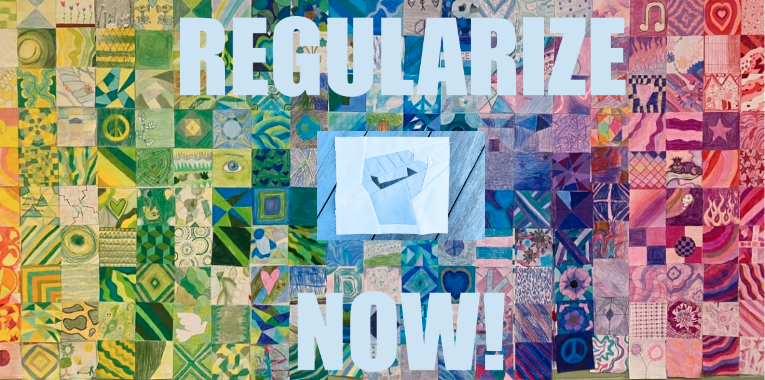
Paint or write on a square fabric that will be stitched together into a large quilt to represent migrant solidarity and struggles and will be part of our push to win Status for All!

  • Step 1: Make a square fabric – Make a 12″ x 12″ square of fabric in Yellow, Red, Green, Orange, or Purple or a traditional cloth. Any old strong cloth will work. 
  • Step 2: Draw, paint or write on it – Show what PR status means for you and your family. It can be any language. 
  • Step 3: Deliver your squares to MWAC – Bring/mail it to 720 Spadina Avenue, Suite 205, Toronto, ON, M5S 2T9. Make sure to include your name & phone number so we can stay in touch.
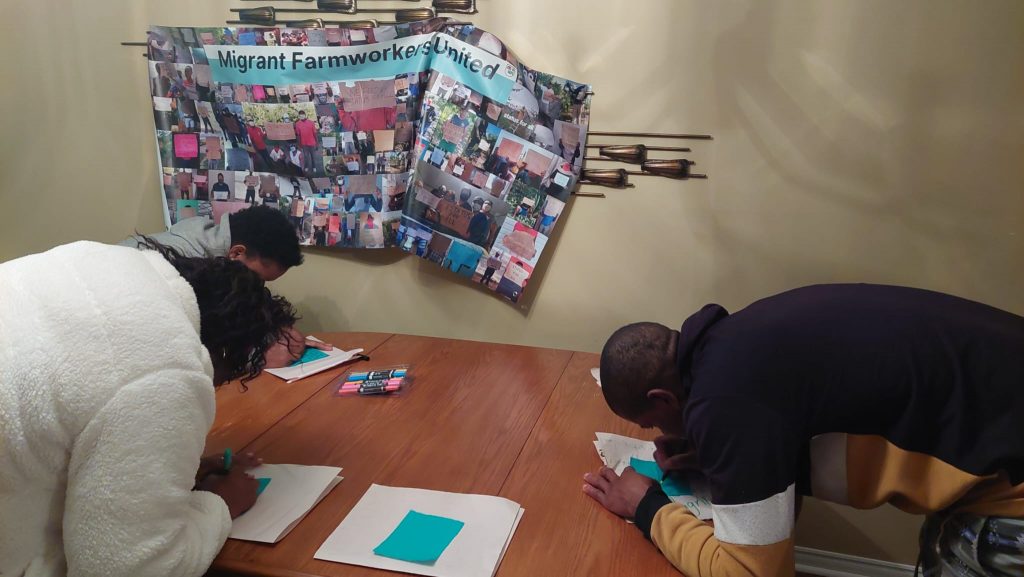
Farmworker members of MWAC create their quilt squares together

Six hidden immigration announcements in Canada’s 2022 Budget

The Federal Budget announced on April 7th includes major policy changes that will impact hundreds of thousands of mostly racialized, working class migrants who are students, workers, refugees, and undocumented people. This includes:

Migrant Workers

  1. The creation of a “new foreign labour program for agriculture and fish processing”.
    • Exploitation, and vulnerability is well-documented in temporary foreign worker programs. Migrants must receive permanent resident status on landing to protect themselves in any new program. 
  2. The creation of a “Trusted Employer” program that will make it easier for employers to hire migrants without ensuring protections for migrants. 
    • With the well-documented reality of reprisals against workers who speak up, and the 2021 Auditor General report that found Canada’s inspections of employers woefully inadequate, there is simply no way to know who is a “trusted employer”. 
  3. Reaffirms the Immigration Levels Plan announced in February of this year, which does not ensure full and permanent inclusion of the 1.6 million and growing migrants in the country. 
    • In particular, thousands of migrant care workers, who have been waiting for years to reunite with their families while taking care of children, the sick and the elderly, and who were left out of the Immigration Levels Plan continue to be excluded. Migrant care workers must get permanent resident status without exclusions immediately.  

For Migrant Student Workers (Current and Former International Students)

  1. Gives new unchecked powers to the Immigration Minister through the “authority to use Ministerial Instructions to help select those candidates who best meet Canada’s labour market needs .. through the Express Entry System”. 
    • There have been no invitations to apply for permanent residency in the Express Entry system since September 2021, and thousands, particularly graduated international students, have been waiting in limbo. They are on non-renewable post-graduate work permits, which have expired or are expiring, at which point they become undocumented or are forced to leave the country. Now the Minister can pick and choose, instead of processing all the applicants waiting. At minimum, post-graduate work permits must be made permanently renewable. 

Refugees

  1. Amendments to the “Immigration and Refugee Protection Act to … require the electronic submission of asylum claims.” 
    • Many refugee claimants do not have access to computers, internet connection, and digital copies of evidence that is required to navigate electronic systems. No resources are being made available to support refugees to apply, which makes it even more difficult for low-waged, racialized people to get rights and protections. 
  2. The creation of a “special permanent residence stream for immediate and extended Ukrainian family members of Canadian citizens and permanent residents”
    • This is an important and crucial step to ensure families are united, and it must be expanded to families in conflict zones around the world, including Yemen, Afghanistan, South Sudan, etc. Non-Ukrainian citizens fleeing the conflict in Ukraine, mostly racialized people, must also be provided with the same rights and protections.