Migrants and undocumented people call on Prime Minister Trudeau to keep his promise to regularize everyone and ensure permanent resident status for all.
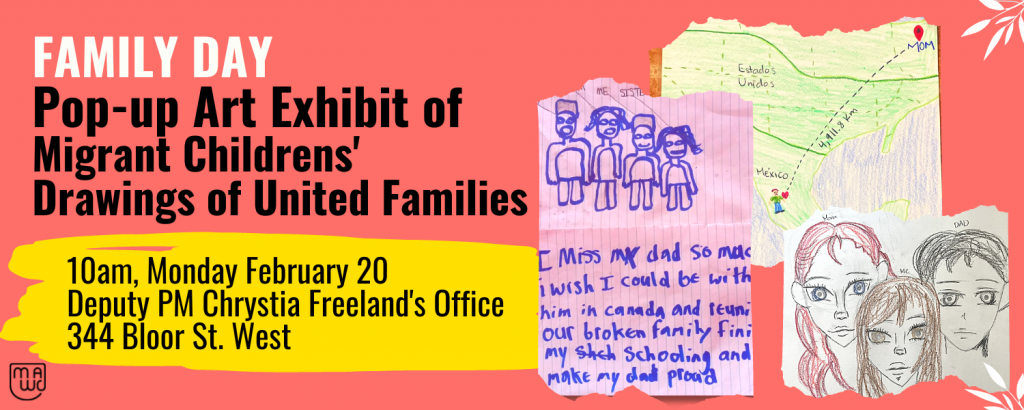
Toronto, February 20, 2023 — Evocative drawings by children of migrants separated from their families for decades and from those fearing family separation because of possible deportations were launched today, Family Day, at a pop-up art exhibit outside the Toronto office of Deputy Prime Minister Chrystia Freeland. Photographs of the drawings have been put together into a sketchbook by Migrant Workers Alliance for Change and were also mailed to every Member of Parliament.
The drawings from children as young as two years old include inscriptions about family separation and fear. A migrant farmworker’s child wrote, “I miss my dad so much. I wish I could be with him in Canada, reunite our broken family, finish my schooling and make my dad proud.” An undocumented child wrote, “I am six years old, I have no friends, I can’t register in school because I have no status. Please help all the kids in Canada to get an education.”
Sarom Rho, spokesperson for Migrant Workers Alliance for Change, explained, “Permanent resident status is the mechanism through which families can be united and everyone has equal rights; without it migrants are separated and in crisis. We are sending these drawings by migrant children to Prime Minister Trudeau and every Member of Parliament to remind them of the cost of their decision and urge them to keep their promise, ensure permanent resident status for all, and stop the suffering.”
Olufunke Ajileye, a 32 year old mother from Nigeria, was slated to speak at the art exhibit but was detained by Canada Border Services Agency (CBSA) over the weekend. She shared the following statement, “In 2017, after living here for 6 years, the government tried to deport me without my children. When I was at the airport waiting to be reunited with them, the CBSA officer said he will make sure I never set eyes on my children again. I had a panic attack and was rushed to the hospital. A few months later, they told me I can put my Canadian-born child in foster care while I and my other child go back to Nigeria. This is family separation. No mother should ever be forced to be separated from her children. Permanent residency keeps families together. Prime Minister Trudeau promised regularization, we need status for all now.”
In December 2021, Prime Minister Trudeau promised regularization in his mandate letter. Every migrant group in Canada and over 500 major civil society, labour and environmental organizations have been urging the Prime Minister to keep his promise and create a comprehensive regularization program that is uncapped (no arbitrary quotas or caps); which includes all undocumented people (including failed refugee claimants); allows migrants to apply for permanent resident status (instead of forcing them into temporary immigration programs) and does not have any unfair exclusions. See: www.migrantrights.ca/resources/regularization-in-canada/.
Cindy Carlos is a migrant care worker from the Philippines who came to Canada in 2010 as a live-in caregiver. Holding a drawing from her son this morning, holding back tears, she said, “After I finished my 24 months of work experience, I applied for permanent residency and was denied because of an officer’s mistake. But their mistake cost me my status. And without status, it feels like my hands and feet are tied up. We don’t have freedom. Everyday I live in fear of deportation and discrimination. Prime Minister Trudeau, untie this knot and give status to everyone! No exclusions!”
Canada created new family work permits for migrants in January but low-waged temporary foreign workers like farmworkers and domestic workers are barred from applying. Migrants can only access equal rights and family unity through permanent resident status but there is no access to permanent residency for most agricultural workers at all; and migrant careworkers must meet impossible conditions like high English language score and education accreditation.
Jesy Sari is an Indonesian caregiver and mother of two sons who has been in Canada for four years. She added, “Everyday I think about my two sons back home. It’s breaking my heart because I told them to wait for me. But I don’t know until when because I cannot apply for permanent residency because of the high English and education requirements. It’s like a never ending nightmare. We don’t know about our future here in Canada. This is why we need to be united with our kids, our families. We need status now”
There are over 1.7 million people in Canada without permanent resident status. This includes those on temporary work and study permits (farmworkers, careworkers and current and graduated international students), refugees, and those who are undocumented. Those in low-wages are largely denied access to permanent resident status, and therefore denied equal rights.
Many migrants spend decades in Canada, working and caring for communities but are separated from their loved ones.
Migrants are missing birthdays, anniversaries and funerals, or are living in daily fear of being torn away from their families because of deportation which causes psychological and emotional distress, family breakdowns and crises.
Migrants who can apply for permanent resident status are only allowed to sponsor children under the age of 22, however due to difficult requirements and long processing times, by the time migrants are able to apply their children have aged out. Canada does not recognize migrant family structures such as siblings, uncles and aunts, nieces and nephews and those not formally adopted for the purpose of family sponsorship.
About Migrant Workers Alliance for Change
Migrant Workers Alliance for Change is Canada’s largest migrant-led organization where migrant farmworkers, careworkers, student workers and undocumented people join together to improve working conditions and immigration and labour laws. Visit us for more information: www.migrantworkersalliance.org
We have created a sketchbook of evocative drawings by over 100 children of migrants separated from their families for decades, and from those fearing family separation because of possible deportations. We urge you to look carefully at the drawings. Share it with your family, friends and colleagues. Imagine the love that went into each drawing. Imagine the birthdays, the funerals, the anniversaries missed. Imagine the immense change that you can help create when you support regularization for all undocumented people and permanent resident status for all migrants. A fair society is only possible with equal rights; and equal rights are only possible if everyone has the same immigration status. Add your name to our petition at www.StatusForAll.ca
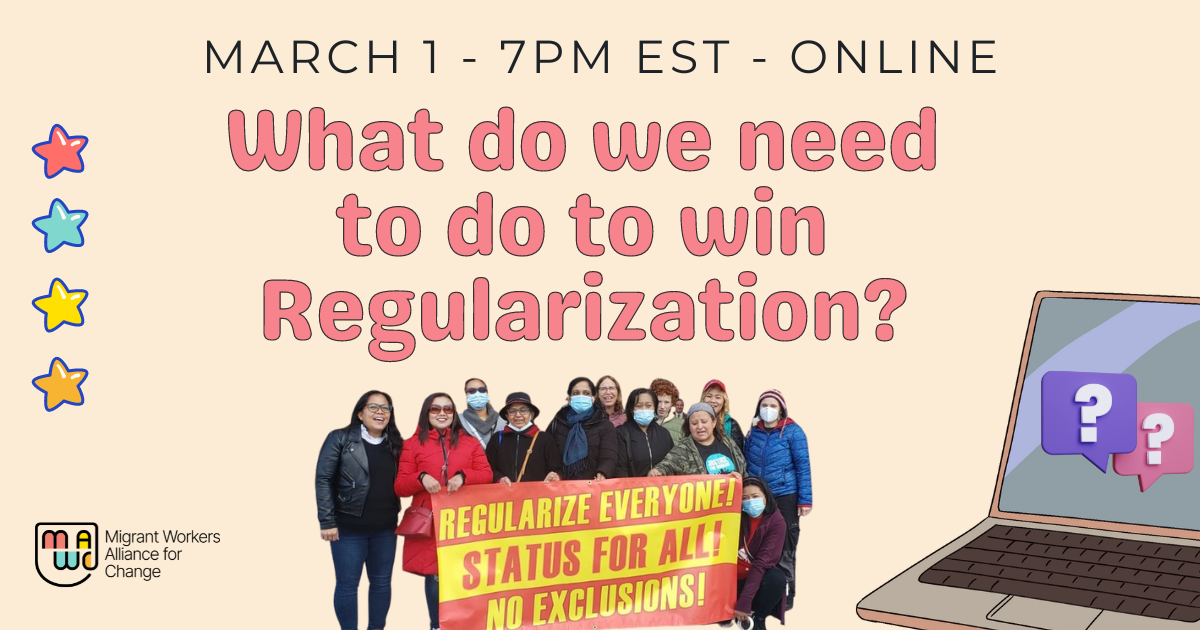
Join us online on Wednesday, March 1 at 7pm (Toronto time) for an open and anonymous meeting for undocumented migrants and supporters from across the country. We will provide an update on the campaign for regularization, answer all your questions, and share what needs to be done for us to win.
REGISTER RIGHT NOW to get the Zoom link or come back to this registration page on March 1st and join in. Simultaneous interpretation will be available in Spanish and English.
On the morning of Family Day, join migrant and undocumented people to call for family unity, regularization and Status for All, without exclusion and without delay, and check out an art exhibit of migrant children’s drawings.
10am, Monday February 20 Deputy PM Chrystia Freeland’s Office 344 Bloor St. West, M5S 3A7 Corner of Spadina and Bloor
1 in 23 people in Canada are separated from our families or fear being torn apart because of deportations. We’re unable to hug our children, put their drawings up on our fridges or be with them for birthdays, graduation or weddings.
This is the most updated information we have about family work permits written for migrants in Canada.
Not all the rules have been announced. Immigration Canada is supposed to release the rules (called the public policy) – we will update this page when that information is released.
Here’s what we know as of 5pm on Wednesday, February 8, 2023. You must meet the qualifications in ALL of the sections below.
This program is for OPEN WORK PERMITS only for SPOUSES/COMMON LAW PARTNERS and WORKING AGE CHILDREN who are dependents.
(1) PERMIT LENGTH AND VALIDITY
You may be able to apply for a work permit for a spouse or a common law partner, and dependent children if you have a valid work permit or authorization to work that is valid for six (6) more months when you apply for a family work permit.
Note that study permit holders can apply for their families to join them if they are studying at a public post-secondary institution. Click here for details.
(2) TYPES OF WORK PERMITS OR IMMIGRATION STATUS THAT ARE ELIGIBLE
You may be able to apply on the basis of a work permit, if you fit in ONE of the categories listed here:
You have a valid work permit in the high-waged worker stream of the Temporary Foreign Workers Program (to see if you are high-waged or low-waged, you must check your Labour Market Impact Assessment).
You have an open work permit that was issued because you applied for permanent resident status as
federal skilled worker class (FSWC)
Canadian experience class (CEC)
federal skilled trades class (FSTC)
caring for children class or caring for people with high medical needs class IF YOU APPLIED BEFORE June 18, 2019
Provincial Nominee Program (PNP) for applicants for whom there are no employer restrictions on nominations
Agri-Food Pilot (AFP)
Quebec skilled worker class (QSWC)
(3) ADDITIONAL REQUIREMENTS
You must additionally meet ALL of the the following requirements:
You are living or plan to live in Canada while working.
You can prove that you are in a genuine relationship with your spouse or common law partner for at least 1 year.
If you are sponsoring your children, you must prove that they are your dependents.
If you are sponsoring your children they must be of working age in the province or territory (check provincial Ministry of Labour website).
If your spouse or children are in Canada, they either
Have a valid temporary resident status.
Have applied to extend your status before it expired (maintained status).
Information updated at 5:30pm on Monday, January 30, 2023 changed the information that was provided as of January 29, 2023. As of 5pm on February 8, 2023, the following people are excluded:
Seasonal Agricultural Workers (8 month contracts or less) and other workers in the Primary Agricultural Stream of the Temporary Foreign Worker Program (1+ year contracts).
All low-wage workers in the Temporary Foreign Workers Program are excluded unless:
You have a work permit issued because you applied for PR in the Economic Streams (see point 2Bd above)
Refugee claimants or refused refugee claimants who have a work permit issued under R206 exemption from an LMIA.
All migrants without a valid work permit are excluded.
Migrant fishery workers, care workers, and others are therefore excluded. This is different from the information provided on January 29, 2023.
We still do not know if the following migrants are included or excluded:
Open work permits for vulnerable workers
Low-wage stream workers but who are now in a high-wage job (TEER 1, 2, or 3).
We must immediately and quickly organize and speak up to say that all families are equal, and that all migrants must be with our families. The government has said they will do a consultation about migrant agricultural workers, but they have not said anything about low-wage workers like fishery workers and care workers.
SEND US A MESSAGE NOW IF YOU WANT TO ORGANIZE AND TAKE ACTION!
Migrant Care Workers/ Health Care Workers: 647-782-6633
In addition, you must also provide the following information:
If you are sponsoring spouses and common-law partners
a copy of your marriage certificate
a declaration of your common-law relationship
If you are sponsoring dependents:
a birth certificate
adoption papers
A copy of your work permit OR the visitor record with expiry date showing that you’re authorized to work without a work permit with expiry date (for 6 months after the date of application)
Proof that the principal foreign worker can work in Canada for 6 months after the date that the family member submits their work permit
a copy of the work permit with expiry date
a copy of a the visitor record with expiry date showing that you’re authorized to work without a work permit
Proof of work
A letter or contract from your current employer (for open work permit holders, such as PGWP or International Experience Canada)
You will have to upload multiple documents in the same field online. Click here to see how.
FREQUENTLY ASKED QUESTIONS
We will be updating this section all day. If you have questions, please contact us on our hotlines.
So what’s changed?
Post graduate work permit holders or other work permit holders through International Experience Canada can now apply for open work permits for their spouses even if they do not have a high-wage job in TEER 1, 2 or 3.
High-wage temporary foreign workers, and those with open work permits under HCCP/HSWP were already able to apply for work or study permits for their families.
Who are dependent children?
Dependent children are those under 22 years old (on the date of application) and do not have a spouse or partner
Children who are 22 or older can qualify as dependents if they have depended on their parents for financial support since before they were 22 AND can’t financially support themselves because of a mental or physical condition
My permit was initially for longer than 6 months, but is now currently less than 6 months until it expires. Can I apply?
As per the information only released at 5:30pm on January 30, 2023, you will not be able to apply.
What is the processing time?
It varies by country and whether you are applying from outside or inside Canada. To check times, click here.
What will the length of the permit be issued to family members?
We don’t know yet.
Can you apply for small children-as old as 3 years old and how?
You cannot apply for a work permit for children as old as 3 years old, but you can apply for a visitor’s visa to unite with family members here.
If you have children who are under 18 or 19 years old (depending on the province), and you have a valid study or work permit, you may be able to apply for a study permit for them as long as you meet the requirements. Click here for more details.
What if I have implied status?
Your work permit must be valid for six more months. So implied status is excluded.
Migrant Workers Alliance for Change is an organization of migrants. We are not part of the government, and we are not immigration consultants or agencies. You will not be charged any fees for this information, and your information will not be be shared with anyone.
Low-waged migrants, agricultural workers and children excluded from open work permit announcement
Toronto, December 2, 2022 — Most migrants in agriculture and carework as well as others in low-waged jobs, have been excluded from Minister Sean Fraser’s confusing family reunification announcement today. Over the last three years, migrants have organized protests and actions every Family Day, Father’s Day and Mother’s Day calling for permanent residence status, so that they can be with their families. On Family Day 2022, migrants sent photos from nearly 200 migrant families that are separated from their loved ones to all MPs.
“All families are equal, we all love our families, migrants live here, take care of communities but are missing birthdays, funerals and anniversaries because they are denied immediate permanent resident status,” says Syed Hussan, Executive Director, from the Migrant Workers Alliance for Change. “Excluding non-working age children and shunting off low-waged migrants and agricultural workers to “consultations”, continues the ongoing discrimination against the people who feed us, take care of children, and are essential to our communities. These migrants are not temporary, and their families are just as important as everyone else’s; all migrants need permanent resident status immediately.”
Minister Fraser announced today a 2 year temporary policy to allow some migrants to bring their spouses and only their working-age children to Canada on open work permits. Without more details, it is unclear who is included in today’s announcement. What is certain is that low-waged migrants, and non-working aged children have been shut out right now. The first phase announced today is restricted to family members of migrants in the “high-wage stream of the Temporary Foreign Worker Program or the International Mobility Program”. However, most migrants in high-waged streams are already allowed to have their spouses and their children come to Canada, no matter what their age.
‘Oral’, a Jamaican father of two and a peach harvester for 7 years, was angry and disappointed that farmworkers, and young children have been excluded. He said, “It’s not right that we come to Canada to take care of our families but miss out on our baby’s first steps, their birthdays and graduations. Right now my daughter is sick in Jamaica and I can’t be there to comfort her like a father should. I have a newborn baby too and only get to be with him for a little while before I must leave again. When I go back home I will be like a stranger to them, they need to be here with me.”
Intan Dewi, a mother of 12 and 9 year old children from Indonesia and a migrant child care worker for over 3 years, said “I was excited to hear that there would be an announcement about open work permits today, but I am frustrated now that it is not for care workers like me, it is for families of people who make more money. Life here is very expensive. What good life can we have with $15 an hour? It is not enough. But that doesn’t mean our families should not be with us, it means that we should be paid enough, we take care of children, we should be able to be with our children too whatever their age, we should all have permanent resident status.”
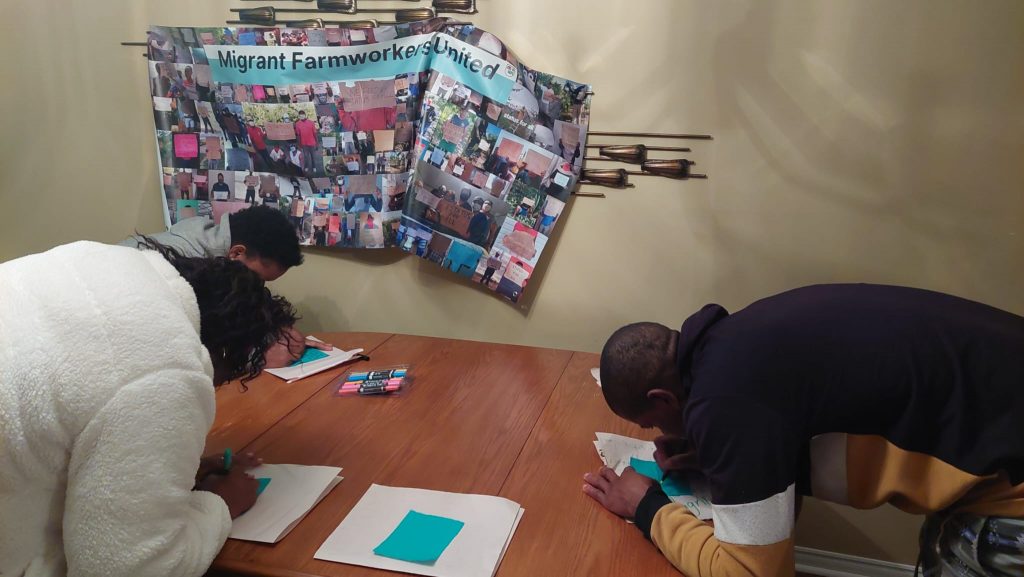
Paint or write on a square fabric that will be stitched together into a large quilt to represent migrant solidarity and struggles and will be part of our push to win Status for All!
Step 1: Make a square fabric – Make a 12″ x 12″ square of fabric in Yellow, Red, Green, Orange, or Purple or a traditional cloth. Any old strong cloth will work.
Step 2: Draw, paint or write on it – Show what PR status means for you and your family. It can be any language.
Step 3: Deliver your squares to MWAC – Bring/mail it to 720 Spadina Avenue, Suite 205, Toronto, ON, M5S 2T9. Make sure to include your name & phone number so we can stay in touch.
Farmworker members of MWAC create their quilt squares together
In an open petition letter to the President of Mexico and Prime Minister of Canada, Mexican farmworker members of Migrant Workers Alliance for Change expose the reality of working and living in Canada and demand Permanent Status for All.
Inspired by and united with Jamaican farmworker comrades, who wrote an open letter to their government in August, Mexican members write, “The billion-dollar agri-food industry depends on us, the workers. For more than half a century our well-being has not has not been thought of, and we are still treated as disposable objects”.
Migrant farmworker members invite political leaders “to be part of history and give us the respect we deserve […] and end this system of modern slavery.”
Among migrant farmworkers’ key demands outlined in the open letter: Permanent resident status to all upon arrival, including seasonal farm workers.
Do you agree? Sign below to add your voice!
Full letter written by Farmworkers:
To: Citizen President Andrés Manuel López Obrador and Prime Minister of Canada Justin Trudeau Citizen President of the Republic of the United Mexican States Andres Manuel Lopez Obrador and Prime Minister of Canada Justin Trudeau
Dear President and Prime Minister:
We are a group of Mexican agricultural workers and members of the Migrant Workers Alliance for a Change employed as migrant workers, many of us under the Seasonal Agricultural Worker Program in Canada. We have been working here for 2 to 20 years.
We want to tell you the truth about working on farms and food processing in Canada and share our demands for change. Thousands of united voices are rising from Canadian farms and we stand together with our colleagues from Guatemala, El Salvador, Honduras, Philippines, and Caribbean countries just to mention a few. We work in fields and food processing factories, in greenhouses, vineyards, and fisheries.
The billion-dollar agri-food industry depends on us, the workers. For more than half a century, our well-being has not been thought of, and we are still treated as disposable objects for employers. We sleep in bunk beds with bed bugs, in houses full of rats, sharing the bathroom with more than ten people, we have no privacy. We feel powerless arriving at a house without the warmth of our family, sad and alone, we feel a huge emptiness, we only see the tired faces of our coworkers. It is humiliating not being able to have a private call with our families, the bosses tell us that having privacy is not important. Many of us spend more than half the year separated from our families.
For decades many of our colleagues have lost their lives in Canada, many others have permanent damage to their health that they cannot afford. The abuse at work that we experience is inhumane, we have to endure shouting, racist comments, insults (like “eat sh*t”, “son of a b*tch”, “you’re a piece of sh*t”, “you’re useless”). The vast majority of the insults we receive are not in Spanish, but we know they insult us because they are screaming at us. They refer to us as if we were their property. They punish us by taking away days or hours of work if they think we don’t work fast enough, and when we don’t work we can’t send money to our families who depend on us.
It is dangerous for us to defend our rights. Employers threaten to fire us, deport us, and kick us out of the program. Without permanent status, employers have the power to get rid of us whenever they please as if they owned us.
When we talk to the consulate they tell us to listen to the employer, that we are here to work and if we do not like it we can go back to Mexico, that there are many people waiting to replace us. Temporary status makes it impossible for us to defend our rights.
President, you are responsible for our well-being, so we ask you to do the following:
– Pressure the Canadian government to implement and enforce National Housing Standards; – Protect us at work by implementing an anonymous system for reporting abusive employers that won’t put our safety or jobs at risk. We ask you that when we make a complaint stand up and represent us; – Facilitate and support us to get an open work permit so we can transfer to another farm, either during the season or before the start of each season; – Ensuring job security and ending the practice of observations made by employers in our files that are not real, this often results in the expulsion of workers from the program without the possibility of appeal or transfer; – Make sure that the Mexican consulates in Canada do their job to see to the welfare of Mexican workers abroad, that the consuls have contact with us, not with the employers, create a commission of migrant workers that evaluate the work of the consulate because nobody supervises them, they can do what they want with us, – Allow us to represent ourselves and our interests in contract negotiations; Provide more education about the contracts we sign, what our rights are in Canada, and support us in accessing and enforcing our rights; – Allow access to benefits that we pay through deductions and taxes, such as: regular unemployment insurance benefits, parental benefits as was the case before the amendment to the law in 2012, full pension and survivor benefits to our families in case of death, child tax benefits that any Canadian citizen can obtain and for that reason; – Call on the Canadian government to grant permanent resident status to all upon arrival, including seasonal farm workers.
As agricultural workers in Canada we experience abuses, unjustified dismissals, deportations, mistreatment and above all intimidation, because without permanent status in Canada we have to endure all of the above with the vague hope that next year we will return. Everything mentioned is a system of exploitation, in which the Canadian and Mexican governments take part by ignoring complaints, actively participating in deportations, and giving more power to employers than to workers.
We know our fellow Mexicans in other industries, like construction and warehouse workers, cleaners, international students, and undocumented workers are also facing injustice and are denied equal rights. We all need permanent resident status for all to protect ourselves and live with dignity.
We invite you to be part of history and give us the respect we deserve both in Canada and in Mexico and to end this system of modern day slavery.
Att: Written and signed by Agricultural workers and Migrants members of MWAC
Miriam, Victor, Oscar, Blanca, Gabriel C., Esteban, Maximino, Humberto, Hernandez, Pablo, Esteban, Victor R., Octavio, Jorge, Ines, Bibiano, Gabriel, Byron, Juan, Prisciliano, Moises, Cruz, Carlos, Leonel, Samuel, Refugio, Samuel