Migrant Students United – Submission to Standing Committee on Citizenship and Immigration

Migrant Students United is an organization of current and former international students in nine provinces, and the only national representative body of current and former migrant students in Canada. 

We call on you to take urgent action to support migrant students impacted by COVID-19:

  1. Ensure real access to PR: Make post-graduate work permits renewable; Lower points requirements for PR (CRS); Count work that is part-time, in-school, and in any occupation towards PR; and ensure full and permanent immigration status for all migrants;
  2. Fix rules around work: Remove time-limits and industry restrictions on work;
  3. Unite families: Allow families to travel; Ensure work permits for family members.
  4. Lower tuition and ensure full services: Work with provincial partners to ensure migrant students pay domestic tuition; and have full access to all services including healthcare, housing, jobs, scholarships, pandemic emergency benefits, and in-school support; Ensure immediate access to Social Insurance Numbers.

Migrant Students United – Letter to Minister Marco Mendicino re Renewing Post Graduate Work Permits

As you know, international students receive time-restricted post graduate work permits (PGWPs) during which they are required to complete 12-24 months of high-waged and high-skilled work to qualify for permanent residency (PR). With COVID-19 related job losses worsening again in the second wave, most graduates do not have access to jobs, particularly the NOC 0, A and B jobs required for PR. Despite living here for years, building relationships and communities, thousands of migrants face deportation if work permits are not renewed. These are potential immigrants who have lived and studied here, and perform skilled, and essential work in Canada. They are being punished for a crisis not of their making.

Because of the important recent public policy change implemented by you, migrants are able restore their status until December 31st of this year. You’ve already taken the first step, and I urge you to make PGWPs renewable to allow post-graduates to avail of this opportunity before December 31st. In addition, please take swift action to:

  1. Ensure real access to PR: Lower points requirements for PR (CRS); Count work that is part-time, in-school, and in any occupation towards PR; and ensure full and permanent immigration status for all migrants;
  2. Fix rules around work: Remove time-limits and industry restrictions on work;
  3. Unite families: Allow families to travel; ensure work permits for family members.
  4. Lower tuition and ensure full services: Work with provincial partners to ensure migrant students pay domestic tuition; and have full access to all services including healthcare, housing, jobs, scholarships, pandemic emergency benefits, and in-school support; ensure immediate access to Social Insurance Numbers.

Advisory: International Students Left Out in the Cold As Schools Reopen & Unemployment Remains High


Thousands face deportation, high fees, and lack of healthcare

Toronto and Mississauga, September 10, 2020 — Current and former international students are organizing a weekend of demonstrations in Toronto (Sep 12) and Mississauga (Sep 13) to call for changes to immigration rules to recover from COVID-19. International student tuition fees have increased dramatically during COVID-19 even as students and their families have lost work and wages, and classes have shifted online. Many international graduates on time-restricted work permits are required to complete 12-24 months of continuous high waged work to qualify for permanent resident status. However, with unemployment for racialized workers at 17%, most graduates do not have access to these jobs. Work permits remain non-renewable despite the impact of COVID-19 on the job market, meaning that thousands face deportation in the near future because they cannot fulfill requirements. Delays in permit processing has resulted in thousands without active Social Insurance Numbers. Access to healthcare for former students, even during COVID-19, is tied to having a full-time job, and most students cannot access emergency supports. Over 14,000 people have signed two petitions calling for changes in immigration policy now.

TORONTO – Saturday, September 12, 2:45pm
Deputy Prime Minister Chrystia Freeland’s office, 344 Bloor Street West

MISSISSAUGA – Sunday, September 13, 2pm 
Westwood Square Mall, 7205 Goreway Drive

BACKGROUND
There were 572,000 new study permits and 98,470 new post graduate work permits issued in 2019. Many of these permit holders remain in Canada for several years. Over 17,000 one or two-year work permits were issued between September 2019 and June 2020.

Migrant students are calling on the federal and provincial government to:

  • FIX RULES AROUND WORK: Make post-graduate work permits renewable so former students can complete requirements for Permanent Residency (PR) in the COVID-19 job market; Remove time-limits and industry restrictions on work;
  • GIVE REAL ACCESS TO PR: Lower points requirements for PR (CRS); Count work that is part-time, in-school, in any occupation, including with gaps towards PR; and Ensure full and permanent immigration status for all migrants;
  • LOWER TUITION & ENSURE FULL SERVICES: Ensure migrant students pay domestic tuition; Full access to all services including healthcare, housing, jobs, scholarships, pandemic emergency benefits, and in-school support; Immediate access to Social Insurance Numbers
  • UNITE FAMILIES: Allow families to travel, ensure work permits for family members

Petition: International Students Need Support! #FixPGWP

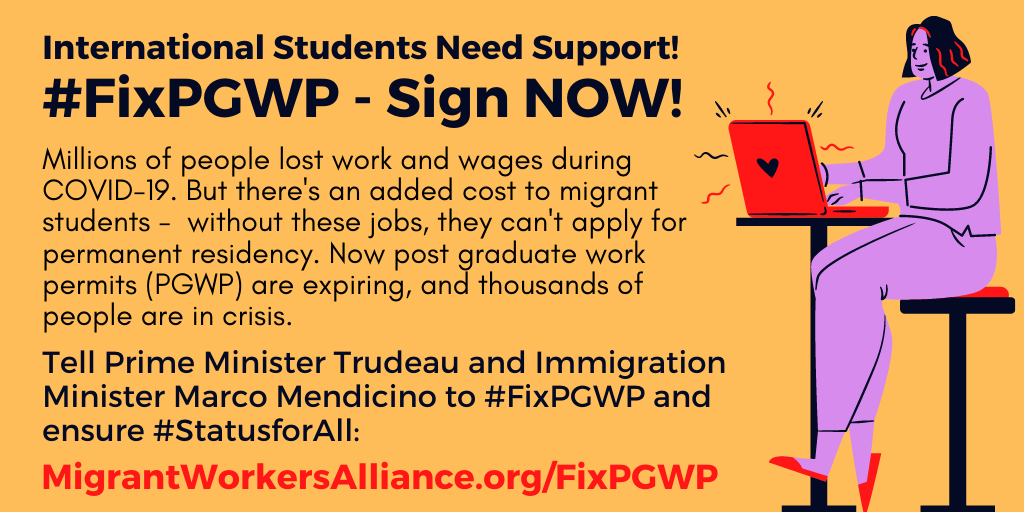
Millions of people lost work and wages during COVID-19. But there’s an added cost to migrant students –  without these jobs, we can’t apply for permanent residency (PR). Now post graduate work permits (PGWP) are expiring, and thousands of us are in crisis. If work permits remain non-renewable, students will lose status and the ability to get PR. Fill in your information below to send an email to Prime Minister Trudeau and Immigration Minister Marco Mendicino to #FixPGWP and ensure #StatusforAll.

We need the government to make immediate changes:
(1) Make Work Permits Renewable, so we have more time.
(2) Value all work to count for PR, including part-time, NOC C & D.
(3) Real access to PR: Lower the Comprehensive Ranking System score.
(4) Unite Families, so our family members can get work permits.
(5) Status for All: All migrants deserve full and permanent status.
(6) Lower Tuition Fees & Universal Services: We want the same rights as everyone else.

Read the letter we sent to Minister Mendicino on Friday October 30, 2020 here.

Release: Migrant Students United & Canadian Federation of Students call on Canada to expand income supports to International Students

MEDIA RELEASE

Media Contact: Sarom Rho, 647-858-2854, Migrant Students United; Geneviève Charest, g.charest@cfs-fcee.ca, Canadian Federation of Students 

Ottawa & Toronto, April 30, 2020 – Migrant Students United, a cross-Canada organization of international students, and the Canadian Federation of Students, Canada’s largest and oldest national student organization, are calling on Prime Minister Justin Trudeau to expand income supports, including the Canada Emergency Response Benefit (CERB) and the Canada Emergency Student Benefit (CESB) to all students, regardless of immigration status or active Social Insurance Number (SIN). Migrant students have taken to social media today calling for emergency supports, using #MigrantStudentsUnited. Follow students speaking out online by clicking here

“Approximately 1 in 5 postsecondary students in Canada are migrants and excluding them from the CESB is unfair and puts many of these students at risk of hunger and homelessness. We urge the federal government to extend the CESB and CERB to all migrant students, including those without valid SIN or stuck outside the country, and ensure $500 per week in income supports,” says Sarom Rho, Coordinator of Migrant Students United. 

“Welcoming students into Canada must be paired with the necessary support mechanisms to ensure that their health, safety, and income security are being prioritized; that is the responsible thing to do. Most importantly, migrant students are people, just like anyone else, who feel scared at a time of uncertainty and who are being overlooked by the government,” said Sofia Descalzi, National Chairperson of the Canadian Federation of Students. 

BACKGROUND

  • On average migrant students pay triple in fees over their domestic counterparts with a national average of $29,714 in tuition fees in 2019. The additional barrier on work restrictions, has placed students in a financial situation where many are struggling to pay for their cost of education, rent, groceries, and other bills. 
  • Migrant students contributed $15.5 billion to the Canadian economy in 2016, making them vital contributors to Canadian society. 
  • Immigration, Refugees and Citizenship Canada has lifted the limitation on working hours for international students in essential industries – but this does not resolve problems. Migrant students in public post-secondary institutions start their summer breaks in April, when the limitation on hours of work already does not apply. Many students are engaged in academic research, which has not been deemed essential. Giving the option to work does not comprehensively address the need of migrant students for income support now, and does not take into account migrant students who are immunocompromised or immunosuppressed or are living with people with these conditions. In a decimated job market, it is incredibly hard to find work considering migrant students are not included in the Canada Summer Jobs program. 
  • In a global pandemic and economic downturn, many students have families back home that are struggling to make ends meet and financial support they would normally have is no longer available.