Release: A million students potentially excluded from emergency income support

MEDIA RELEASE
MIGRANT STUDENTS UNITED

Contact: Sarom Rho, Migrant Students United Organizer, 647-858-2854, sarom@migrantworkersalliance.org

A million students potentially excluded from emergency income support 

Toronto, April 22, 2020 – Migrant Students United is calling on the federal government to expand Canada Emergency Student Benefit (CESB) and Canada Emergency Response Benefit (CERB) to migrant students. Already, CERB is inaccessible to migrants without a valid Social Insurance Number, which impacts hundreds of thousands of students who cannot renew their work or study permits because of COVID-19 related delays. Now CESB seems to excludes migrant students on a study permit. Over 7,000 migrant students have signed a petition for income supports, worker protections, healthcare and permanent resident status on arrival. 

“Approximately 1 in 5 postsecondary students in Canada are migrants. Excluding them from emergency income supports is unfair. In a pandemic, it is a public health imperative to ensure everyone can stay at home safely, but if migrant students are left out, they are forced to work or face hunger and homelessness. Migrant students pay incredibly high tuition fees and are in the country without their families – they need more support, not less. Everyone, regardless of immigration status must get income supports!” – Sarom Rho, Organizer, Migrant Students United!

BACKGROUND

  • There are nearly 1 million study and post-graduate work permit holders in Canada. Their SIN begins with ‘9’ and expires along with their immigration permits. To renew SIN, immigration permits must be renewed. COVID-19 has created enormous delays in permit processing, and hundreds of thousands of workers are without income supports. 
  • Migrant students in public institutions are allowed to only work 20 hours off campus during the school term, private institution students can’t work off campus without a new work permit.
  • Migrants students are over-represented in essential industries. They work in construction, cleaning, grocery stores, restaurants, warehouses, domestic work and as truck drivers and delivery workers. 
  • Migrant students pay retail tax on purchases, and property taxes through rent as well as income tax, EI and CPP. 
  • 42.9% of non-permanent residents are low-income (as compared to 12.5% of non-immigrants, and 17.9% of immigrants). They are therefore extremely vulnerable to economic crises – a single missed paycheque causes irreversible harm to health, safety, and future life possibilities.
  • Like other low-wage workers, migrant students spend the majority of their income on rent, basic necessities, food and transportation. As such, they play a critical role in sustaining and growing local economies. When income disappears for the poorest, the effects are amplified across the entire economy. 
  • In a global pandemic and economic downturn, many students have families back home that are struggling to make ends meet – migrant students need emergency income, as well as access to lower fees.
  • Over 7,000 students have signed a petition calling for healthcare for all, enhanced workers protections, open work permits and permanent resident status for all, an end to detentions and deportations, and community supports for migrant students: www.MigrantRights.ca/MigrantStudents

Migrant Rights Network – Letter re Income Supports for Migrant and Undocumented Residents

Letter to Prime Minister Justin Trudeau and Members of Canada’s COVID-19 Cabinet Committee

This letter is an update to our letters from March 26th and March 16th.

There are at least 1.8 million migrant and undocumented residents in Canada, or 1 in 22 people. This includes seasonal agricultural workers who are essential to Canada’s food supply, care workers in long term care homes, and taking care of children, sick and the elderly. It includes cleaners in hospitals and homes, and it includes many warehouse, food delivery and grocery store workers. Many of Canada’s essential workers are migrant and undocumented and deserve income support. They deserve to stay home if they are sick, and they deserve income if they have lost work or have had hours of work reduced.

This week, we urge you to make the following changes:
1. Ensure residents without Social Insurance Numbers have access to Canada Emergency Response Benefit through the provision of accessible Individual Tax Numbers where information is not shared with immigration authorities. We reiterate our request for a meeting to develop a dedicated delivery mechanism to ensure that all migrants are aware of and able to apply for income supports.

2. Extend access to CERB for those whose SIN has expired. Many workers in implied status or recently out of immigration status have been unable to renew Social Insurance Numbers because of delays from Immigration, Refugee and Citizenship Canada. This particularly impacts workers on study permits, who are struggling to make ends meet.

3. The government rightly decided to ensure seasonal workers affected by COVID-19 can access CERB. This measure should be extended to seasonal migrant workers. Seasonal TFWP and SAWP workers should have access to income supports for delays in contracts, both inside and outside the country.Many agricultural workers have been delayed from starting their contracts due to border closures. Most have still not arrived. These workers must be able to apply for income supports for lost wages in this period.

4. Ensure that migrant workers who are forced to leave jobs or those that aren’t starting contracts right now are not deemed to have “quit voluntarily” and receive income supports.Many migrant care workers have been forced by their employers to move in with them. While their work hours have greatly increased, they are not being remunerated. Some migrant agricultural workers are choosing not to come for health and safety reasons, because of lack of protections while traveling or working in Canada. Migrant workers on employer dependent work permits are uniquely vulnerable to exploitation, and most cannot leave bad jobs easily. When they do leave, they are often in egregious conditions, and need income supports to transition to safety.

5. Extend income supports to migrant and undocumented residents who did not earn at least $5,000 in the previous 12 months.Many workers had lost jobs, or seen their hours cut in the months prior to CERB becoming available. Others have just arrived in Canada – an average of 48,000 new migrants arrive in Canada each month. Many workers have clung to jobs, even as hours have been reduced. Migrant workers on employer dependent visas who have left one job, but have not been able to secure an alternative LMIA approved employer are falling just below the $5,000 mark. Recently arrived refugee claimants have not earned $5,000.

Migrant Students United – Letter to PM Trudeau re COVID19 Supports for International Students

International Students Need Specific COVID-19 Supports

Migrant Students United is a cross-country organization of current and former migrant students. As you are aware, there are more than 721,000 study permit holders in Canada, as well as an estimated 500,000 post-graduate work permit holders. This is a significant number of people who, like millions of other workers affected by COVID-19, require urgent support. 

Over the last few weeks, we have surveyed 2,300 current and former migrant students, held two online information sessions with 1,200 students registered, and conducted focus groups and polling to determine migrant student needs and priorities. We have spoken with current and former students in each province, as well as the Northwest Territories. We are summarizing here concerns and priorities of migrant students that must be addressed as part of the COVID-19 response and beyond. 

1. Ensure access to healthcare.


Currently, current and former migrant students in many provinces do not have access to COVID-19 testing or treatment. A patchwork of private insurance companies exist at public post-secondary institutions, but do not include private educational institutions. Students in between permits, those that have recently moved provinces, and those awaiting a full-time job, are not covered. Many students are removed from their support systems, don’t have access to social networks they can rely on, and are in many cases without work. Extending universal coverage to these people is an essential public health measure.

The federal government must work with provinces to guarantee access to healthcare for all regardless of immigration status or health card. As time is of the essence, in the absence of provincial changes, the federal government must extend Interim Federal Health coverage to all migrants. 

2. Provide guaranteed comprehensive income support.

Many current or former migrant students have lost income. Campus closures and the overall economic downturn means that either jobs have been eliminated or hours of work drastically reduced. We have heard from hundreds of students forced to turn to food banks and religious spaces for basic necessities. Income supports that have been announced already are inaccessible to many students. In some cases, migrant students have not accumulated enough hours for Employment Insurance or have not been paid $5,000 in the previous 12 months. Many students do not have adequate documentation for wages they have been paid. Some are without an active Social Insurance Number because of immigration rules that require renewal (such as having a work permit renewed first). Students are working at reduced hours just to survive. Migrant students who are recent graduates report extreme difficulty in finding jobs in the current climate. Students who are still enrolled and need employment for program or co-op placements are struggling to get income. Some students and post-graduate work permit holders travelled abroad to take care of their families and are unable to access incomes, while their jobs here have laid them off. 

The federal government must create a special delivery mechanism to ensure income support of at least $2,000/month to all migrants, including those outside Canada, who have lost income due to COVID-19 without a requirement for an active SIN or evidence of having paid taxes. This should include job loss, as well as reduction in wages. 

3. Provide open and extended work permits, and permanent resident status on landing.

Permit restrictions pose a myriad of challenges for migrant students that are simply insurmountable in this climate. Public post-secondary students are only allowed to work 20 hours off-campus, but campuses are closed. Students with applications in process are reporting delays and are falling into “implied status”, where their SIN and health cards are expiring but cannot be reviewed because of Service Canada closures. While the exemption of migrant students from border closures is a critical step, many spouses and family members of students haven’t been allowed to enter because of lack of clarity on rules. Post-graduate work permit holders have been turned back from flights in various countries despite having active permits. Private college students don’t have access to post-graduate work permits. Many are still in the country even if their courses are done because of closed borders or flight restrictions. The economic downturn has made it difficult for students to find work that can be counted towards their eventual permanent residence applications. Hundreds of post-graduate students are reporting that they won’t be able to get enough points for permanent residency by the time their current work permits expire. Current and former students are also facing deportations, often to places without healthcare support or where travel is shut off.

The federal government must automatically extend study permits and post graduate work permits during COVID-19. All study permit holders must be allowed to work off-campus without hours of work or industry restrictions. Study permit and post-graduate work permit holders should be allowed to bring their families to Canada. Post-graduate work permits must be issued to all, and extended so that students can work now and get appropriate work experience. Points for Express Entry in the next three years must be lowered to respond to the long-term effects of this economic downturn. All deportations must be stopped.

4. Provide support with rent, tuition, bills and quarantine. 

Migrant students and post-graduate work permit holders arriving in Canada are required to enter quarantine but many are reporting they have nowhere to go, as campuses are closed, emergency accommodations have fallen through, and long-term rentals are unavailable. Many students suffering from job loss or cuts in wages are reporting difficulty paying high tuition fees. Many colleges and universities have reduced course offerings and cancelled Spring classes, but are continuing to charge fees. At the same time, remaining enrolled full-time is a requirement of the study permit. 

The federal government must take action to freeze tuition fees, or at minimum offer domestic tuition fees to international students for the next three terms. A moratorium on evictions and rent, utilities, and other bills (such as credit cards and transportation) should be put into effect federally for the duration of the crisis. 

These demands are in line with and in support of the full list of demands issued by the Migrant Rights Network for a just response to the COVID-19 crisis, available at migrantrights.ca/Covid19

We look forward to a swift and comprehensive response. Please contact me at sarom@migrantworkersalliance.org for any questions and to continue this conversation. 
Migrant Rights Network – Letter re Migrant Worker Quarantine

Re: Guidance for Employers of Temporary Foreign Workers Regarding COVID-19

These guidelines must be mandatory requirements, and monitoring and enforcement mechanisms to ensure employer compliance must be established:

  • These requirements must be adapted with a view to giving workers the ability to enforce their rights and thus protect public health. Employers already have inordinate control over workers’ lives, including over their working conditions, housing, transportation, and access to services and groceries. As such, it is essential that these proposals be deemed as requirements,not as ‘guidelines’ – failure to meet them will endanger the health and well-being of workers and the communities in which they live.
  • Employers must be required to enable self-isolation and quarantining, provide healthcare information in a worker’s language of choice, and connect workers to local public health services.
  • Employers must provide wages to workers during the quarantine period, even if they are not working. Federal income supports must be available to workers who cannot come to Canada, or who have been delayed in their arrival.
  • These requirements must apply from the moment workers depart their home countries, throughout their travel to Canada, and through travel from airports to workplaces. If workers are housed in hotels, these requirements must extend to travel from hotels to workplaces.
  • A responsive monitoring and enforcement system must be set up, in consultation with migrant worker organizations like ourselves. At a minimum this enforcement and monitoring system must include: 
    • A dedicated enforcement unit established between federal and provincial authorities, building on Employment and Social Development Canada’s compliance unit. Contact information about the enforcement unit must be shared with migrant worker organizations.
    • The enforcement unit must assess work and housing conditions prior to workers arrival to ensure physical distancing is possible and health and safety rights protected. This pre-assessment should be done via a safety plan checklist that employers must submit.○
    • The enforcement division must do swift, unannounced inspections on employers where complaints have been made, in coordination with local public health officials.
    • Non-compliance should be met with fines and suspensions as per the pre-existing employer compliance regimes. In addition, specific measures must be enacted to ensure workers are appropriately compensated where employers put their lives at risk through non-compliance.
    • A 24-hour accessible telephone hotline and web interface for workers to confidentially and anonymously make complaints about employer non-compliance in their own languages, or through third parties such as migrant worker support organizations, including through photos and videos.

Public health, not enforcement

  • Employers are not equipped to assess the health of migrant workers. All health assessmentand follow-up support must be done by public health officials. Where workers are symptomatic, and with worker permission, public health officials can coordinate with employers to ensure workplace health and safety is upheld.
  • There should be no sharing of information or contacting of law enforcement or consulates, either by employers or by compliance units in cases where workers make complaints. The possibility of health information being shared with non-health related authorities will dissuade workers from taking necessary steps to protect themselves and others from the spread of COVID-19.
  • Workers who are sick must be provided healthcare in Canada, not deported.
  • Employers must ensure adequate hygiene products and meals for workers during theirquarantine period without deductions. These must be extended to the entire course of the crisis, if workers request it, also without deductions. These meals must be prepared by an unrelated third party catering company and the meal plan must be reviewed and approved by a qualified nutritionist (as outlined in existing SAWP contracts).
  • Workers’ ability to reach social supports must be facilitated through guaranteed wireless internet access, and connecting workers to local support organizations.
  • Healthcare must be guaranteed in all provinces, without the need for a health card, through emergency changes to Interim Federal Health program or expanded provincial health transfers.

Communication with workers is essential

  • These requirements must be made available to workers and worker rights organizations inadvance of workers travelling to Canada and at the port of entry, with information on how workers can assert their rights and make anonymous complaints, available in appropriate languages.
  • Employers must be required to share information on the safety plan with workers immediately upon arrival, and update on changes regularly.
  • Workers should also be provided with public health guidelines on hand-washing and physical distancing during the COVID-19 pandemic in appropriate languages.
  • All workers at a workplace must be informed about the results of inspections following anonymous tips.

Migrant Rights Network – Letter re Income Supports for Migrants

Letter to Prime Minister Justin Trudeau and Members of Canada’s Federal Cabinet Re: Regulatory changes to ensure Canada Emergency Response Benefit is available to migrants and undocumented residents

As you discuss developing regulations to implement the Canada Emergency Response Benefit (CERB), we urge you to ensure that all residents of Canada, regardless of immigration status or previous work entitlements, are able to get income supports.

  1. The benefit is currently defined as available to “residents”. ‘Resident’ must be broadly defined to include any resident of Canada, regardless of immigration status, including undocumented residents, refugee claimants, temporary foreign workers, study permit holders and others.
    • There were 874,770 new temporary work, study or humanitarian permits issued in 2019. In addition, there are at least 500,000 undocumented residents in Canada.
  2. The benefit is limited to residents who have earned at least $5,000 in the previous 12 months. Specific measures need to be enacted to ensure workers who have not earned as much, have not been able to report their earnings and/or have not been in Canada that long, are protected.
    • An average of 48,000 new residents arrived each month in the first quarter of 2019. The numbers are similar in Canada for January and February 2020.
    • Many temporary foreign workers have been laid off from their jobs or seen their hours reduced in care work, retail, and tourism industries. Study permit holders have lost on-campus jobs, and seen hours reduced.
  3. Workers who have seen their hours of work or wages reduced – which is many of our members – must be able to get income supports.
  4. Specific tools should be developed to ensure that undocumented residents and other informal economy workers are able to access income supports.
    • There should be no requirement for Social Insurance Numbers.
    • Guarantees should be created so that information is not shared with immigration enforcement.
    • Proof of income should be interpreted widely, as cash economy workers do not receivepaystubs, have bank accounts or pay regular taxes.
  5. A dedicated delivery mechanism must be created in coordination with our groups to ensure that migrants are aware of and able to apply for income supports.
  6. All workers who are facing job loss or a cut to hours of work should receive $2000/month whetherthrough CERB or Employment Insurance, including workers outside Canada, who are unable to come because of health concerns or border closures, and those in quarantine.
  7. Benefits should be available to those who due to disability or other reason are unable to work.

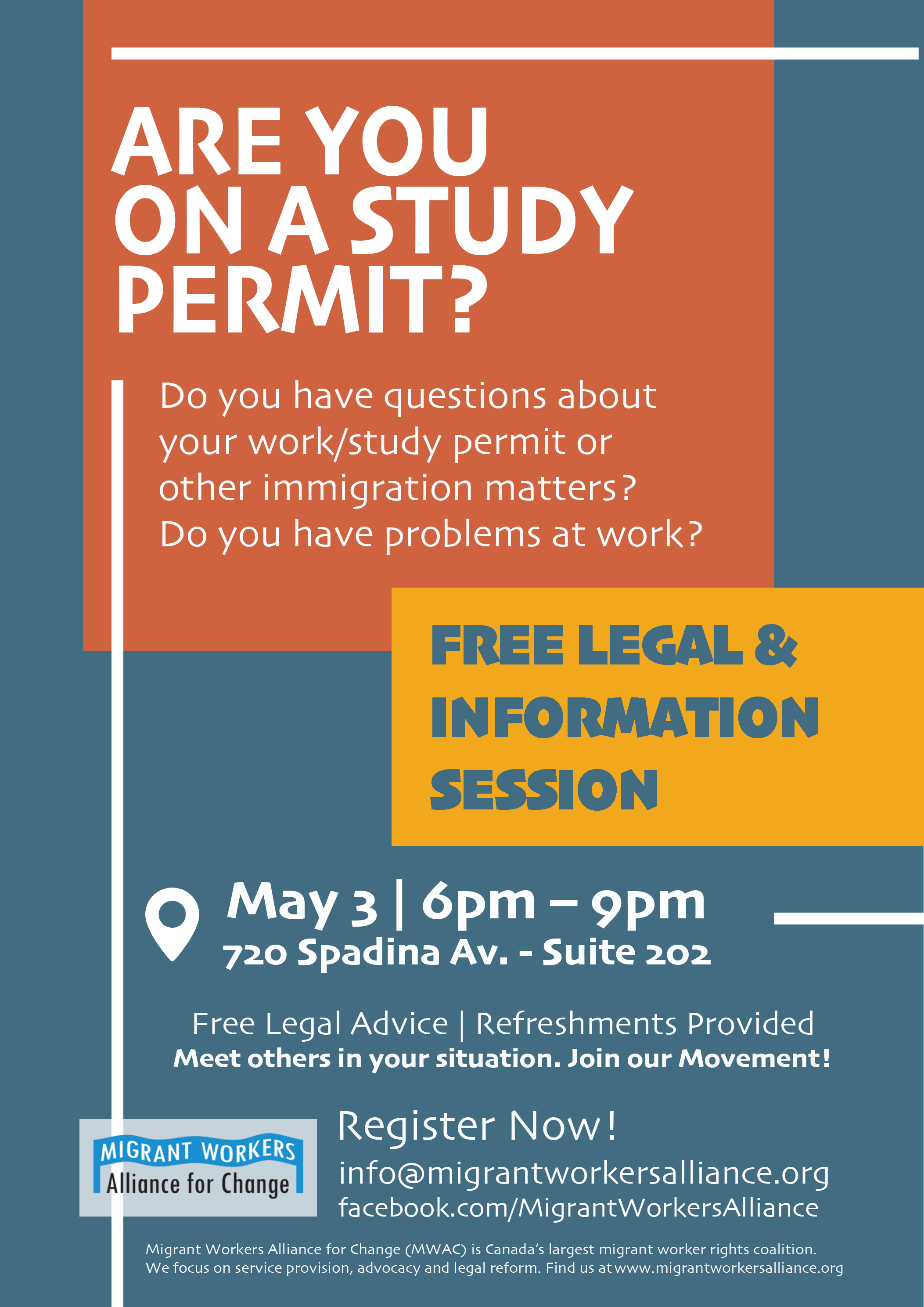
Free Legal Information Session for International Students

Are you on a study permit? Do you have questions about your study permit or other immigration matters? Is your boss not paying you enough? Do you have problems with school administration?

Then this session is for you. Come for free legal advice, to meet others in your situation and to ask questions

REGISTER NOW: info@migrantworkersalliance.org

Employment and Immigration Rights Session
May 3, 6pm – 9pm,
Suite 202, 720 Spadina Avenue

Organized by the Migrant Workers Alliance for Change (MWAC). MWAC is Canada’s largest migrant worker rights coalition. We focus on service provision, advocacy and legal reform. Find us at www.migrantworkersalliance.org