Family open work permits for spouses & kids

This is the most updated information we have about family work permits written for migrants in Canada.

Not all the rules have been announced. Immigration Canada is supposed to release the rules (called the public policy) – we will update this page when that information is released. 

Here’s what we know as of 5pm on Wednesday, February 8, 2023. You must meet the qualifications in ALL of the sections below.

This program is for OPEN WORK PERMITS only for SPOUSES/COMMON LAW PARTNERS and WORKING AGE CHILDREN who are dependents. 

(1) PERMIT LENGTH AND VALIDITY

  • You may be able to apply for a work permit for a spouse or a common law partner, and dependent children if you have a valid work permit or authorization to work that is valid for six (6) more months when you apply for a family work permit. 
  • Note that study permit holders can apply for their families to join them if they are studying at a public post-secondary institution. Click here for details. 

(2) TYPES OF WORK PERMITS OR IMMIGRATION STATUS THAT ARE ELIGIBLE

You may be able to apply on the basis of a work permit, if you fit in ONE of the categories listed here:

  1. You have a valid work permit in the high-waged worker stream of the Temporary Foreign Workers Program (to see if you are high-waged or low-waged, you must check your Labour Market Impact Assessment). 
  2. You have an open work permit that was issued because you applied for permanent resident status as 
    1. federal skilled worker class (FSWC)
    2. Canadian experience class (CEC)
    3. federal skilled trades class (FSTC)
    4. caring for children class or caring for people with high medical needs class IF YOU APPLIED BEFORE June 18, 2019
    5. Provincial Nominee Program (PNP) for applicants for whom there are no employer restrictions on nominations
    6. Agri-Food Pilot (AFP)
    7. Quebec skilled worker class (QSWC)

(3) ADDITIONAL REQUIREMENTS

You must additionally meet ALL of the the following requirements:

  1. You are living or plan to live in Canada while working.
  2. You can prove that you are in a genuine relationship with your spouse or common law partner for at least 1 year. 
  3. If you are sponsoring your children, you must prove that they are your dependents
  4. If you are sponsoring your children they must be of working age in the province or territory (check provincial Ministry of Labour website). 
  5. If your spouse or children are in Canada, they either 
    1. Have a valid temporary resident status.
    2. Have applied to extend your status before it expired (maintained status).
    3. Or are eligible to restore your status.

WHO IS EXCLUDED? AND WHAT DO WE NOT KNOW? 

Information updated at 5:30pm on Monday, January 30, 2023 changed the information that was provided as of January 29, 2023. As of 5pm on February 8, 2023, the following people are excluded:

  • Seasonal Agricultural Workers (8 month contracts or less) and other workers in the Primary Agricultural Stream of the Temporary Foreign Worker Program (1+ year contracts). 
  • All low-wage workers in the Temporary Foreign Workers Program are excluded unless:
    • You have a work permit issued because you applied for PR in the Economic Streams (see point 2Bd above)
  • Refugee claimants or refused refugee claimants who have a work permit issued under R206 exemption from an LMIA.
  • All migrants without a valid work permit are excluded.

Migrant fishery workers, care workers, and others are therefore excluded. This is different from the information provided on January 29, 2023.

We still do not know if the following migrants are included or excluded:

  • Open work permits for vulnerable workers
  • Low-wage stream workers but who are now in a high-wage job (TEER 1, 2, or 3). 

We must immediately and quickly organize and speak up to say that all families are equal, and that all migrants must be with our families. The government has said they will do a consultation about migrant agricultural workers, but they have not said anything about low-wage workers like fishery workers and care workers. 

SEND US A MESSAGE NOW IF YOU WANT TO ORGANIZE AND TAKE ACTION! 

  • Migrant Care Workers/ Health Care Workers: 647-782-6633
  • Migrant Students: 647-858-2854
  • Migrant Fishery Workers: 506-251-7467
  • Migrant Farm Workers: 905-324-2840

HOW TO APPLY

You must apply for your open work permit online, unless you are in one of the following categories. The applications are different based on if you are inside Canada or not. Click here to create an account and start your application.

In addition, you must also provide the following information: 

  • If you are sponsoring spouses and common-law partners
    • a copy of your marriage certificate
    • a declaration of your common-law relationship
  • If you are sponsoring dependents:
    • a birth certificate
    • adoption papers
  • A copy of your work permit OR the visitor record with expiry date showing that you’re authorized to work without a work permit with expiry date (for 6 months after the date of application)
  • Proof that the principal foreign worker can work in Canada for 6 months after the date that the family member submits their work permit
    • a copy of the work permit with expiry date
    • a copy of a the visitor record with expiry date showing that you’re authorized to work without a work permit
  • Proof of work 
    • A letter or contract from your current employer (for open work permit holders, such as PGWP or International Experience Canada)

You will have to upload multiple documents in the same field online. Click here to see how


FREQUENTLY ASKED QUESTIONS

We will be updating this section all day. If you have questions, please contact us on our hotlines. 

  1. So what’s changed?
    • Post graduate work permit holders or other work permit holders through International Experience Canada can now apply for open work permits for their spouses even if they do not have a high-wage job in TEER 1, 2 or 3. 
    • High-wage temporary foreign workers, and those with open work permits under HCCP/HSWP were already able to apply for work or study permits for their families.
  2. Who are dependent children? 
    • Dependent children are those under 22 years old (on the date of application) and do not have a spouse or partner
    • Children who are 22 or older can qualify as dependents if they have depended on their parents for financial support since before they were 22 AND can’t financially support themselves because of a mental or physical condition
  3. My permit was initially for longer than 6 months, but is now currently less than 6 months until it expires. Can I apply?
    • As per the information only released at 5:30pm on January 30, 2023, you will not be able to apply.
  4. What is the processing time? 
    • It varies by country and whether you are applying from outside or inside Canada. To check times, click here
  5. What will the length of the permit be issued to family members? 
    • We don’t know yet.
  6. Can you apply for small children-as old as 3 years old and how?
    • You cannot apply for a work permit for children as old as 3 years old, but you can apply for a visitor’s visa to unite with family members here.  
    • If you have children who are under 18 or 19 years old (depending on the province), and you have a valid study or work permit, you may be able to apply for a study permit for them as long as you meet the requirements. Click here for more details.
  7. What if I have implied status? 
    • Your work permit must be valid for six more months. So implied status is excluded. 

Migrant Workers Alliance for Change is an organization of migrants. We are not part of the government, and we are not immigration consultants or agencies. You will not be charged any fees for this information, and your information will not be be shared with anyone.
Learn more about us: Facebook | Twitter | Instagram 

MWAC Members: Have your voice heard in Ottawa!

On November 14, migrant representatives from across the country are going to Ottawa. 15 of them will be migrant representatives from Migrant Workers Alliance for Change (MWAC).

Come to this MWAC MEMBERS ONLY meeting to tell our representatives what they should say on our behalf when they meet with government officials. Come prepared to share your opinion and passion with our representatives.

Saturday, November 5 at 12pm Toronto | 9am Vancouver | 10am Regina
Fill out the form and check your email for the Zoom link!
More information below the form

MWAC representatives have been selected by each of our sectors (Migrant Farmworkers, Students, Care Workers & Healthcare workers) on the following basis:
* Able to represent all of us collectively,
* From different communities, industries of work, and previous immigration status.

We are prioritizing more undocumented representatives at this time as we have the potential to change laws for undocumented people (regularization) right now. But we are also ensuring that those on work permit, study permits, and with refugee status are represented.

Prime Minister Trudeau, Minister Sean Fraser, and other MPs from different political parties have been invited to meet with us. But have not confirmed.

Work With Us

We are building a movement, and we need motivated and committed people in our team. Here are the current job opportunities.

Job Posting: Finance & Operations Organizer

Are you extremely well-organized? Do you have experience with financial management for a non-profit? Do you have excellent people skills and can support and inspire mission-driven staff in Are you a go-getter that can make things happen? Can you be the anchor in a fast-paced, constantly changing work environment? Are you committed to migrant justice? Then, we are looking for you! 

Migrant Workers Alliance for Change (MWAC) is looking for a Finance and Operations Organizer that is committed to building and supporting worker power to win. The individual should be self-directed, and passionately committed to migrant and worker justice. 

For more information about us, check out our website at www.migrantworkersalliance.org 

SALARY: $58,920-61,905 (Depending on experience. Salaries are set on a grid, with staff moving up a step each year)

BENEFITS: In lieu of benefits, an additional 10% of the salary will be paid until MWAC transitions to a benefits plan under the direction of the new Finance and Operations Organizer. 

HOURS: The position is full time and entails a 35-hour work week. Some travel and evening/ weekend hours will be required. 

JOB SUMMARY

As our work and campaigns have grown, we are in need of a meticulous Finance & Operations Organizer to work closely with the Executive Director who can keep us on track, make sure things don’t fall through the cracks, and support our membership-led work and campaigns. This is a new position for an experienced administrator to develop and implement systems for a growing organization. 

Click here for the full job description.

DUTIES

  • Financial administration: i.e. develop and implement budgets, work with the bookkeeper to do expense tracking and billing systems, audits, etc 
  • Personnel support: ie support with staff evaluation, training and administration, policy, coordinate employee benefits;  etc
  • Grant support and fundraising: Support with grant applications and report writing; support with fundraising activities, oversee systems for donations and contributions.
  • Board support: Assist with board minutes, circulate agendas, set up meetings, support board policy work.
  • Campaign support: Order supplies, assist with production of campaign materials (getting quotes, printing, coordination and delivery), logistical support for meetings and events (online and in person). 
  • Liaise with supporters and volunteers: Respond to email inquiries and requests, provide logistical support for organizations that are members of Migrant Rights Network and Migrant Rights Network – Ontario. 

Qualifications

  • Demonstrated experience in overseeing financial and administrative tasks
  • Demonstrated experience supporting employees
  • Familiarity with legal and regulatory obligations for non-profit organizations  
  • Strong ability to maintain internal relationships 
  • Excellent organizational, problem solving and coordination skills, and attention to detail
  • Highly efficient in meeting strict deadlines and able to work in a fast-paced setting 
  • Demonstrated ability to ensure highly confidential information is kept safely and securely
  • Experience working with migrant and racialized communities and/or low-income workers is an asset.

APPLICANTS

We encourage applications from migrants, Black people, Indigenous people, people of colour, women, people who identify with disability, LGBTQ+ people and people from other equity-seeking groups that face systemic discrimination. We will prioritize qualified candidates with migrant experience. If you believe you can do this role and you do not have all the qualifications, please still apply or reach out to Syed Hussan, Executive Director, hussan@migrantworkersalliance.org to discuss.

TO APPLY

Please send an email to info@migrantworkersalliance.org with the subject line “Finance and Operations Organizer” with a resume. 

In lieu of a cover letter, please answer the following questions [max 200 words per answer]:

  1. Why are you interested in working at MWAC as a Finance and Operations Coordinator?
  2. Please tell us about your experience working in finance.
  3. Please tell us about your experience with supporting employees.
  4. Have you supported work (paid or unpaid) that centers racialized communities, women, migrants, low-wage workers or other marginalized communities? If so, how?
  5. Are there ways we can meet your accessibility needs in this recruiting process?
  6. Would you like us to use specific pronouns when we refer to you? If you do not specify here, we will assume they/them/theirs until you tell us otherwise.

Job Posting: Communications, Databases and Digital Organizing Lead

Migrant Workers Alliance for Change (MWAC) is looking for an organizer committed to building and supporting worker power to win. The individual should be self-directed, a problem-solver and passionately committed to migrant and worker justice. We are not looking just to fill a role, we are looking for a comrade to join in the struggle.

For more information about us, check out our website at www.migrantworkersalliance.org 

POSITION SUMMARY

We are seeking a skilled and motivated Digital Organizing and Communications Lead to implement and manage our CRM and digital communications system; to develop, organize and manage MWAC member, supporter and media communications; and to support communications for Migrant Rights Network.

Salary:
$58,920-61,905 per year (based on experience. Salaries are set on a grid, with staff moving up a step each year).

Benefits: In lieu of benefits, an additional 10% of the salary will be paid until MWAC transitions to a benefits plan. 

Hours: The position is full time and entails a 35-hour work week. Some travel and evening/ weekend hours will be required.  The successful candidate must be willing to be flexible and work hours required to meet MWAC’s expectations. 

IS THIS JOB FOR YOU? 
This role may be perfect for you, if you: 

  • understand communications looks different for working class people 
  • are familiar with CRMs (we use Saleforce) 
  • know how to use email communication and digital communication tools
  • are strategic and can look at the big picture goals and know the small steps to get there 
  • are analytical and work well with deadlines and timelines 
  • have confidence in your abilities to do this role and will take ownership of your responsibilities 
  • have experience with social justice movements
  • are familiar with immigration and employment justice 

YOUR EXPERIENCE:
You are a communication pro with experience in a grassroots, volunteer OR work environment. You have experience:

  • Creating social media posts, email blasts, designing materials, and other verbal and written grassroots communications
  • Supporting work that centers and takes direction from racialized communities, women, migrants and/or low-wage workers
  • Managing external relationships (ie mainstream media journalist, vendors, etc) 

WHAT WOULD YOU BE DOING?

  • Managing systems and databases, including change management and troubleshooting (ie CRM, digital comms systems, etc) 
  • Creating new materials and communications including graphics, videos, newsletters and SMS
  • Helping get media attention on migrant matters
  • Build a clear vision and strategy for communications 
  • Updating all outward communications including websites and all social media accounts 
  • Collaborating and cross training with members and coworkers

To read the full job description, please click here

APPLICANTS
We encourage applications from migrants, Black people, Indigenous people, people of colour, women, people who identify with disability, LGBTQ+ people and people from other equity-seeking groups that face systemic discrimination.

We will prioritize qualified candidates with migrant experience and knowledge of Spanish and/or French. 

We understand that experience comes in different forms. If you believe you can do this role and you do not have all the qualifications, please still apply or reach out to us to discuss.

LOCATION
This position would usually work out of our office at 720 Spadina Avenue in Toronto, which is a collaborative and inclusive shared space with other decent work organizations.

TO APPLY
Please send an email to info@migrantworkersalliance.org with the subject line “Communications and Digital Organizing Lead” with a resume. 

In lieu of a cover letter, please answer the following questions [max 200 words per answer]:

  1. Why are you interested in working at MWAC as a Communications and Digital Organizing Lead?
  2. Please tell us about your experience creating copy, graphics, and other communication materials. Feel free to attach samples of social media graphics (including captions), media releases or posters you’ve created (no more than 3)
  3. Please tell us about your experience with CRMs and related databases.
  4. How have you supported work that centers racialized communities, women, migrants, low-wage workers or other marginalized communities?
  5. Are there ways we can meet your accessibility needs in this recruiting process?
  6. Would you like us to use specific pronouns when we refer to you? If you do not specify here, we will assume they/them/theirs until you tell us otherwise. 

Six hidden immigration announcements in Canada’s 2022 Budget

The Federal Budget announced on April 7th includes major policy changes that will impact hundreds of thousands of mostly racialized, working class migrants who are students, workers, refugees, and undocumented people. This includes:

Migrant Workers

  1. The creation of a “new foreign labour program for agriculture and fish processing”.
    • Exploitation, and vulnerability is well-documented in temporary foreign worker programs. Migrants must receive permanent resident status on landing to protect themselves in any new program. 
  2. The creation of a “Trusted Employer” program that will make it easier for employers to hire migrants without ensuring protections for migrants. 
    • With the well-documented reality of reprisals against workers who speak up, and the 2021 Auditor General report that found Canada’s inspections of employers woefully inadequate, there is simply no way to know who is a “trusted employer”. 
  3. Reaffirms the Immigration Levels Plan announced in February of this year, which does not ensure full and permanent inclusion of the 1.6 million and growing migrants in the country. 
    • In particular, thousands of migrant care workers, who have been waiting for years to reunite with their families while taking care of children, the sick and the elderly, and who were left out of the Immigration Levels Plan continue to be excluded. Migrant care workers must get permanent resident status without exclusions immediately.  

For Migrant Student Workers (Current and Former International Students)

  1. Gives new unchecked powers to the Immigration Minister through the “authority to use Ministerial Instructions to help select those candidates who best meet Canada’s labour market needs .. through the Express Entry System”. 
    • There have been no invitations to apply for permanent residency in the Express Entry system since September 2021, and thousands, particularly graduated international students, have been waiting in limbo. They are on non-renewable post-graduate work permits, which have expired or are expiring, at which point they become undocumented or are forced to leave the country. Now the Minister can pick and choose, instead of processing all the applicants waiting. At minimum, post-graduate work permits must be made permanently renewable. 

Refugees

  1. Amendments to the “Immigration and Refugee Protection Act to … require the electronic submission of asylum claims.” 
    • Many refugee claimants do not have access to computers, internet connection, and digital copies of evidence that is required to navigate electronic systems. No resources are being made available to support refugees to apply, which makes it even more difficult for low-waged, racialized people to get rights and protections. 
  2. The creation of a “special permanent residence stream for immediate and extended Ukrainian family members of Canadian citizens and permanent residents”
    • This is an important and crucial step to ensure families are united, and it must be expanded to families in conflict zones around the world, including Yemen, Afghanistan, South Sudan, etc. Non-Ukrainian citizens fleeing the conflict in Ukraine, mostly racialized people, must also be provided with the same rights and protections. 

What do migrants need to know about the new immigration levels plan?

PM Trudeau announced his government’s “targets” for immigration yesterday. Headlines around the world are cheering Canada’s decision to welcome 1.3 million new immigrants over the next three years. 

But there is not much to celebrate for working class migrants. 

Here’s what you need to know. If you have a question that is not answered below, please email us at info@migrantworkersalliance.or

  1. What is Immigration Level Plan?
    The Immigration Level Plan is the annual targets set by Canada on the number of people that will be granted permanent resident status. It is divided into categories: economic, family and humanitarian.
  1. Does it include temporary residents (study permit, work permits, super visas)? 
    No. The Immigration Levels Plan is only for permanent residents.
  1. Is the Immigration Level Plan just for people in Canada?
    No. The Immigration Level Plan is for permanent resident status that will be granted in 2022, 2023 and 2024 both from inside the country and outside the country. 
  1. Is the Immigration Level Plan fixed? 

    No. Historically, the Immigration Level Plan has not been met. Sometimes there is more in one category than the other. 

    In 2021, for example, Canada created the Temporary Resident to Permanent Resident pathway. This was not part of the plan that was announced. So if we raise our voices with others like us, we can change anything.

    This is just an announcement. The government must table these numbers again on November 1st of each year. 

    That means, if we organize and speak up, we can change this decision.
  1. I am an international student – what does this announcement mean for me?

    Most international students apply for permanent resident status through the Canada Experience Class, or the Federal Skilled Workers Program, both of which are through the Express Entry system. The target for this has been reduced by half from previous years. This likely means that there will be fewer draws, and the CRS score required to qualify may go up. 

    If you are concerned about this decision, get in touch with us so we can work to change the rules. Click here to RSVP to our upcoming meeting of Migrant Student Workers.
  1. I am a migrant caregiver in the backlog – what does this mean for my application? 

    According to some reports there are over 16,000 caregiver applications in the backlog as of February 1, 2022. If you applied through the Live-In Caregiver Program or the Pilot Programs – you are included in the Pilot Program target of 10,250 – but this also includes programs for agricultural workers, refugees, and rural immigration. If you applied through the TR to PR program, you are included in the target of 40,000 (in 2022). The Interim Pathway applicants are also included in this number. The government has said that it will clear the backlog by the end of 2022. But it is unclear how that will happen considering the low target set for caregivers.

    If you are a migrant caregiver concerned about this decision, Call, text, or WhatsApp us at 647-782-6633 to unite with others like you. 
  1. I applied through the TR to PR program – what happens to me? 

    The government says it will process 40,000 TR to PR applications this year and another 32,000 next year. This means you may be waiting until the end of 2023 to get a decision. 

    If you are concerned about this, get in touch with us to take action.
    > Migrant Care Workers (including healthcare): 647-782-6633
    > Migrant Students: 647-858-2854
  1. I am a caregiver who wanted to apply through the HCCP Childcare stream but I could not because the program closed. What does this mean for me?

    This announcement does not include any changes to the HCCP. That’s not fair! Many of us are waiting or cannot apply because of high requirements. Call, text, or Whatsapp us at 647-782-6633 to unite with others like you. 
  1. I am a refugee or non-status person who worked in essential services during COVID-19, including in healthcare. Did the announcement include me? 

    While the Minister talked about essential workers in the media, the actual announcement does not include a clear target for essential workers. 

    We must organize and speak up! If you are a migrant in healthcare, call, text, or Whatsapp us at 647-782-6633 to unite with others like you. 
  1. I am a refugee that has been waiting to have my application heard. Did the announcement include me?

    There are only 24,500 spots available for refugee  claimants but at the end of 2021, there were nearly 60,000 applicants in the backlog. But – Canada is not supposed to set targets for refugees. Everyone that has a valid claim should get PR. 
  1. I am undocumented. Did the announcement include me? 

    The only pathway for non-status people is the Humanitarian and Compassionate application system but it has only 8,250 spots while there are over half a million non-status people in the country. Take action now, call on the federal government to ensure permanent resident status for all: https://migrantrights.ca/status-for-all/

Separated from your family? You can change that.

People across Canada will celebrate “Family Day” this month. But many migrants are either separated from our family for many years or are worried that we might be separated from them. Politicians keep making promises, but millions of migrants and families don’t have permanent resident status.

This February 21st, we will make sure that politicians cannot turn away. We at the Migrant Workers Alliance for Change will be sending every Member of Parliament (MP) a photo collage of hundreds of migrants with our families. We will be taking out ads in social media so that they have to look into your eyes and think about the laws they have made.

For this to work, you need to act. Already hundreds of migrants have sent us photos with their families, now its your turn! Send us a photo with you and your family to add to the photo letter.

By email: info@migrantworkersalliance.org
By WhatsApp: 647-858-2854

There’s no time to lose. We need your photo by February 14th so that we can get the photos to every MP by Family Day.

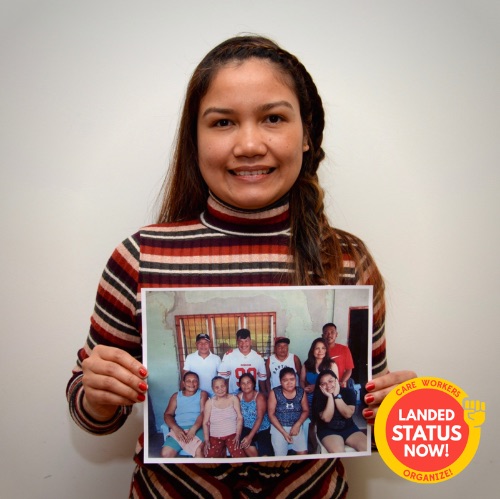
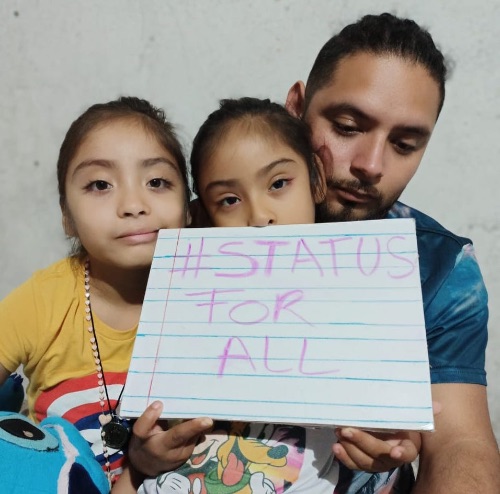
Here are some photos we have received already!

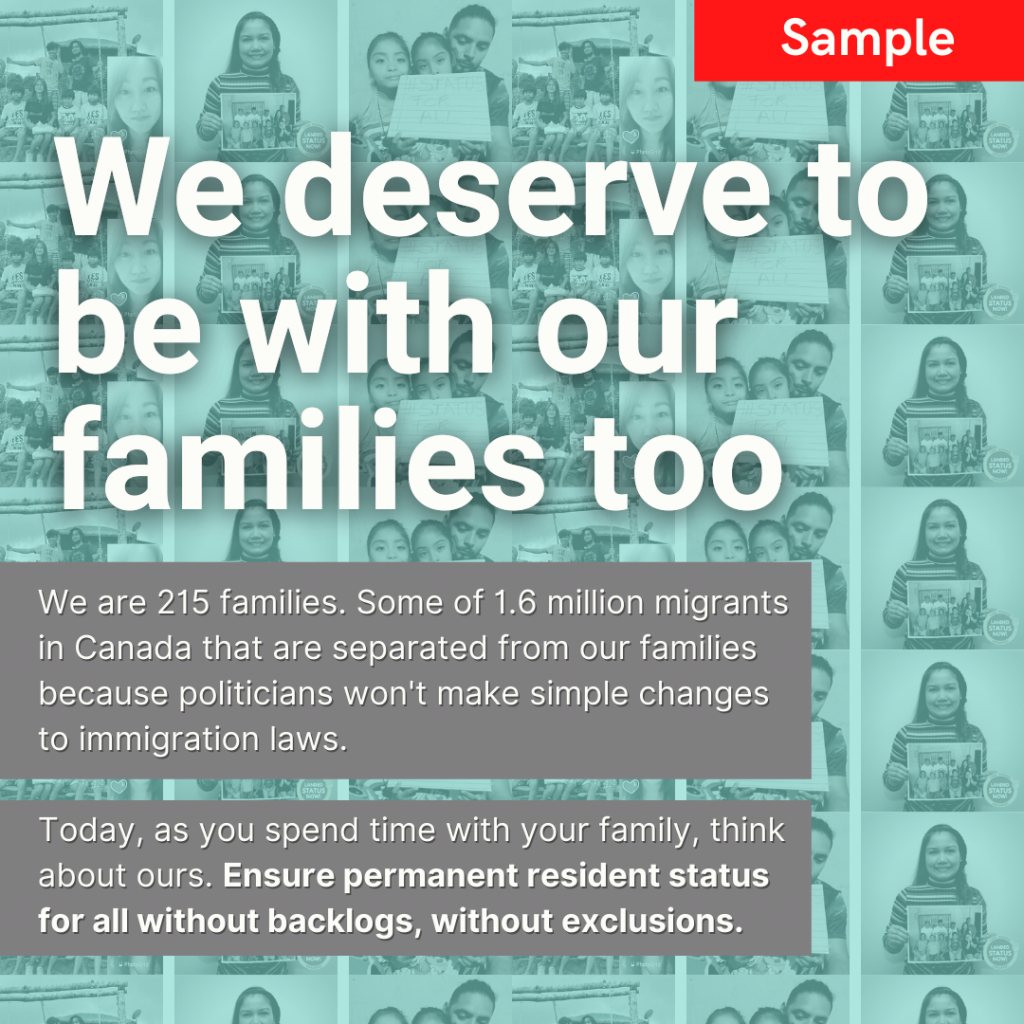
Here’s what the photo letter to MPs will look like