Petition: International Students Need Support! #FixPGWP

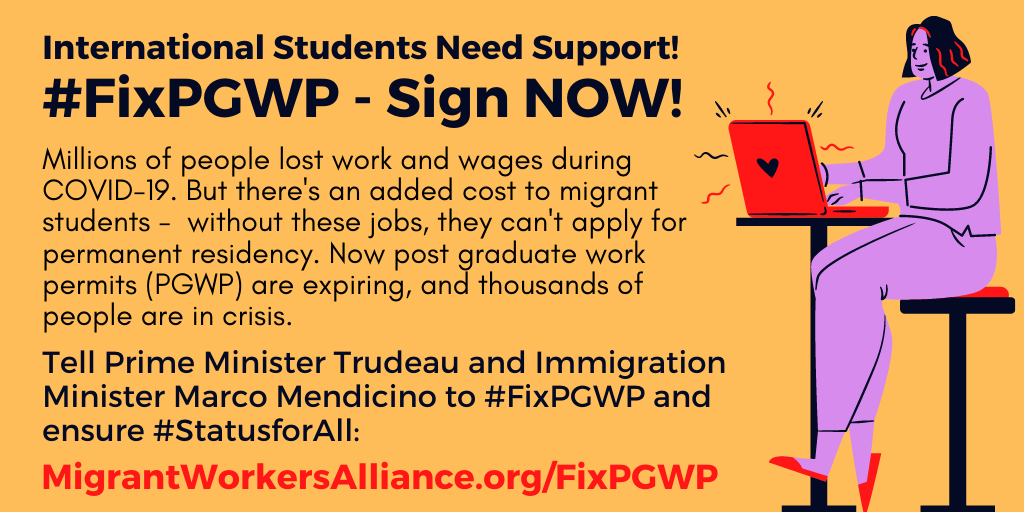
Millions of people lost work and wages during COVID-19. But there’s an added cost to migrant students –  without these jobs, we can’t apply for permanent residency (PR). Now post graduate work permits (PGWP) are expiring, and thousands of us are in crisis. If work permits remain non-renewable, students will lose status and the ability to get PR. Fill in your information below to send an email to Prime Minister Trudeau and Immigration Minister Marco Mendicino to #FixPGWP and ensure #StatusforAll.

We need the government to make immediate changes:
(1) Make Work Permits Renewable, so we have more time.
(2) Value all work to count for PR, including part-time, NOC C & D.
(3) Real access to PR: Lower the Comprehensive Ranking System score.
(4) Unite Families, so our family members can get work permits.
(5) Status for All: All migrants deserve full and permanent status.
(6) Lower Tuition Fees & Universal Services: We want the same rights as everyone else.

Read the letter we sent to Minister Mendicino on Friday October 30, 2020 here.

Migrant worker fired for speaking to journalists calls for full immigration status for all

Toronto, July 30, 2020 — Migrant farmworker, Luis Gabriel Flores Flores, who was fired for speaking to journalists after testing positive for COVID-19, calls on the Minister of Immigration Marco Mendicino today to demand immigration status for all. 

Reading from a letter he had written, Mr Flores said, “What happened to me is what happens to migrants when we try to defend their rights. We have been subjected to a system of temporary immigration where if we stand up for ourselves, we are deported. Today, I am here to say to you that I am not afraid. That I deserve dignity. That all of us deserve dignity. That is why we need permanent resident status now, so workers can have the power to protect ourselves. Our health, our well-being, our families, and our lives depend on it.” See Mr Flores’ full letter to the Minister of Immigration here

Mr Flores first came to Canada in 2014, and is a father of 2 children from Mexico. In 2020, he came to work at Scotlynn Farms. He tested positive for COVID-19 and was quarantined. During that time he spoke to journalists about the poor living conditions and mistreatment at Scotlynn Farms. On June 20th, Juan López Chaparro, who also worked at Scotlynn farm and lived with Mr Flores, died from COVID-19. The following day, Mr Flores was fired by Mr Robert Biddle Jr., founder of Scotlynn Farms.

“For years, we have called on the federal government to stop tipping the scales against migrant workers, to stop giving employers complete control over workers’ lives. All migrants must have the power to protect themselves, to speak up, to leave abusive and dangerous situations, and that means full immigration status for all is essential,” says Syed Hussan, Executive Director of Migrant Workers Alliance for Change. “The federal government needs to send a signal to migrant and undocumented people across the country today that what happened to Mr Flores will not be tolerated, and that migrants who speak out will be protected.”

Over 1,100 migrant farmworkers in Ontario have been infected with COVID-19 because of their housing and working conditions. One in 23 people (over 1.6 million people) in Canada are migrants, refugees, or undocumented. They are unable to access essential services, assert basic rights or access emergency support. Employer reprisals against them are common.

Over 10,000 people have signed a petition calling for permanent resident status for all and other protections for migrants: https://migrantrights.ca/covid19/. A visual petition of over 200 migrant workers calling for status was recently posted on Prime Minister Trudeau’s office: https://twitter.com/MWACCanada/status/1284122949549785093

Timeline of Reprisals Against Mr Flores

  • Mr Flores came to Canada on April 18, 2020, and was in quarantine for two weeks at a hotel. 
  • He started work at Scotlynn Farms in Norfolk, Ontario, where housing and working conditions were very poor. It was impossible for workers to physically distance, workers had no Personal Protective Equipment (PPE), and they were not allowed to rest. 
  • A couple of weeks later several of Mr Flores’s colleagues started showing COVID-19 symptoms. Mr Flores and others repeatedly requested medical attention for them. 
  • They were told by supervisors that information had been shared with management but no medical attention was provided and no testing was done. 
  • Eventually workers got so sick, that one of Mr Flores’s colleagues called a contact off the farm to send an ambulance. 
  • As a result, testing finally occurred at the end of May and nearly 200 workers at the farm tested positive, including Mr Flores. 
  • While in quarantine, Mr Flores shared the story of labour exploitation and sub-standard housing with Globe & Mail on June 10, 2020 and Toronto Star on June 13, 2020 in tandem with a report released by the Migrant Workers Alliance for Change (MWAC). He was one of several workers who spoke out. The press conference of the report received coverage on CTV, Global, CBC, Toronto Star, Globe and Mail and many other outlets. 
  • At 11pm on June 20, 2020, Mr Flores and other farmworkers were informed that his roommate Mr Juan Lopez Chaparro had died of COVID-19. 
  • Mr Flores spoke up at that time to supervisors, demanding an explanation from the employer and that the farm take responsibility for what happened. 
  • At 11:00 a.m. on June 21, 2020, Mr. Robert Biddle Jr., founder of Scotlynn Farms, arrived at Mr. Flores’ bunkhouse apartment unit. Mr Biddle showed Mr Flores an image of a video from a press conference by MWAC which featured Mr Flores’ colleague. He told Mr Flores that he would be sent back to Mexico first thing the next morning. Mr Flores insisted that he was not the person in the video. See Mr Biddle’s photo here
  • Mr Biddle left and a foreman reiterated the employer’s decision, and informed Mr Flores that the employer was looking for three other workers they suspected of speaking to the press. 
  • Mr Flores left the farm, and has been housed by a supporter in coordination with Migrant Workers Alliance for Change.
  • On July 30, 2020, Mr Flores filed an anti-reprisals claim to the Ontario Ministry of Labour for $40,401.35 (the maximum possible under existing laws), and visited the office of Federal Immigration Minister Marco Mendicino to call for full and permanent immigration status for all.
  • Mr Flores remains in Canada, on a tied work permit that only allows him to work for Scotlynn, which is set to expire on November 30th. He has no permanent housing, or permanent income and is concerned about how he will support his family back home. 

Media Contact: Syed Hussan, Executive Director, Migrant Workers Alliance for Change416-453-3632, hussan@migrantworkersalliance.org

Report: Unheeded Warnings – COVID-19 & Migrant Workers in Canada

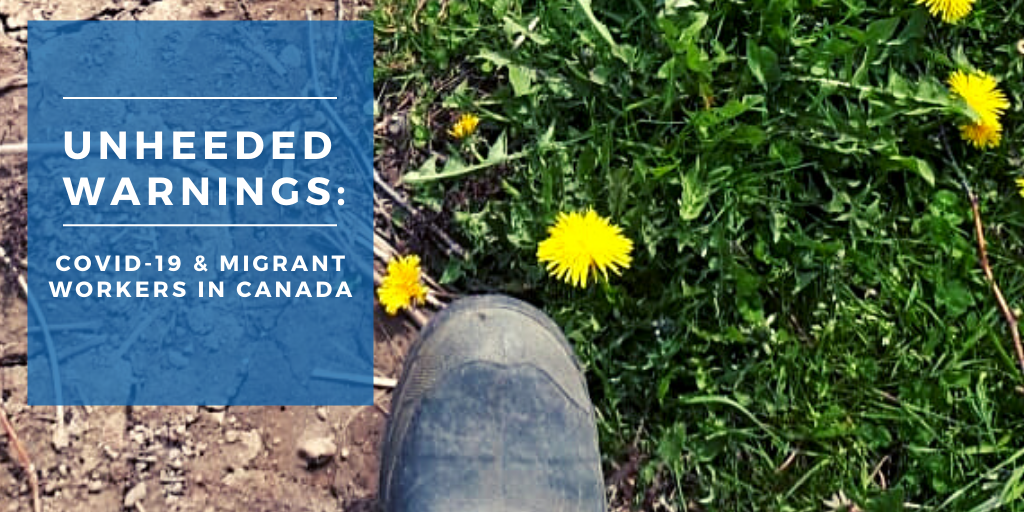
We are releasing a report of complaints on behalf over a thousand migrant workers and their organizations that were unheeded by federal and provincial authorities and consulates in advance of the recent COVID-19 outbreaks, which have led to two worker deaths and at least two in Intensive Care. This shocking report provides a snapshot of the abuses faced by migrant farmworkers, including stolen wages during quarantine, being forced to work while awaiting COVID-19 test results, racist threats, decrepit housing and inhumane treatment. The report situates these abuses in a long history of prior warnings made by migrant workers about Canada’s temporary immigration and labour laws. The report includes a comprehensive set of recommendations made by migrant workers, including permanent resident status for all. 

CLICK HERE TO READ | Press Release here


Migrant Workers / Trabajadores Migrantes: Information about Permanent Residency / Información acerca de la residencia permanente

Watch this video and fill out this form to get information about your rights to permanent resident status. It will take less than 5 minutes! You must answer all questions and click ‘Submit’ at the end for your information to be saved and sent to us. We will keep you updated about your access to permanent resident status.

———-

Mire este video y llene este formulario para recibir información sobre tus derechos a la residencia permanente. ¡Tomará menos de cinco minutos! Tienes que contestar todas las preguntas y hacer clic en ‘Submit’ al final para que tus respuestas se guarden y las recibamos. Te mantendremos al tanto de noticias acerca de tu acceso a la residencia permanente.

Funded by the Law Foundation of Ontario

CBC Ombudsperson: Investigate documentary on “birth tourism”

The following is a letter sent to CBC Ombudsperson. You can send a complaint also through: https://cbc.radio-canada.ca/en/ombudsman/contact

CBC 5th Estate Documentary – Passport babies: The growing shadow industry of birth tourism is inaccurate, unfair, imbalanced and puts migrants at risk

We are writing to you regarding the recent CBC 5th Estate’s documentary titled Passport babies: The growing shadow industry of birth tourism broadcast on January 5, 2020, and accompanying CBC web articles. This letter is co-signed by 30 immigrant rights, labour, research and indigenous rights organizations. 

The documentary and the accompanying articles fail to meet even the most minimal standards for fairness and accuracy in reporting. The program provides a biased version of events, and does not include any immigration rights expert voices. In the current climate of rising xenophobia and racism, this kind of misinformation only increases the  risk of violence and hatred toward migrants and their families.

(1) Accuracy

The program repeatedly reiterates that there are 5,000 non-resident births per year in Canada, and directly links that number to births by tourists. This number has only been cited in one report by Policy Options from November 22, 2018. However, in that study, the report author Mr. Griffith highlights that the 5,000 figure includes all migrants in Canada that do not have health coverage – not just tourists. This fact is not mentioned in the 5th Estate’s report at all. Over 780,000 temporary permits were issued during the period of Mr. Griffith’s study. In addition, there are an estimated  500,000 undocumented residents in Canada. Births by any migrants who did not have medical coverage are counted in the 5,000 figure. Thus, births by tourists are likely dramatically lower than what 5th Estate states them to be.

(2) Fairness

The 5th Estate episode, as well as the accompanying CBC piece titled ‘All about the money’: How women travelling to Canada to give birth could strain the health-care system, posit that lack of fee payment by tourist mothers is hurting the integrity of the healthcare system. The statistics provided, as outlined above, are not limited to tourists but include all non-payment of health fees by migrants. Many migrants are excluded from health coverage because of their temporary permits. Many are unable to pay up front the high fees necessary for life-saving care, putting their lives at risk. In July of 2019, the United Nations urged Canada to change legislation to ensure access to healthcare to all residents. This is critical context about the systemic denial of healthcare to migrants which, when left out, negatively biases viewers towards the reality of healthcare access for migrants. 

The show highlights that hospitals and doctors are collecting high fees from patients – $18 million invoiced, and only $2 million not paid. Considering non-payment of fees here includes all migrants, it is important to clarify that 42.9% of non-permanent residents in Canada are low-income, and thus are unable to afford such high fees. And yet the CBC reports the numbers as if they are simply rich tourists accessing services and refusing to pay. 

At the same time, front line nurses in the show itself point out how increased profit by hospitals is not resulting in increased staffing. But the production and editing of the show, including corresponding questions to hospital authorities and government officials, lays the blame for the strains on the health care system on fee non-payment by migrants, instead of inadequate staffing support and low government funding for front line workers, particularly nurses. 

(3) Balance

The show features several voices, including US President Donald Trump and Canadian parliamentarians, all speaking out against “birth tourism”. No immigration rights organizations, experts or lawyers are featured that could provide nuance or alternative interpretations of the statistics cited, , or shed light on the impact that high healthcare fees have on migrants, or to outline policy alternatives  developed by migration policy experts, for example, on the regulation of international recruiters – a subject of extensive policy and legislative work by immigrant rights organizations. 

(4) Impact on migrants

Police-reported hate crimes in Canada have been surging, a fact highlighted in the accompanying 5th Estate documentary aired on the same date. This rise in hate crimes is a direct result of growing anti-immigrant sentiment, analyses and rhetoric. In such an environment, producing inaccurate, unfair, and unbalanced media reports serves only to fan these flames of xenophobia and racism by redirecting concerns about lack of funding for healthcare towards immigrants.  This is dog-whistle politics, and it has a direct and harmful effect on hundreds of thousands individuals and families, and biases policy makers. 

We urge you to investigate the documentary, and accompanying web-stories closely, and to issue retractions and clarifications, and to ensure such inaccurate and biased reports on immigration policy are not aired in the future. 

On behalf of:

  1. Migrant Workers Alliance for Change*
  2. OCASI-Ontario Council of Agencies Serving Immigrants
  3. Idle No More
  4. Association for the Rights of Household and Farm Workers (ADDPD-ARHW)
  5. Butterfly (Asian and Migrant Sex Workers Support Network
  6. BC Health Coalition
  7. Caregiver Connections Education and Support Organization
  8. Caring for Social Justice collective
  9. Chinese Canadian National Council Toronto Chapter
  10. Collaborative Network to End Exploitation
  11. CUPE 1571
  12. Durham Region Labour Council 
  13. Faraday Law
  14. Idle No More Ontario
  15. Institut universitaire SHERPA: migration, diversité, santé
  16. Migrant Worker Solidarity Network, Manitoba
  17. Migrant Workers Centre – BC
  18. Migrante Alberta
  19. Migrante BC
  20. Montréal Antifasciste
  21. No One is Illegal – Halifax: K’jipuktuk
  22. No One Is Illegal Toronto
  23. No One Is Illegal – Fredericton
  24. Northumberland Labour Council
  25. Ontario Coalition Against Poverty
  26. Sanctuary Health
  27. Toronto Seed Library
  28. Unifor Local 222
  29. Vancouver Committee for Domestic Workers and Caregivers Rights (CDWCR)
  30. Workers Action Centre

* The Migrant Workers Alliance for Change (MWAC) includes individuals as well as Asian Community Aids Services, Butterfly (Asian and Migrant Sex Workers Support), Caregiver Connections Education and Support Organization, Caregivers Action Centre, Chinese Canadian National Council – Toronto, Durham Region Migrant Solidarity Network, FCJ Refugee House, GABRIELA Ontario, IAVGO Community Legal Clinic, Income Security Advocacy Centre, Migrante Ontario, No One Is Illegal – Toronto, Northumberland Community Legal Centre, OCASI – Ontario Council of Agencies Serving Immigrants, OHIP For All, PCLS Community Legal Clinic, SALCO Community Legal Clinic, Students Against Migrant Exploitation, UFCW, UNIFOR, Workers’ Action Centre and Workers United.
Migrant Worker Policy Priorities – May 2019

DOWNLOAD OUR POLICY POSITION HERE.

There are a number of issues of key concern to migrant workers and their support organizations across Canada at this moment. These include:

  1. Employment and Social Development Canada proposals for an occupation specific work permit;
  2. Interim Pathway for Caregivers, set to expire on June 4th, 2019;
  3. Proposal for the creation of permanent residency pilot program for non-seasonal agricultural workers and a permanent residency program for Caregivers; and
  4. Regulations for the creation of an Open Work Permit Program for temporary foreign workers at risk of abuse.

For migrant workers at the receiving end of these programs and proposals, these issues are interconnected. To engage in separate consultations on each matter, and only speak to a part of an issue rather than the whole further fragments the ability of migrant workers to give meaningful input. For these reasons, we are submitting one document that addresses all four issues.

As elaborated below, migrant workers in Canada continue to demand:

  1. Permanent resident status on arrival for all migrant workers in Canada through the creation of a Federal Workers Program for care workers, and in consultation with migrant workers in other streams;
  2. In the interim, creation of open or occupation specific work permits that are not reliant on employers that would allow workers to move freely between jobs and workplaces and work for any employer in a sector;
  3. The extension and then grandparenting of the Interim Pathway for care workers to ensure that no worker is left behind;
  4. Immediate implementation of an Open Work Permit Program for workers facing risk of abuse or being abused.

In this policy memo, the Migrant Workers Alliance for Change*, Association for the Rights of Household & Farm Workers (ARHW)- Montreal, Caregiver Connections Education and Support Organization (CCESO) – Toronto, Caregivers Action Centre – Toronto, Cooper Institute – PEI, FCJ Refugee Centre – Toronto, Immigrant Workers Centre (IWC) Montreal, Income Security Advocacy Centre – Toronto, Migrant Worker Solidarity Network – Manitoba, Migrant Workers Centre (BC), Migrante Alberta, Migrante BC, Migrante Canada, Migrante Manitoba, Migrante Ontario, Migrante Ottawa, Migrante Quebec, Migrants Resource Centre Canada – Toronto, PINAY – Quebec, RAMA – Okanagan, Sanctuary Health – Vancouver and Vancouver Committee for Domestic Workers and Caregivers Rights (CDWCR) propose a joint position on all these matters.

* The Migrant Workers Alliance for Change includes individuals as well as Asian Community Aids Services, Butterfly (Asian and Migrant Sex Workers Support), Caregiver Connections Education and Support Organization, Caregivers Action Centre, Durham Region Migrant Solidarity Network, FCJ Refugee House, GABRIELA Ontario, IAVGO Community Legal Clinic, Income Security Advocacy Centre, Migrante Ontario, No One Is Illegal – Toronto, Northumberland Community Legal Centre, OCASI – Ontario Council of Agencies Serving Immigrants, OHIP For All, PCLS Community Legal Clinic, SALCO Community Legal Clinic, Students Against Migrant Exploitation, UFCW, UNIFOR, Workers Action Centre and Workers United.  

DOWNLOAD OUR POLICY POSITION HERE. 

Poorest Migrants and Refugees In Grave Danger in Ontario

Toronto – Ontario’s decision to deny Legal Aid to migrants and refugees for immigration matters effectively puts thousands of lives in grave danger.

Until yesterday, Legal Aid certificates were only issued to migrant workers who earned below $11,632 and in some cases below $17,731 annually. That is, only the poorest were able to qualify. Today, they have been shut out. These changes will be disastrous for many, fatal for the rest.

As of this morning:

  • A migrant care worker who bravely left her abusive employer will not be able to access Legal Aid to secure her immigration status long enough to press charges against her employer;
  • A migrant farm worker who was injured on the job, and needs to stay in Canada for healthcare, would not be able to get Legal Aid to support them to secure their status;
  • A migrant agricultural worker who had faced labour exploitation even though they have been trafficked could not get the assistance of a lawyer from Legal Aid;
  • Refugees or migrants who face death or torture if deported would not be able to access Legal Aid to appeal their case or go to court;
  • Migrants or refugees who are being unfairly held in immigration prison will not have access to a Legal Aid lawyer to help them to argue for their liberty.

and the list goes on.

Ontario’s cuts to the minimum wage, job protections, social assistance, housing support, mental health services have collectively  pushed many migrants and refugees in exploitative conditions to a breaking point. Now, by denying them Legal Aid, Ontario has taken away their ability to even stay in the country to fight for basic rights.

The Migrant Workers Alliance for Change will do everything in our power to support the self-organization of migrant workers to access rights, dignity, services and status. We will unite our members along with all labour, community and environmental groups in Ontario under attack from recent cuts to push back against this avalanche of injustice.

Media Contact: Syed Hussan, 416-453-3632, Migrant Workers Alliance for Change

The Migrant Workers Alliance for Change includes individuals as well as Alliance for South Asian Aids Prevention, Asian Community Aids Services, Butterfly (Asian and Migrant Sex Workers Support), Caregiver Connections Education and Support Organization, Caregivers Action Centre, Durham Region Migrant Solidarity Network, FCJ Refugee House, Fuerza Puwersa, GABRIELA Ontario, IAVGO Community Legal Clinic, Income Security Advocacy Centre, Justice for Migrant Workers, Migrante Ontario, No One Is Illegal – Toronto, Northumberland Community Legal Centre, OCASI – Ontario Council of Agencies Serving Immigrants, OHIP For All, PCLS Community Legal Clinic, SALCO Community Legal Clinic, Students Against Migrant Exploitation, UFCW, UNIFOR, Workers Action Centre and Workers United.
Time to respond: Proposed Open Work Permits for Workers Facing Abuse or Risk of Abuse

On Friday, December 15th, the Federal Government proposed in the Canada Gazette the creation of an Open Work Permit Program for Workers Facing Abuse or Risk of Abuse. This Open Permit is in line with our proposed permits and are a step in the right direction. Click here to see our original submissions calling for this permit in December 2017.

The Migrant Workers Alliance for Change has made specific submissions on ways to ensure that the proposed Open Work Permits actually ensure migrant worker protections – Read them here

The proposed regulatory changes are promising in terms of interim protections for migrant workers as we continue our call for a system of permanent resident status on landing for low-waged migrants. However, they can and must be strengthened. Current gaps include:

  • Wide range of discretionary powers for the officers to define abuse, determine the length of permits or to issue the permit at all, and lack of a robust appeals process to maintain a check on these powers;
  • Lack of specific provisions for Care Workers who need to complete 24 months of service within 48 months and need the work experience on these permits to be counted; and lack of protections from blacklisting for Seasonal Agricultural Workers;
  • Lack of guaranteed access to healthcare; and
  • Lack of specific investigative mechanisms to ensure workers are compensated for harms.

Take Action Now! Send a letter to the Federal Government right now calling for changes. Use this template letter to draft your own submissions Please share this with your colleagues.

This Thanksgiving, remember migrant farmworkers

As you sit down with your family and friends for a Thanksgiving meal this weekend, take a moment to think about who grew your food, who caught the turkey, who picked the grapes.

The migrant farmworkers who did have a message for you. They too want to be with their families. And they are asking you to help spread their story on Facebook and Twitter.


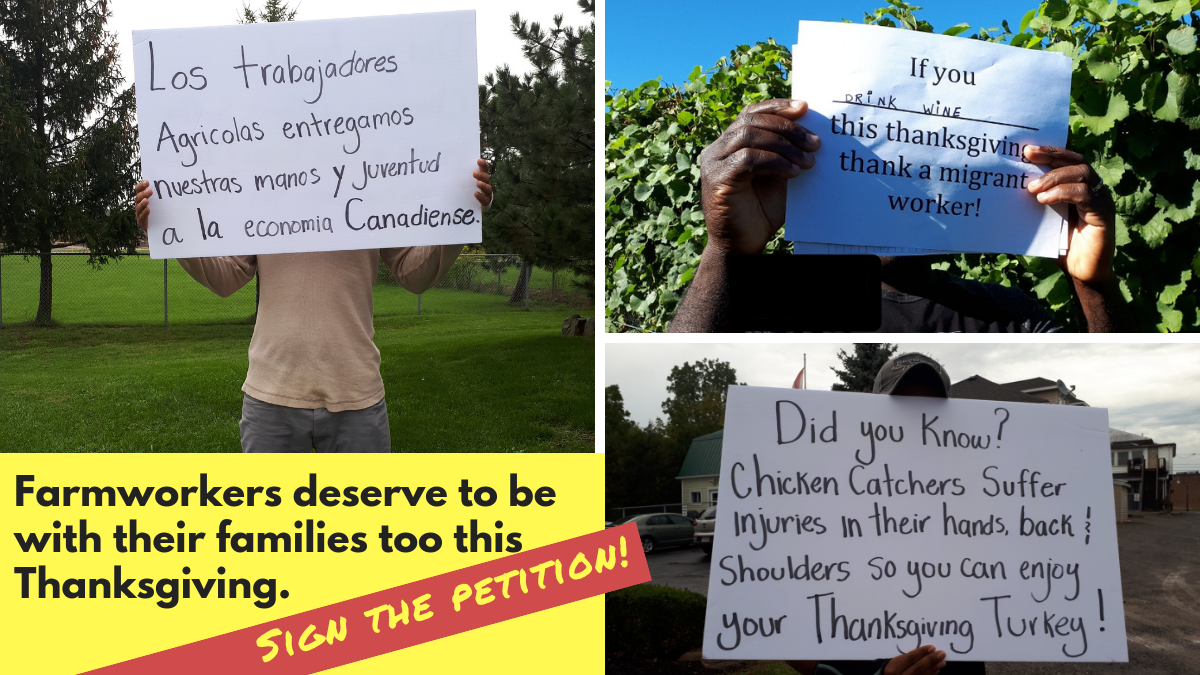
Featured in these photos are three of the over 40,000 migrant agricultural workers that come to Canada year after year, working in fields, greenhouses and factories. These jobs are dangerous, low-waged and necessary. Without them, our food system would simply not work. Yet, the law excludes them from basic protections, or the ability to reunite with their families. While they are afraid of reprisals from bosses if they show their faces, they are organizing and resisting. This Thanksgiving, they are asking people across Canada to remember them.

Share their story on Facebook and Twitter this weekend and urge your friends and family to sign this petition: http://migrantrights.ca/en/take-action/#email.

Read their stories below. Their names have been changed to protect workers against employer reprisals.

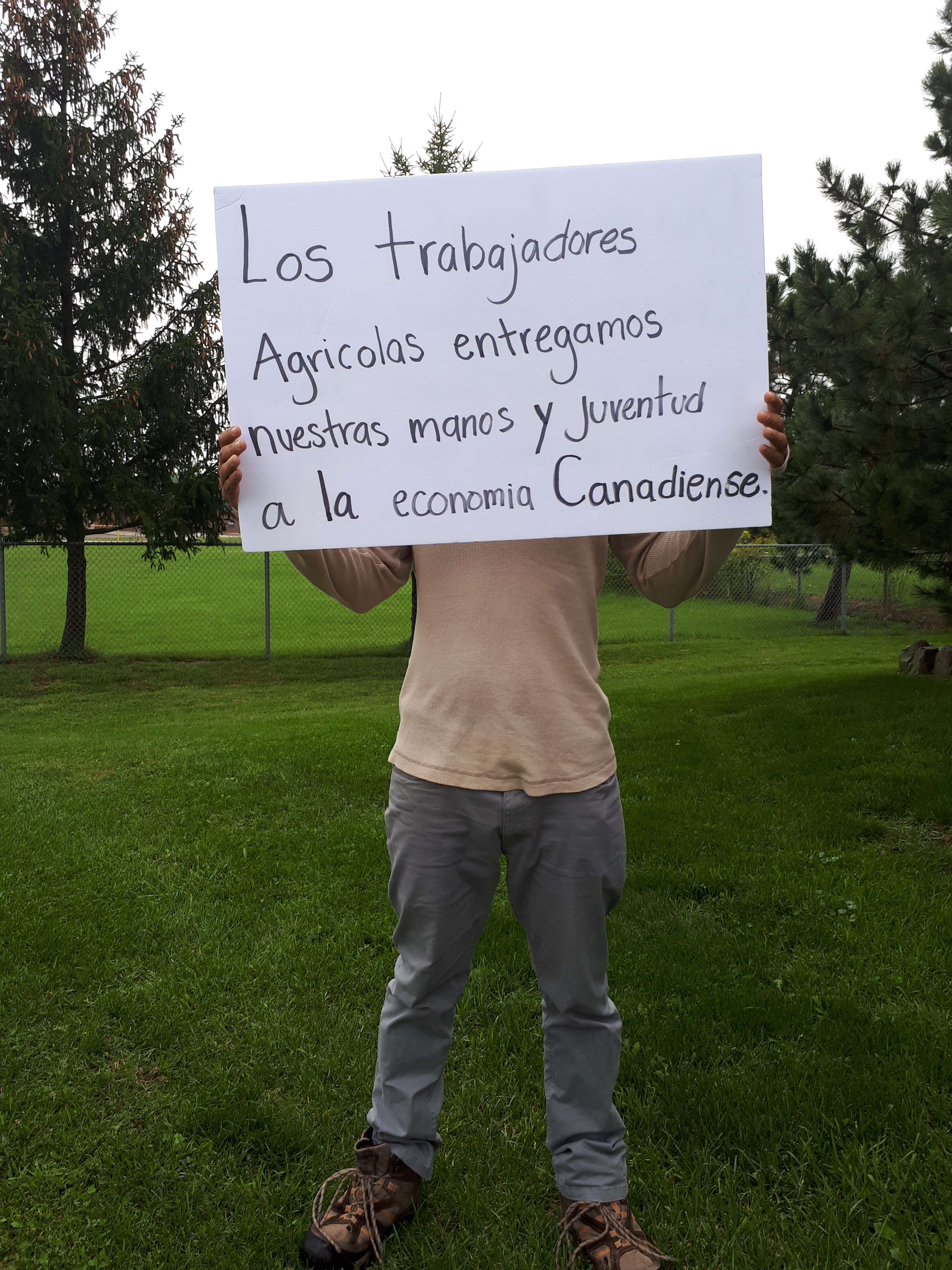
This is Mario. He is 29. His sign reads, “Agricultural workers give our hands and our years of youth to the Canadian economy.” He also says,  “I gave my hands and labour to this country. And I have suffered injuries while working here. And because I’m not a permanent resident,  I will be one more number that will be replaced when my contract ends! We do the heavy work Canadians won’t do, but we don’t have the same rights as permanent residents. That’s not fair.”


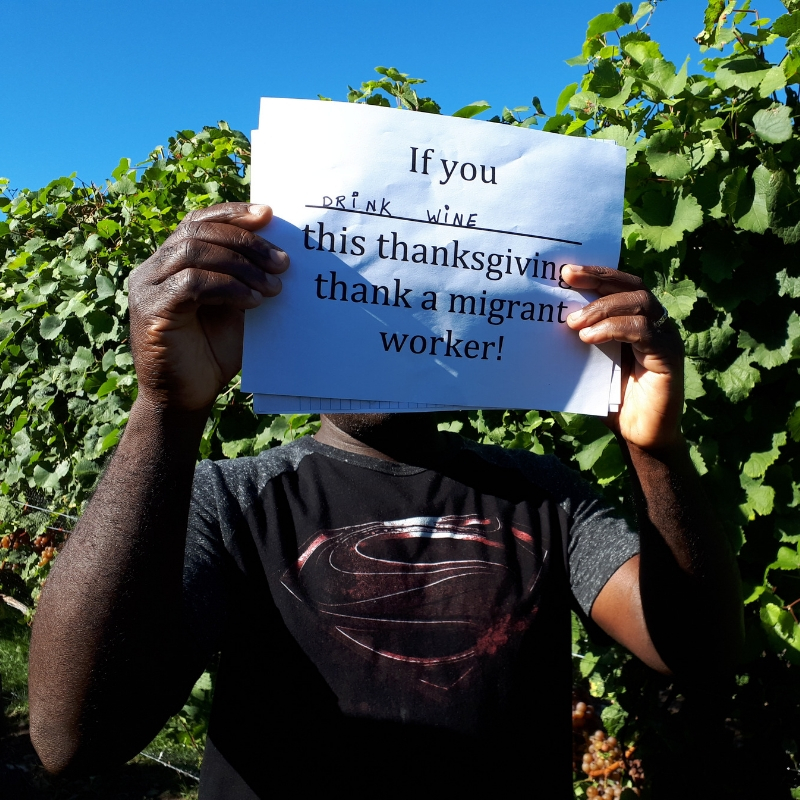
This is Chris. His sign reads, “If you drink wine this Thanksgiving, thank a migrant worker.” 41 year old Chris is a Caribbean father of two and has been coming to Canada for 10 years to grow and harvest peaches, pears, and grapes. He works up to 13 hours a day, 7 days a week. The income he earns here provides food, clothing, and school expenses for his children back home. Chris adds, “One day I want to bring my family to Canada so we can all be together.”


This is Mario. He is 29. His sign reads, “Agricultural workers give our hands and our years of youth to the Canadian economy.” He also says,  “I gave my hands and labour to this country. And I have suffered injuries while working here. And because I’m not a permanent resident,  I will be one more number that will be replaced when my contract ends! We do the heavy work Canadians won’t do, but we don’t have the same rights as permanent residents. That’s not fair.”

Policy Submission: Permanent Status on Landing – Real reform for Caregivers

DOWNLOAD THE FULL JOINT SUBMISSIONS
DOWNLOAD A SAMPLE LETTER, ADD YOUR NAME / ORGANIZATION AND EMAIL IT IN

A century of experience has demonstrated that caregiving labour is an ongoing permanent need in the economy. More than 60 years of caregivers’ experience with temporary labour migration to Canada has demonstrated consistent, well-documented, widespread problems of exploitation and abuse by employers and recruiters. Repeated reviews by Parliamentary Committees (most recently the 2016 HUMA Committee hearings), as well as academic and community-based research have demonstrated that this exploitation is rooted in the vulnerability that is created by the terms of Canada’s temporary labour migration program itself.

In addition, caregivers over the past four decades of the program have suffered from the ‘two-step’ immigration system that requires them to finish their employment contracts before being allowed to apply for permanent residency. This has led to profoundly damaging and lasting impacts on the physical and mental health of caregivers and their families. Years of family separation can cause intergenerational conflicts between caregivers and their children as well as family breakdown.

The time has come to make real, meaningful reforms that ensure decent work and security in this core area of the labour market. Caregivers are united in demanding:

  1.  A comprehensive and transparent consultation process to reform the Caregiver Program.
  2.  A new Federal Workers Program – Caregiver Stream that provides caregivers with permanent status on entry and family unity.
  3. Reforms to protect caregivers who are already in Canada and in the backlog to ensure that no one is left behind.

These interim reforms will involve allowing caregivers to come to Canada with their families; eliminating the backlog in caregivers’ permanent residency applications; removing the ‘excessive demand’ provision in the Immigration and Refugee Protection Act (IRPA); regularizing the status of caregivers who have become undocumented; developing immigration criteria that are consistent with what is needed to do the job; and putting an end to the second medical and to excessive educational and language requirements re-introduced in 2014. We particularly urge the creation of an open work permit program as an interim measure.