What is the Open Work Permit for Vulnerable Workers?

  • It is the last resource for workers who hold a closed work permit (employer-specific) and who are at risk of experiencing abuse or are already experiencing abuse with the employer they currently have a contract with 
  • Workers can apply while they are still working with the employer as well as after they have left the farm or workplace Note: The sooner you apply after leaving the farm, the better as IRCC might question why you didn’t apply right away.

How do we support you in this process?

  • We support you to prepare part of the application then we will refer you to a partner organization to finalize the application at no cost to you.  When possible we can refer you to a local organization in the province you are living wheter that is the province where the farm is or the province you are currently living.  .
  • We can assist you in writing your narrative if you have literacy limitations (your case can take a bit longer)
  • We write a letter of support for your case and follow up with you during the process until your case concludes (approved or refused) . We might be able to continue supporting you if you are refused depending on your case and if our partner organization makes a case for workers to reapply.
  • You need to write a narrative. This is a letter explaining  with as many details as possible including  who, when, where , how.  The more details the better, you need to paint  a picture for the immigration officer who will review your case and who might not be familiar with the conditions at the farm or workplace so it is important to give details and express your feelings in this letter. Use expressions like: I felt sad, angry, disappointed, etc.
  • Provide evidence: We need at least 3 pieces of evidence which can include, photos of you at work,  copy of work contract, paystubs, photos of working conditions, housing conditions or short videos preferably 1 minute or less, doctors notes, text with employer or human resources (HR), letter of support from witnesses such as friends and acquaintances, anything you can think it will support the details on your letter
    • You need to provide the following documents:
      • Copy of current work permit (If your permit has already expired you are not eligible to apply)
      • Copy of passport and visa (passport needs to be valid for at least a year  if is less than a year, you need to renew it before you can apply), but is your situation is dire and you need to leave your employer, you can apply for the open work permit, but it will only be approved for however many months you got left on your passport.
      • An active email address and best time to reach you.

How long does the process take?

  • The process can take anywhere from 1-3 months depending on many factors including if your narrative and supporting documents need to be translated
  • Your availability to provide documents and follow up on your case 
  • If the organization we will refer you to has a waiting list.

Important things to consider if you decide to apply:

  • You might no longer be able to participate in your country’s farm work program (Seasonal Agricultural Workers Program) as your liaison officer or consulate official might say you breached your contract by leaving the employer. This is not fair  and migrant workers like you are fighting for solutions to these unfair rules. If you want to know more on how you can join, let us know and an organizer will follow up with you. 
  • You need to have a plan if you are leaving your employer we are not able to support you  finding housing and it can be difficult and expensive. 
  • Make sure to put some money aside if you decide to leave your employer so you can support yourself while waiting for your permit to be processed.
  • Have a plan B in case your Work Permit is  refused.
  • An open work permit allows you to work in any job, anywhere in the country for any employer. You will not be part of a program that will connect you with an employer. 
  • Keep in mind that you will need to look for a job yourself. There are agencies that could help you with job search, but MWAC does not find employment for workers.

If you have read this document and think you qualify for the open work permit for vulnerable workers , please get in touch with us!

Farm Workers 905-324-2840 

Fishery workers 506 251 7467

Send a message with the code “Open Work Permit”, your full name, and the city you currently are and we will get back to you after September 5th as we currently have a waiting list for new cases.

For more details of what is considered  abuse, what types of evidence, who can apply  etc,  see the IRCC website: https://www.canada.ca/en/immigration-refugees-citizenship/services/work-canada/permit/temporary/vulnerable-workers.html

Regularize Everyone! Community Meeting at Jane & Finch

We are in a crisis of inequality and migrants are caught in the middle of it! Rent is high, wages are low, food is expensive, and services are being cut. We grow food, care for children & the sick, build homes, and keep society functioning. But we are denied basic rights because we do not have permanent resident status.

Prime Minister Trudeau promised to regularize undocumented migrants, but nothing has happened. Join us on Sunday, August 20, 2023 at 3pm for a community meeting at Jane Finch Corner Commons (1911 Finch Ave West) to get ready for our massive day of action on September 17th. We will share food, music, and conversation – bring your friends!

This event is being hosted by Migrant Workers Alliance for Change & Jane Finch Action Against Poverty.

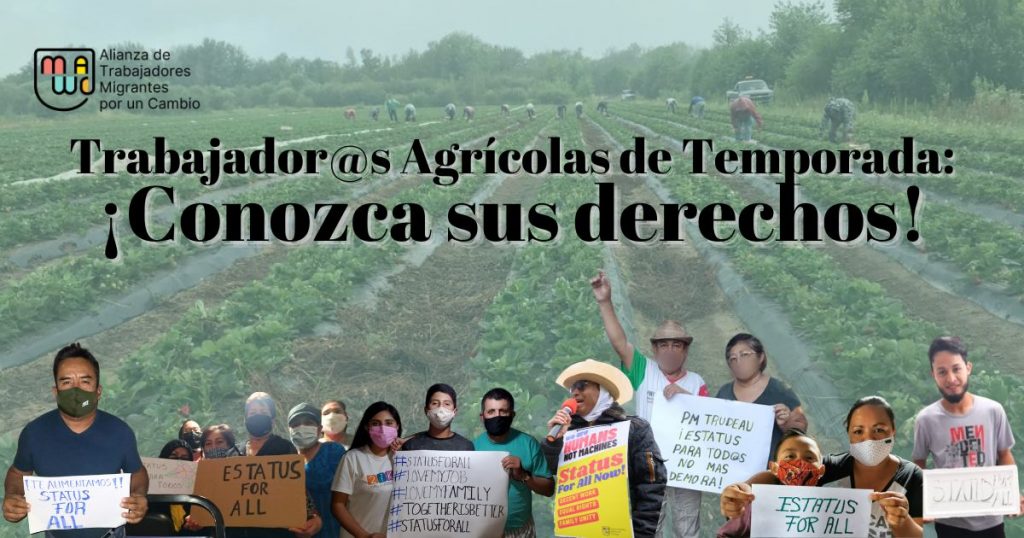
Trabajador@s Agrícolas de Temporada: ¿Conoce sus derechos?

Si es un trabajador/a agrícola migrante de temporada en Canadá, puede ser difícil y confuso conocer sus derechos. Esta guía le ayudará y si tiene alguna duda sobre sus derechos, envíe un mensaje de WhatsApp al 647-807-4722 con tu problema y ubicación.

A medida que lea esta guía, es posible que vea que no tiene tantos derechos como le prometieron. L@s trabajador@s agrícolas están excluid@s de muchos derechos laborales básicos por los que trabajador@s en Canadá han luchado y ganado. ¡No es justo! Tod@s merecen igualdad de derechos, trato y salarios justos y lugares de trabajo más seguros. ¡Es por eso que trabajador@s agrícolas como usted se están uniendo con más trabajador@s migrantes para tomar acción y ganar una vida mejor para usted y su familia!

¿Cuáles son sus derechos y dónde puede encontrarlos?

Para l@s trabajador@s agrícolas temporales, hay 3 lugares principales donde puede leer sobre sus derechos:

  1. Su contrato (federal)
  2. Leyes laborales (provinciales)
  3. Pautas de vivienda (provincial + municipal)

En su contrato tiene derechos

Si vino a Canadá bajo el Programa de Trabajador@s Agrícolas Temporales (PTAT) a través del Ministerio de Trabajo de su país de origen, tiene un contrato que tanto usted como su empleador han firmado. Es su derecho saber qué hay en su contrato y tener su propia copia. Si no tiene una copia de su contrato, háganoslo saber. [Toque este enlace para ver una versión en línea]

Estos son algunos de sus derechos según su contrato:

  1. Proporcionar alojamiento limpio y adecuado al TRABAJADOR sin costo para el TRABAJADOR (excepto en Columbia Británica, donde los empleadores pueden deducir por alojamiento). (Sección 2, Parte A, #1);
  2. Acceso a lavadoras adecuadas; O transporte gratuito a una lavandería (Sección 2, Parte A, #2);
  3. Proporcionar al TRABAJADOR una pausa para comer y al menos dos (2) períodos de descanso de diez (10) minutos de duración, uno de los cuales deberá ser a media mañana y el otro a media tarde, remunerado o no remunerado, de acuerdo con la legislación laboral provincial/territorial (Sección 2, Parte C, #13);
  4. 1 día de descanso después de trabajar 6 días seguidos; Si no es posible, su jefe debe pedirle permiso para retrasar su día libre a una fecha posterior (Sección 2, Parte C, #14);
  5. Después de trabajar para el mismo jefe por 5 años seguidos, tiene derecho a un pago de reconocimiento de $4/semana por un máximo de $ 128, pagadero al final de su contrato (Sección 3, #6);
  6. Cobertura de salud (Sección 5);
  7. Capacitación en seguridad para los TRABAJADORES, que incluya la operación de maquinaria y herramientas, sin costo para el TRABAJADOR para garantizar que el TRABAJADOR pueda realizar sus tareas de manera segura. (Sección 8, Parte 3 Inciso b);

Las leyes laborales, otorgan derechos

Canadá tiene 10 provincias y 3 territorios. Trabajador@s del programa de trabajo agrícola temporal (PTAT) trabajan principalmente en las provincias de BC, Ontario, New Brunswick y Nova Scotia. El gobierno canadiense es responsable de cosas como su permiso de trabajo, contrato y otros asuntos relacionados con migración. El gobierno provincial en la provincia donde trabaja determina cosas como sus derechos laborales. Eso significa que sus derechos pueden ser diferentes según la provincia en la que trabaje.

Trabajador@s agrícolas generalmente están excluid@s de las normas laborales básicas, incluido el derecho al pago de horas extra y días festivos y vacaciones pagas. En Ontario, l@s trabajador@s agrícolas están excluid@s del máximo de horas de trabajo y tiempo libre entre turnos. ¡Esto es inaceptable! Comuníquese con nosotr@s hoy para saber cómo l@s trabajador@s agrícolas como usted están rechazando las leyes laborales injustas.

Estos son 3 de sus derechos bajo la ley laboral provincial (Ontario):

  1. El derecho a trabajar libre de acoso y abuso (por parte de su jefe, supervisor o compañer@s de trabajo);
  2. El derecho al pago regular de salarios;
  3. El derecho a igual salario por igual trabajo (su jefe no puede discriminarlo y pagarle menos que a otra persona en la finca por hacer el mismo trabajo)

Enlace en inglés [Toque este enlace para leer más del sitio web del Ministerio de Trabajo de Ontario]

Si le tratan injustamente en el trabajo o no le pagan adecuadamente, envíenos un mensaje de WhatsApp al 647-807-4722 para obtener apoyo.

Pautas de vivienda, otorgan derechos

Al igual que las leyes laborales, las pautas de vivienda pueden ser diferentes según la provincia en la que viva y trabaje. Su contrato le garantiza el derecho a “condiciones de vida limpias y adecuadas”, y las pautas de vivienda detallan más lo que el gobierno considera que eso significa.

Estas pautas de alojamiento son utilizadas por el departamento de Salud Pública del municipio donde trabaja para inspeccionar la casa y aprobarlo. Si no está seguro de dónde encontrar las pautas de vivienda, envíenos un mensaje de WhatsApp con su código postal canadiense (una combinación de letras y números que estará en su talón de pago o en la dirección del lugar de trabajo).

Usando las pautas de vivienda en Ontario como ejemplo, estos son algunos de sus derechos:

  1. Alojamiento seguro, limpio y libre de roedores;
  2. Su jefe debe proporcionarle mantas, sábanas y fundas de almohadas limpias a su llegada;
  3. Suministro de agua potable para beber, lavar y cocinar;
  4. El empleador debe proporcionar utensilios de cocina (utensilios, platos, tazones, etc.), utensilios de cocina (ollas y sartenes) y utensilios de cocina.

Enlace en inglés [Toque este enlace para ver una versión en línea de las pautas de vivienda en Ontario.]

Envíenos un mensaje por WhatsApp al 647-807-4722 y podemos revisar la lista de verificación con usted o visitar la granja si lo solicita.

¡Usted merece más, unámonos para ganar!

Como puede ver, estas opciones no son lo suficientemente buenas. Se merece el poder de protegerse y luchar por la igualdad de derechos. Es por eso que trabajador@s agrícolas migrantes como usted y trabajador@s migrantes se están uniendo para luchar por el estatus de residente permanente para tod@s. Sin un estatus permanente, el jefe puede amenazarle con ser despedido, perder su vivienda, ser envid@ a su país y ser incluid@ en la lista negra del programa de trabajo agrícola. ¡Ya Basta!

El 17 de septiembre, migrantes y simpatizantes saldrán a las calles de Canadá para ganar estatus permanente para tod@s, incluidas las personas sin papeles. Invite a sus amig@s y familiares en Canadá a tomar acción con nosotr@s enviándoles este enlace: migrantrights.ca/events/sep17 . ¡Unid@s somos más fuertes!

Migrant food and farm workers support Metro workers on strike!

Last year alone, Canada’s 3 largest grocery stores took $3.6 billion in profit. That money belongs to workers, including migrants like you – people who grow, harvest, transport, and sell food. Right now nearly 4,000 workers at Metro (which also owns Food Basics) are striking for better wages & work hours and job security – things that all of us deserve! Sign below to show your support for workers taking action to win a better life for all of us.

Seasonal Farmworkers: Do you know your rights?

If you’re a seasonal migrant farmworker in Canada, it can be difficult and confusing to learn about your rights. This guide will help you and if you have any questions about your rights, send a WhatsApp message to 905-324-2840 with your issue and location.

As you read through this guide, you may see that you don’t have as many rights as you were promised. Farmworkers are excluded from many basic labour rights that workers in Canada have fought for and won. It’s not fair! Everybody deserves equal rights, fair treatment & wages, and safer workplaces. That’s why farmworkers like you are uniting together with other migrant workers to take action and win a better life for you and your family!

What are your rights and where can you find them?

For seasonal agricultural workers, there are 3 main places where you can read about your rights:

  1. Your contract (Federal)
  2. Labour laws (provincial)
  3. Housing guidelines (provincial + municipal)

Your contract gives you rights

If you came to Canada under the Seasonal Agricultural Workers Program through your home country’s Ministry of Labour, you have a contract that both you and your employer have signed. It’s your right to know what’s in your contract and to have your own copy. If you don’t have a copy of your contract, let us know. [Tap this link to view an online version.]

Here are some of your rights according to your contract:

  1. Clean, adequate living conditions (Section 2, Part A, #1);
  2. Access to adequate washing machines; or free transportation to a laundry facility (Section 2, Part A, #2);
  3. 1 meal break of at least 30 minutes after 5 consecutive hours of work, and 2 rest periods (10 mins each) in mid-morning and mid-afternoon (Section 2, Part C, #13);
  4. 1 day of rest after working 6 days in a row; if not possible, your boss must ask your permission to delay your day off to a later date (Section 2, Part C, #14);
  5. After working for the same boss for 5 years in a row, you are entitled to a recognition payment of $4.22/week for a maximum of $135, payable at the end of your contract (Section 3, #4);
  6. Health coverage (Section 6);
  7. Safety training and protective equipment at no cost to you (Section 9, #5);
  8. Free transportation to do your shopping once per week (Section 9, #7).

Labour laws give you rights

Canada has 10 provinces and 3 territories. Workers on the seasonal farmwork program mainly work in the provinces of BC, Ontario, New Brunswick, and Nova Scotia. The Canadian government is responsible for things like your work permit, contract, and other immigration-related matters, and the provincial government in the province where you work determines things like your labour rights. That means your rights may be different depending on what province you work in.

Farmworkers are generally excluded from basic labour standards – including the right to overtime pay and holidays & holiday pay. In Ontario, farmworkers are excluded from maximum hours of work and time off in between shifts. This is unacceptable! Reach out to us today to learn how farmworkers like you are pushing back against unfair labour laws.

Here are 3 of your rights under provincial labour law (Ontario):

  1. The right to work free from harassment and abuse (from your boss, supervisor, or coworkers);
  2. The right to regular payment of wages;
  3. The right to equal pay for equal work (your boss cannot discriminate against you and pay you less than somebody else on the farm for doing the same work)

[Tap this link to read more from the Ontario Ministry of Labour website]

If you are being treated unfairly at work or not being paid properly, message us on WhatsApp at 905-324-2840 for support.

Housing Guidelines Give You Rights

Like the labour laws, housing guidelines may be different depending on which province you live in and work. Your contract guarantees you the right to “clean, adequate living conditions”, and the housing guidelines go into more detail about what the government thinks that means.

These housing guidelines are used by the Public Health department in your area to inspect the bunkhouse and pass it. If you’re not sure where to find the housing guidelines, message us on WhatsApp with your postal code (a combination of letters and numbers that will be on your paystub or workplace address).

Using Ontario guidelines as an example, here are some of your rights:

  1. Safe, clean housing free from rodents;
  2. Clean blankets, sheets and pillow cases must be provided by your boss;
  3. Safe water supply for drinking, washing, and cooking;
  4. Employer must provide kitchenware (utensils, plates, bowls, etc), cookware (pots & pans), and cooking utensils

[Tap this link to view an online version of the housing guidelines in Ontario.]

Send us a message on WhatsApp at 905-324-2840 and we can walk through the checklist with you, or visit the farm at your request.

You Deserve More, Let’s Unite to Win!

As you can see, these options are not good enough. You deserve the power to protect yourself and fight for equal rights. That’s why migrant farmworkers like you and other migrant workers are uniting together to fight for permanent resident status for all. Without permanent status, the boss can threaten you with being fired, losing your housing, getting sent home, and being blacklisted from the farmwork program. Enough is enough!

On September 17, migrants and our supporters are taking to the streets across Canada to win permanent status for all, including people without papers. Invite your friends and family in Canada to take action with us by sending them this link: migrantrights.ca/events/sep17. United we are stronger!

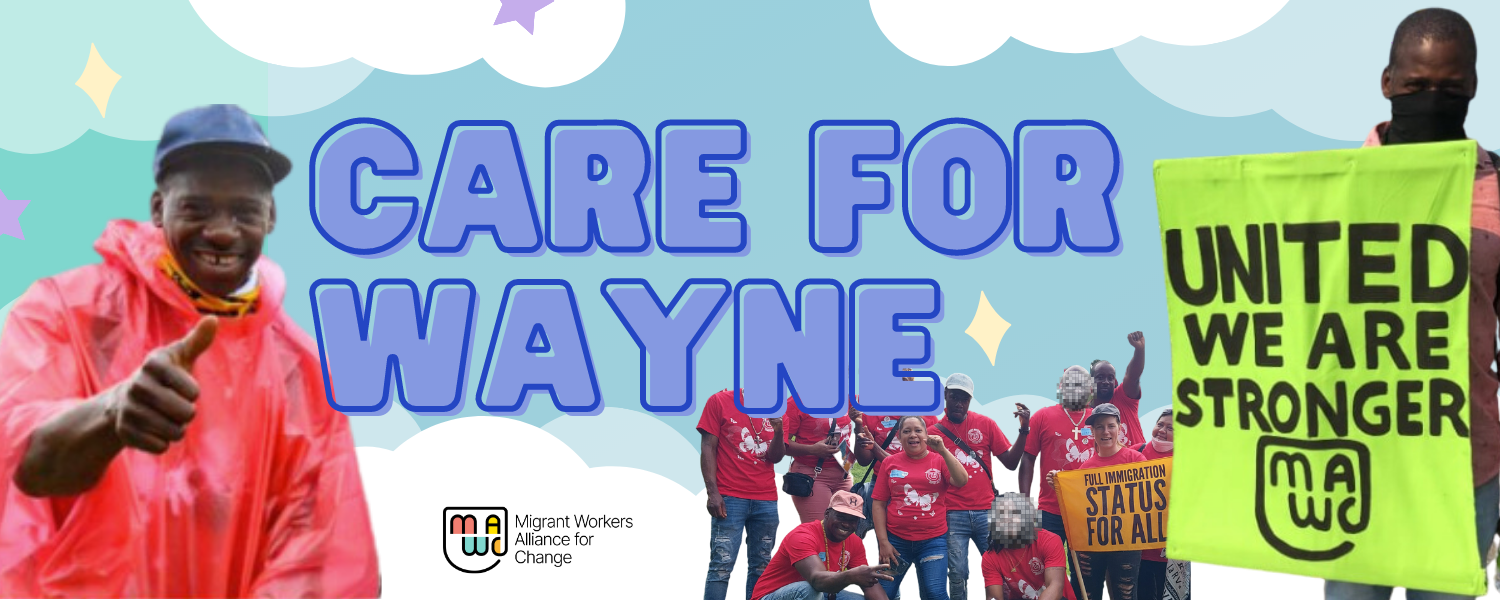
Care for Wayne Fundraiser

Wayne is a Migrant Workers Alliance for Change member leader from Jamaica who was blacklisted from the farm work program for speaking up about unpaid wages. He is a young father of two and has been providing for his family by driving taxi, but is now facing unexpected expenses after his dad passed away following father’s day. We are asking for community support to help with burial and funeral costs. Extra funds will be used to pay school fees for Wayne’s children.

TAKE ACTION: Donate using the form above, then join the movement to win equal rights for 1.7 million people like Wayne!

Migrant Workers – You may be able to study now!

This information is up to date as for June 27, 2023. Please check back for updates

What was announced?
Temporary foreign workers with a “work permit” (see below for who may be excluded) that is valid on June 7, 2023, or temporary foreign workers with an expired work permit but who applied for an extension June 7, 2023, may be able to study for up to three years without a study permit.

What changed exactly? 
Until now, if you were on a work permit, you could only study for a course of up to 6 months. For courses  longer than 6 months, you would have to apply for a study permit. Now you will be able to study without a study permit until your work permit expires.

Does this change apply to refugees, post-graduate work permit holders or humanitarian applicants with valid work permits? 
It is not clear at this time. Please fill in your information below and we will let you know when more information is provided by the federal government.

Can I study full-time?
Yes, you are allowed to study full time. 

But the work experience you get while studying full time cannot be used for future immigration applications under Express Entry programs. If you study part-time, you will be able to count the full time work for your Express Entry applications. 

If you are applying under the HCCP or HSWP or for the Agri-Food Immigraiton Pilot, it is not clear if you can count work while you are studying full time (but you can count work while you are studying part time). Please fill in your information below and we will let you know when more information is provided by the federal government.

What is part-time study?
Schools have different definitions. Usually anything less than 4 or 5 courses per semester is considered part-time. Check with the school before enrolling. 

Can I start a full-year course if my work permit expires during the course?
We don’t know if you can start a course in September for one year (until September 2024), if your work permit expires in the middle (for example in November 2023). Please fill in your information below and we will let you know when more information is provided by the federal government.

Can I get accreditation for high-school equivalency or one-year post-secondary education in this way without applying for a study permit? 
It is possible. However, you must make sure that the school you are applying to will provide you a certification that you can use. You must make sure that you choose part-time or full-time based on whether you need to count the work experience, and when your work permit expires. 

Can I study online?
Yes, you can study online. 

  • For Post-Secondary education: The post-secondary education must be a “Designated Learning Institute”. Check here to see if the school is registered. Be careful, there are many “private colleges” that are not listed so make sure you check this list even if the school is large and you know other people that attend. 
  • For high-school accreditation: Make sure it is a provincial organization. For example, in Ontario, click here.

Do I have to pay international tuition fees?
Yes, you will have to pay international tuition fees, which is 3-4 times higher than domestic tuition fees.

What are the requirements to enroll at a college or university or to get a high school diploma?
Every college and university has different requirements. You should read their websites carefully to apply. Only trust the information that you read yourself. Do not trust the advice of education agents without checking yourself. 

Fill Out This Form For More Information

Care Workers Online Monthly Meeting

The Home Child Care Worker Pilot (HCCP) and Home Support Worker Pilot (HSWP) programs will expire in June 2024. Many of us are still struggling to apply for permanent resident because of English test and education credential requirements that are excluding many. On top of that, many are still in the backlog waiting for years to be reunited with their families.

But we have an opportunity to win immigration changes for all of us care workers. This is why current and former care workers like you are meeting up to connect, talk about our struggles and what can we do to improve our lives for the better.

The Migrant Workers Alliance for Change (MWAC) is an organization for and by migrants. We are current and former care workers, international students, health care, farm and fishery workers across Canada uniting to win rights at work and immigration justice. Get involved and join us to win fair rules, equal rights and PR status for all of us!

We at Migrant Workers Alliance for Change wants to make sure that we have a safe space for us to talk about the issues that affects our lives while being away from our families. We are a community, we are a family that supports each other to fight for equal rights and fair immigration rules. That is why we encourage you to come to our meetings that happens every month to meet others like you.

Event : Caregivers Monthly Online Meeting

Date: Sep 26, 2023 , Tuesday

Time: 8PM Toronto, 5PM BC, 6PM AB

Regularization Action Week in Toronto from June 19 – June 22!

Migrants, undocumented people, refugees, healthcare workers – let’s come together to push for permanent resident status for all of us!

Come to our drop-in action week to join rallies, make phone calls, get updates, and tell the government why we need Status Now!