¡VUÉLVASE MIEMBR@!
Unite to #MakeItFair: Fairness Agenda for Migrant Student Workers
Click here to sign your organization up as an endorser. Click here to sign as an individual.
Endorsed by: Canadian Federation of Students – National, University of Toronto Mississauga Students Union, Public Service Alliance of Canada (PSAC) Local 901, York Federation of Students, Canadian Federation of Students – Ontario, Sudbury Workers Education and Advocacy Centre, Canadian Union of Public Employees (CUPE) Local 2626, Afro-Canadian Positive Network of British Columbia, Global Peace Alliance BC Society, Canadian Union of Public Employees (CUPE) Local 3902, Capilano Students’ Union and more
The Fairness Agenda for Migrant Student Workers is a platform that unites current and former international students’ demands and issues directed at all levels of government, institutions and employers. The objective of the platform is to:
- Create a unified cross-cutting set of demands that any organization working with migrant students workers can link to regardless of their particular expertise or focus;
- Build bridges between various migrant student worker organizations; and
- Establish a process to discuss and strategize on demands in the federal government’s upcoming review and announced changes.
We at Migrant Students United are connected with over 25,500 current and former international students. We are the only cross-country organization that has a membership of current, graduated and undocumented students with chapters in Ontario, BC and Newfoundland, and members in 10 provinces and territories. Over the last year, our membership has been identifying priorities and we have been consulting with organizations like yours, particularly as we have campaigned for and won recent changes to post-graduate work permit and study permit hours of work rules. Over 4,700 current and former students’ input has shaped this agenda. The Fairness Agenda for Migrant Student Workers is the culmination of this assessment and study.
The Fairness Agenda for Migrant Student Workers is a broad set of principles from which more specific policy proposals can be created as we continue our ongoing work. We at Migrant Students United will continue to build collective migrant student worker power to campaign for this agenda at all levels.
By endorsing the agenda, your organization:
- Agrees to be listed as an organizational supporter of the Fairness Agenda for Migrant Student Workers;
- Agrees to link to the Fairness Agenda for Migrant Student Workers where appropriate in your individual campaigns;
- Can opt-in to receive and share information about your campaigns and activities with other endorsers;
- Can opt-in to be connected to organizations similar to yours campaigning towards the same aim;
- Can opt-in to participate in future joint activities that will be determined in coordination with endorsers.
See link to the endorsement request letter here and read what’s in the agenda here.
Fill out this form to endorse!
Fairness Agenda for Migrant Student Workers
Current and graduated international students (Migrant Student Workers) are now the largest group of temporary migrants in the country. We are uniting as migrants for our rights, for justice and dignity.
ENSURE STATUS FOR ALL MIGRANT STUDENT WORKERS
- Fix Express Entry: Fair CRS calculations, predictable draws, no one left out
- Value all work in immigration selection: In any NOC/TEER, work done on the study permit, in co-op
- No exclusions: PR status for all regardless of age, immigration status, work, language and education requirements
FIX PERMITS
- Permanently end the 20 hour work rule for study permit holders
- Make PGWP renewable, and include private college students
- Allow co-op work authorization without extra permits
- Permit protections for vulnerable and destitute migrant student workers
- No industry of work restrictions
LOWER TUITION, ENSURE GOOD JOBS & ALL SERVICES
- Fair tuition: No differential treatment, caps on fee increases, stop the fees
- Regulate education recruiters, provide whistleblower protections to students
- Ensure access to employment and decent work; end wage theft and labour exploitation
- Ensure full access to all services including healthcare, housing, jobs, scholarships, and in-school support
- Ensure family unity
¿Permisos de trabajo abiertos familiares, para mi pareja e hij@s?

El ministro de Inmigración, Sean Fraser, acaba de anunciar un nuevo programa de permisos de trabajo para cónyuges e hijos en edad de trabajar a partir de enero de 2023. Pero se han anunciado muy pocos detalles. Agregue su información en esta página y vea el video a continuación. Le enviaremos los detalles por correo electrónico cuando el gobierno publique más información.
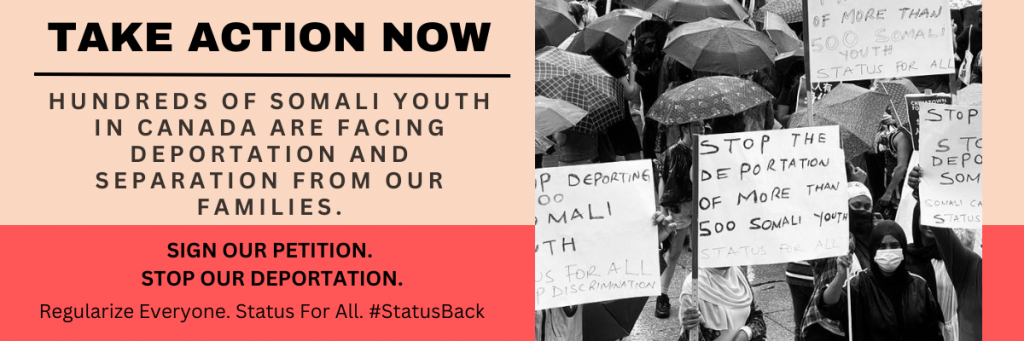
Petition: Stop mass deportations of Somali refugee youth
We are Qalid, Kaif, Hamza and Jamal. We are four of at least 100 young Somali refugees who are in crisis. We have been ruthlessly stripped of our Canadian permanent residency and citizenship. But we have an opportunity right now! Prime Minister Trudeau is creating a program called “regularization” for undocumented people like us. We need your support to make sure we are included. Read our story below and enter your information to send it as an email to all federal Ministers.
What do I need to know about HCCP & HSWP if I am a refugee or undocumented?
The Home Child Care Provider Pilot (HCCP) and Home Support Worker Pilot (HSWP) are temporary pathways to permanent residency for temporary residents who have provided in-home care to children or the elderly and/or people with disabilities.
There are two categories you can apply under for HCCP and HSWP:
- Direct to permanent residency category
- This option is for temporary migrants who gathered the required work experience in in-home care to children, the elderly and/or people with disabilities while on valid temporary work authorization.
- That means work experience while you were a refugee claimant without temporary status or undocumented cannot be counted.
- Gaining work experience category
- This option is for temporary migrants who have not gathered the required work experience yet, but have a job offer with an employer to provide in-home care to children, the elderly and/or people with disabilities. You must maintain your valid immigration status while waiting for a decision on your HCCP or HSWP application.
- If you have a pending refugee application, you may have valid status, but make sure to get legal help to verify this. If your refugee application has been denied, you do not have valid status. If you lose temporary status or receive a negative decision on your refugee claim while waiting for a decision on your HCCP or HSWP application, your application may be denied unless you restore your immigration status.
Can refugee claimants or undocumented people apply under HCCP or HSWP?
- If you are a refugee claimant with valid temporary status and a job offer in in-home care for children, the elderly and/or people with disabilities – and you meet all the other criteria – technically you can apply. But make sure you meet all the criteria first! Read below for more information!
- Because you must maintain temporary status throughout the application process, you cannot apply if you do not have temporary status, are undocumented, your refugee claim was denied, you are appealing at the RAD or under judicial review, or you have or are waiting for a removal order.
What type of work experience do I need to have or get to be eligible to apply for HCCP or HSWP?
Direct to permanent residency category
You must have completed two years (at least 30 hours per week) of valid, full-time work experience in the last three years as an in-home care worker to children, the elderly and/or people with disabilities.
This means work in a hospital, nursing home or long-term care home does not count. However, if you are hired by an agency to provide care to one or multiple clients inside their house or residence, this work can be counted.
“Valid” means you did this work while on temporary status or with temporary work authorization (i.e. the work permit as a refugee claimant does not count because it is not considered to be valid temporary status).
Gaining work experience category
If you have a job offer from an employer for in-home care with children, the elderly and/or people with disabilities, they must complete this form: https://www.canada.ca/content/dam/ircc/documents/pdf/english/kits/forms/imm5983e.pdf. After this form is completed, you can use it to apply for an industry-specific work permit under HCCP or HSWP, so that you can complete the two years of work experience required to apply for permanent residency.
What other requirements do I need to have to apply for HCCP or HSWP?
- Outside of Quebec: You must declare that you will not live in Quebec if you get permanent residency.
- Ability to do the job: You must show you have relevant work experience or training as a home child care provider (nanny, babysitter, live-in caregiver providing child care) or a home support worker (attendant for persons with disabilities, live-in caregiver for seniors, personal care attendant, home support worker). These jobs are described under the National Occupation Classification (NOC) code 4411 and 4412 under NOC 2016, or 44100 and 44101 under NOC 2021.
- Education accreditation: You must provide proof of at least 1 year Canadian post-secondary education or its equivalent.
- If you did not study in Canada, you must get an Educational Credential Assessment (ECA) from an approved organization to see if your completed degree, diploma or certificate from back home is equivalent to 1 year of post-secondary education in Canada.
- Language test: You must provide valid English or French language test scores for a minimum of CLB Level 5. The test results must be valid and less than two years old. Read more here.
- Any migrant with valid identification, including refugee claimants, can take the IELTS or CELPIP test. Just type “IELTS or CELPIP test centres” in google, find the closest location to you, and book your test online. The cost for each test is usually around $300!
Is there a cap or limit to how many applications IRCC will receive per year under HCCP and HSWP?
- Yes. HCCP and HSWP programs have only 2,750 spots EACH per year, and this year they broke it down into these categories:
- Gaining experience category:
- 1,650 applications, including 1,500 online applications & 150 alternate format applications
- Direct to permanent residence category:
- 1,100 applications, including 1,000 online applications & 100 alternate format applications
- Gaining experience category:
- Once IRCC receives 2,750 applications in a year, they stop accepting more applications. This is not fair!
Is this a new program?
- The HCCP and HSWP programs were created in 2019. It was created because migrant workers like you in Migrant Workers Alliance for Change (MWAC) campaigned under the call of “Landed Status Now”.
- But these temporary programs have existed in one way or another since the 1950s making it the longest running temporary foreign worker program in Canada. We have been fighting to improve it, and were successful at making partial changes before. But now the increased requirements, including the education accreditation and language tests, have blocked many of our care worker members on work permits from being able to apply – just like what many of you are going through right now!
- We must continue to fight for regularization and status for everyone, and make sure no one is excluded because of racist and discriminatory requirements like English skills, education or caps!
Year-end MWAC members’ review
As a member of Migrant Workers Alliance for Change, do you want to want to see your organization grow in strength and numbers so that we can win everything we want?
Fill out this form and share your views!
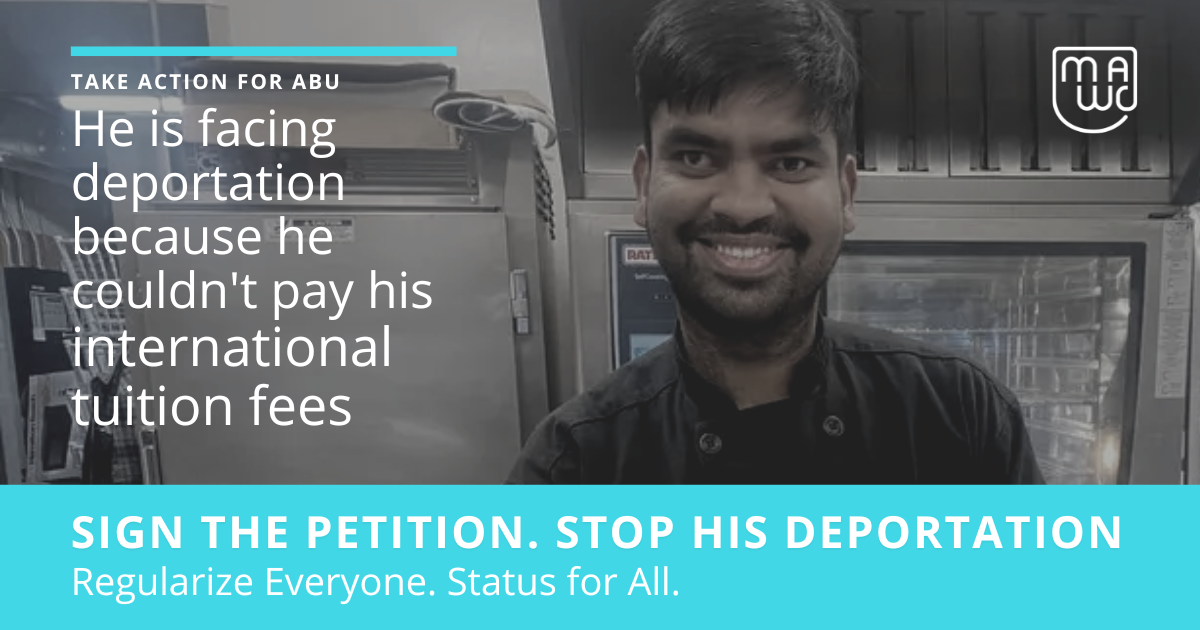
Stop Abu’s Deportation!
We can’t lose our people. Abu won his case on December 31, just hours before he was set to be deported. But he doesn’t have permanent resident status yet. Let’s continue the fight for Abu, and the 1.7 million migrant farmworkers, careworkers, current and former international students, refugees and undocumented people in the country who are denied equal rights. Sign the petition for PR status for all: https://migrantrights.ca/take-action/permanent-resident-status/
Please scroll below the first paragraph and wait a moment for the petition to load.
My name is Abu Hena Mostofa Kamal. I’m a former international student and I am facing deportation on January 1st because I couldn’t pay my high tuition fees. Please support me by sending a message to Immigration Minister Sean Fraser and Public Safety Minister Marco Mendicino. You can read more of my story below.
Abu’s story
I came to Canada when I was 19 years old from Bangladesh, as a migrant student to study in Thunder Bay, Ontario. I was not able to renew my study permit because of high international tuition fees. Tuition fees have increased over the pandemic, and when migrant students like me can’t pay, we get punished.
As a migrant student, I had to take jobs with bad working conditions, but couldn’t speak up because of my status. Employers didn’t pay me my wages and I got unfairly treated at work. I feel like we’re on a leash, like we are disposable human beings with an expired date.
I applied for permanent residency 18 months ago, but it still has not been processed. Immigration Canada approved me for temporary status, but I am still facing deportation.
Because of this crisis, I had to rely on a local church and I wasn’t sure where my next meal was coming from. I am now 23 years old, it feels like my life is on hold.
But I have not been quiet. On November 14, 2022, I drove 15 hours to go to Ottawa from Thunder Bay to meet with Immigration Minister Sean Fraser. I reminded the Minister that Prime Minister Trudeau promised to give status to all undocumented people. Prime Minister Trudeau must deliver on his promise, he must deliver a regularization program without caps and without exclusions, and status for all, without delay.
Please add your name to my petition calling for a stop to my deportation, and full and permanent immigration status for all migrant and undocumented people.
You can read more about me in the Toronto Star here: https://www.thestar.com/news/canada/2022/11/12/this-is-our-only-hope-undocumented-migrants-risk-arrest-to-make-their-case-in-ottawa.html
Family open work permits for spouses & kids
This is the most updated information we have about family work permits written for migrants in Canada.
Not all the rules have been announced. Immigration Canada is supposed to release the rules (called the public policy) – we will update this page when that information is released.
Here’s what we know as of 5pm on Wednesday, February 8, 2023. You must meet the qualifications in ALL of the sections below.
This program is for OPEN WORK PERMITS only for SPOUSES/COMMON LAW PARTNERS and WORKING AGE CHILDREN who are dependents.
(1) PERMIT LENGTH AND VALIDITY
- You may be able to apply for a work permit for a spouse or a common law partner, and dependent children if you have a valid work permit or authorization to work that is valid for six (6) more months when you apply for a family work permit.
- Note that study permit holders can apply for their families to join them if they are studying at a public post-secondary institution. Click here for details.
(2) TYPES OF WORK PERMITS OR IMMIGRATION STATUS THAT ARE ELIGIBLE
You may be able to apply on the basis of a work permit, if you fit in ONE of the categories listed here:
- You have a valid work permit in the high-waged worker stream of the Temporary Foreign Workers Program (to see if you are high-waged or low-waged, you must check your Labour Market Impact Assessment).
- You have an open work permit that was issued because you applied for permanent resident status as
- federal skilled worker class (FSWC)
- Canadian experience class (CEC)
- federal skilled trades class (FSTC)
- caring for children class or caring for people with high medical needs class IF YOU APPLIED BEFORE June 18, 2019
- Provincial Nominee Program (PNP) for applicants for whom there are no employer restrictions on nominations
- Agri-Food Pilot (AFP)
- Quebec skilled worker class (QSWC)
(3) ADDITIONAL REQUIREMENTS
You must additionally meet ALL of the the following requirements:
- You are living or plan to live in Canada while working.
- You can prove that you are in a genuine relationship with your spouse or common law partner for at least 1 year.
- If you are sponsoring your children, you must prove that they are your dependents.
- If you are sponsoring your children they must be of working age in the province or territory (check provincial Ministry of Labour website).
- If your spouse or children are in Canada, they either
- Have a valid temporary resident status.
- Have applied to extend your status before it expired (maintained status).
- Or are eligible to restore your status.
WHO IS EXCLUDED? AND WHAT DO WE NOT KNOW?
Information updated at 5:30pm on Monday, January 30, 2023 changed the information that was provided as of January 29, 2023. As of 5pm on February 8, 2023, the following people are excluded:
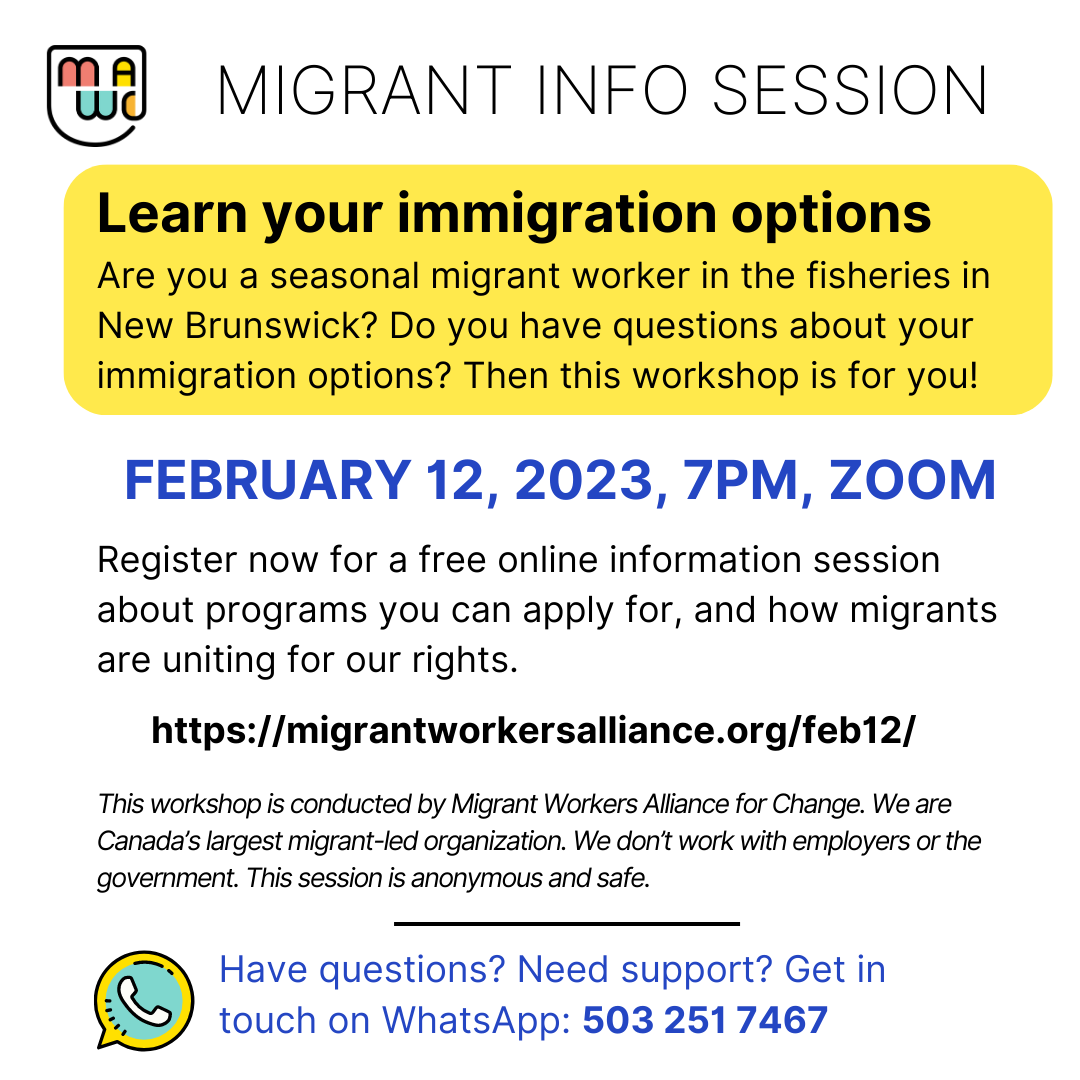
- Seasonal Agricultural Workers (8 month contracts or less) and other workers in the Primary Agricultural Stream of the Temporary Foreign Worker Program (1+ year contracts).
- All low-wage workers in the Temporary Foreign Workers Program are excluded unless:
- You have a work permit issued because you applied for PR in the Economic Streams (see point 2Bd above)
- Refugee claimants or refused refugee claimants who have a work permit issued under R206 exemption from an LMIA.
- All migrants without a valid work permit are excluded.
Migrant fishery workers, care workers, and others are therefore excluded. This is different from the information provided on January 29, 2023.
We still do not know if the following migrants are included or excluded:
- Open work permits for vulnerable workers
- Low-wage stream workers but who are now in a high-wage job (TEER 1, 2, or 3).
We must immediately and quickly organize and speak up to say that all families are equal, and that all migrants must be with our families. The government has said they will do a consultation about migrant agricultural workers, but they have not said anything about low-wage workers like fishery workers and care workers.
SEND US A MESSAGE NOW IF YOU WANT TO ORGANIZE AND TAKE ACTION!
- Migrant Care Workers/ Health Care Workers: 647-782-6633
- Migrant Students: 647-858-2854
- Migrant Fishery Workers: 506-251-7467
- Migrant Farm Workers: 905-324-2840
HOW TO APPLY
You must apply for your open work permit online, unless you are in one of the following categories. The applications are different based on if you are inside Canada or not. Click here to create an account and start your application.
In addition, you must also provide the following information:
- If you are sponsoring spouses and common-law partners
- a copy of your marriage certificate
- a declaration of your common-law relationship
- If you are sponsoring dependents:
- a birth certificate
- adoption papers
- A copy of your work permit OR the visitor record with expiry date showing that you’re authorized to work without a work permit with expiry date (for 6 months after the date of application)
- Proof that the principal foreign worker can work in Canada for 6 months after the date that the family member submits their work permit
- a copy of the work permit with expiry date
- a copy of a the visitor record with expiry date showing that you’re authorized to work without a work permit
- Proof of work
- A letter or contract from your current employer (for open work permit holders, such as PGWP or International Experience Canada)
You will have to upload multiple documents in the same field online. Click here to see how.
FREQUENTLY ASKED QUESTIONS
We will be updating this section all day. If you have questions, please contact us on our hotlines.
- So what’s changed?
- Post graduate work permit holders or other work permit holders through International Experience Canada can now apply for open work permits for their spouses even if they do not have a high-wage job in TEER 1, 2 or 3.
- High-wage temporary foreign workers, and those with open work permits under HCCP/HSWP were already able to apply for work or study permits for their families.
- Who are dependent children?
- Dependent children are those under 22 years old (on the date of application) and do not have a spouse or partner
- Children who are 22 or older can qualify as dependents if they have depended on their parents for financial support since before they were 22 AND can’t financially support themselves because of a mental or physical condition
- My permit was initially for longer than 6 months, but is now currently less than 6 months until it expires. Can I apply?
- As per the information only released at 5:30pm on January 30, 2023, you will not be able to apply.
- As per the information only released at 5:30pm on January 30, 2023, you will not be able to apply.
- What is the processing time?
- It varies by country and whether you are applying from outside or inside Canada. To check times, click here.
- It varies by country and whether you are applying from outside or inside Canada. To check times, click here.
- What will the length of the permit be issued to family members?
- We don’t know yet.
- We don’t know yet.
- Can you apply for small children-as old as 3 years old and how?
- You cannot apply for a work permit for children as old as 3 years old, but you can apply for a visitor’s visa to unite with family members here.
- If you have children who are under 18 or 19 years old (depending on the province), and you have a valid study or work permit, you may be able to apply for a study permit for them as long as you meet the requirements. Click here for more details.
- What if I have implied status?
- Your work permit must be valid for six more months. So implied status is excluded.
Migrant Workers Alliance for Change is an organization of migrants. We are not part of the government, and we are not immigration consultants or agencies. You will not be charged any fees for this information, and your information will not be be shared with anyone.