Policy Submission: Repeal Section 38(1)(c) of IRPA

Migrant Workers Alliance for Change and Caregivers Action Centre made the following policy submission to the Standing Committee on Citizenship and Immigration. DOWNLOAD HERE

Our key recommendations on Medical Inadmissibility:

  • Immediately repeal Section 38(1)(c) of the Immigration and Refugee Protection Act
  • Immediately grant permanent residency to everyone who was denied permanent residency on the basis of Section 38(1)(c)  in the last 10 years.

FURTHER RECOMMENDATIONS FOR MIGRANT WORKER RIGHTS

We also urge the Standing Committee on Citizenship and Immigration to develop legislation that:

1) Ensures permanent immigration status for all migrant workers

Status for All, Status on Arrival: All migrant workers must be able to immigrate to Canada as permanent residents immediately, independently and permanently without depending or relying on the sponsorship or good will of their employers or third party agencies. This program should include migrant workers already in Canada, those that have worked here and left and those arriving in the future. Migrant workers who have been granted permanent residency should get comprehensive settlement services that will ensure their success.

  • This recommendation is distinctly separate from a provision of ‘pathway to permanent residency’. A ‘pathway’ is a two-step process that Caregivers had until November 2014 — the current two-streamed program contains a more restrictive pathway — and even then was shown to have the same forms of abuse and vulnerability that are found in other parts of the program.
  • Permanent residency ensures services: Many labour rights and basic services in Canada like healthcare and post-secondary education are tied to permanent immigration status. Migrant workers pay for all these services through taxes and deserve access to them.
  • Permanent residency is the norm: Most immigrants – refugees, spouses, high-waged immigrants – arrive to Canada with permanent resident immigration status, which gives them peace of mind, the ability to re-unite with their families and the tools they need to lay deeper roots and build our society further as soon as they arrive.
  • Permanent residency re-unites families: Landed status on arrival would also allow caregivers to enter Canada with their families, thus eradicating family separation (which averages 6-8 years) while caregivers complete the program and wait for their permanent residence applications to be processed.

2) Ensures access to all social services and benefits

Ensure access to Canada Pension Plan, Employment Insurance and other federal entitlements to migrant workers already in Canada and portable benefits to migrant workers who are no longer here.

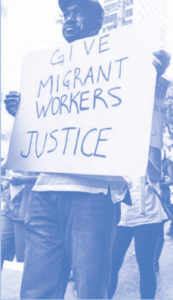
MWAC calls for stronger labour standards for Migrant Workers

The Fair Workplaces, Better Jobs Act, 2017 (Bill 148) introduces many important changes to address Ontario’s outdated labour laws. The proposed changes in Bill 148 to the Employment Standards Act (ESA) and Labour Relations Act (LRA) provide a good start to addressing precarious work to deal with changing workplace practices.

However, we join with the Workers Action Centre and Parkdale Community Legal Services in calling for amendments to Bill 148 to ensure it can close the gaps and raise the floor of minimum standards for the highest possible number of workers in Ontario. In particular, we call on the Committee to make the necessary amendments to ensure that workers have notice of their schedules and are compensated when the shift is cancelled at the last minute, and to ensure that the equal pay provisions can meet their goal of alleviating the unfair treatment of part-time and temporary agency workers.

At the same time we urge the government of Ontario to take this opportunity to address the following areas:

  • End employment standards exemptions: Only one quarter of workers in Ontario are completely covered by the minimum standards due to a complex web of exemptions. The proposed legislation does not address these exemptions, instead leaving the issue to a recently announced and  separate process. Many migrant workers fall within these exemptions. The Employment Standards Act sets the floor for the most basic workers’ rights – all workers should enjoy these rights and Bill 148 should simply eliminate exemptions that apply to migrant workers. In the alternative, Bill 148 should be amended to include a narrow definition of the  circumstances in which an exemption will be available in order to better guide the separate review of exemptions.
  • Stop illegal recruitment fees: In 2009, the provincial government took an important step by prohibiting recruitment fees. However, there are ongoing reports of recruiters demanding exorbitant and illegal fees from migrant workers. Effective enforcement and mandatory registration for recruiters and employers is required to ensure that migrant workers can take home their pay.
  • Effective enforcement requires protection from repatriation for migrant workers: The important gains in the proposed legislation will be illusory unless enforcement is strengthened. MWAC welcomes government announcements about significant increases to enforcement resources. We urge the government to consider the particular vulnerabilities faced by migrant workers, who face immediate repatriation by unscrupulous employers if they complain. Working with the federal government to issue open work permits when complaints are made and allowing anonymous complaints would alleviate some barriers to enforcement for migrant workers.
  • Caregivers and agricultural workers must have equal rights to unionize: Unions are the most effective way to ensure fairness and democracy in workplaces. Yet agricultural workers and caregivers – two industries that are rife with abuse – are excluded from the Labour Relations Act and thus have no effective way to unionize. We urge government to accept the recommendations of the Special Advisors and end these unfair exemptions. There is no reason to delay this step to a separate “exemptions review” process.

Millions of workers (and their families) in this province are waiting to see how your committee will pave the way to strengthen Ontario’s archaic labour laws. We are calling on you to reject suggestions that will make work more precarious, under the guise of enabling flexibility for the kind of business practices that continue to exert downward pressure on the wages and working conditions of all of us.

The bulk of evidence shows that decent work is the foundation of a strong economy, better health outcomes, and reduced inequality.

The Migrant Workers Alliance for Change also fully supports the recommendations and amendments put forward in the submissions by: the Workers’ Action Centre, Parkdale Community Legal Services, and the Ontario Federation of Labour as part of the Fight for $15 and Fairness.

DOWNLOAD OUR LETTER HERE

The Right to Unionize for Migrant Workers

Please read the joint submission by Migrant Workers Alliance for Change and Caregivers Action Centre entitled

Stronger Together:

Delivering on the Constitutionally Protected Right to Unionize for Migrant Workers

This submission was written by Fay Faraday, a member of Migrant Workers Alliance for Change and part of the Equal Pay Coalition.

You can download and read the submission here.

Migrant workers earn low wages and have work permits tied to one employer. This creates a context of rampant abuse and exploitation. Yet they are legally denied the right to unionize and collectively bargain.

Despite the recommendations of the Changes Workplaces Review, the current proposals in Bill 148 do not address or correct the the denial of these fundamental rights to migrant workers.

We are demanding that the exclusion domestic workers, agricultural workers and horticultural workers from the Labour Relations Act must be repealed. We also demand that the Labour Relations Action be reformed to enable broader based bargaining where migrant workers are employed.

For more information about this submission, contact info@migrantworkersalliance.org.

Gains and Gaps for Migrant Workers in Ontario’s Proposed New Workers Rights Regime

by Sharmeen Khan (Migrant Workers Alliance for Change) and Jackie Esmonde (Income Security Advocacy Centre)

Long hours of work for little pay, the inability to take time off of work when personal emergencies arise, fear that speaking out about abuses will lead to deportation – these are the kinds of working conditions faced by many of the 200,000 temporary foreign workers in Ontario.

The proposed changes to Ontario’s labour laws found in the Fair Workplaces, Better Jobs Act (or Bill 148) have the potential to hugely impact their lives and well-being.

So how does the proposed Bill fare in terms of the lives and workplaces of migrant workers?

A $15 Minimum Wage Will Lift Many Migrant Workers out of Poverty

The Bill takes some important steps to address migrant worker precarity, including progress on personal leaves, and equal pay for temporary and part-time workers. A proposed $15 minimum wage is a cornerstone of this legislation and an important step towards lifting migrant workers out of poverty. Migrant workers are amongst the lowest paid workers in Ontario. They are a disposable workforce of predominantly Black or people of colour, whose skills and lives are seen as having little value.

Poverty in Canada is directly tied to poverty abroad. Migrant workers come to Canada in the hope of escaping poverty and despite their low wages, they send large portion of their earning back to their families.

Here are some other changes that can benefit migrant workers:

  • Ten days job protected personal emergency leave – two of these days will be paid. Employers cannot require medical notes when you are off sick.
  • Equal pay for equal work for seasonal workers – those seasonal workers that are doing a similar job as a full-time or permanent employee will be entitled to the same pay. This also applies to part-time, temporary agency and causal workers.
  • Three hours of pay for cancellation of work shift with less than 2 days’ notice and the right to refuse a shift scheduled with less than 4 days’ notice.

These are important gains that must be protected. At the same time we urge the government of Ontario to take this opportunity to address the following areas:

  • End exemptions: Only one quarter of workers in Ontario are completely covered by the minimum standards due to a complex web of exemptions. The proposed legislation does not address these exemptions, instead leaving the issue to a promised review in the fall. Many migrant workers fall within these exemptions. The Employment Standards Act sets the floor for the most basic workers’ rights – all workers should enjoy these rights. In the alternative, the legislation should strictly define the circumstances in which an exemption will be available.
  • Stop illegal recruitment fees: In 2009, the provincial government took an important step by prohibiting recruitment fees. However, there are ongoing reports of recruiters demanding exorbitant and illegal fees from migrant workers. Effective enforcement and mandatory registration for recruiters and employers is required to ensure that migrant workers can take home their pay.
  • Effective enforcement requires protection from repatriation for migrant workers: The important gains in the proposed legislation will be illusory unless enforcement is strengthened. MWAC welcomes government announcements about significant increases to enforcement resources. We urge the government to consider the particular vulnerabilities faced by migrant workers, who face immediate repatriation by unscrupulous employers if they complain. Working with the federal government to issue open work permits when complaints are made and allowing anonymous complaints would alleviate some barriers to enforcement for migrant workers.
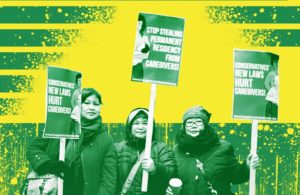
  • Caregivers and agricultural workers must have equal rights to unionize: Unions are the most effective way to ensure fairness and democracy in workplaces. Yet agricultural workers and caregivers – two industries that are rife with abuse – are excluded from the Labour Relations Act and thus have no effective way to unionize. We urge government to accept the recommendations of the Special Advisors and end these unfair exemptions.

If you would like to help improve the working conditions of migrant workers, please go to Migrant Worker Alliance for Change for resources and tool kits. Click for more information on how you can help with the Fight for $15 and Fairness. 

Migrant workers left behind in 2017 Federal Budget

Joint Release from Migrant Workers Alliance for Change and Coalition for Migrant Workers

MEDIA RELEASE

Contact:     Sharmeen Khan – Migrant Workers Alliance for Change – 1-647-881-0440

Natalie Drolet – Executive Director, West Coast Domestic Workers’ Association – 1-604-669-6452 or 1-604-445-0661

March 24, 2017, Toronto — Migrant workers and advocates are angered that the 2017 Federal Budget failed to deliver promised details on reforms to the Temporary Foreign Worker Program.  The Liberals delayed their response to a Parliamentary Committee review of the TFWP in January by promising that details would be announced in the Budget.  But the Budget offers only a handful of paragraphs that ignore migrant workers’ critical demands for open work permits, permanent residency and robust rights enforcement.  Instead, the Budget re-announces policy positions that were originally announced in December or in the Liberals’ 2015 election platform.

“The Liberals are continuing to delay while migrant workers continue to face exploitation,” says Sharmeen Khan, Coordinator of the Migrant Workers Alliance for Change. “The Budget acknowledges that migrant workers need protection for their rights to decent work and that migrant workers need access to permanent residency.  But the Budget doesn’t actually deliver any policy response to address these long-standing demands or dedicate resources to meaningful proactive rights enforcement,” says Khan.  “Migrant workers raised many important concerns in the TFWP review and the Liberals need to address them in a real way that delivers real change.”

Under the new budget, workers in the Seasonal Agricultural Worker Program and the Caregiver and Temporary Foreign Worker Programs will continue to have their work permits tied to one employer. Furthermore, the exemption to “caps” in low-wage seasonal industries means further exploitation and precarity for migrant workers in sectors such as fisheries where an unlimited number of migrant workers are only hired for 6 months on a non-renewable permit.

The Standing Committee on Human Resources, Skills and Social Development (HUMA) recommended in its 2016 review of the Temporary Foreign Workers Program that the government develop open work permits and pathways to permanent residency  for temporary foreign workers. Yet despite these clear recommendations, the Liberal government has refused to overhaul this deeply unjust and exploitative condition on Canada’s most marginalized workforce. While the government claims to continue investigating ways to developing pathways to permanent residency, no details or resources were given in the budget regarding how this work would be done.

“The vulnerability and violence we experience is a result of tied work permits,” says Gabriel Alahuda, a member of Justice for Migrant Workers. “I should be able to complain about my employer, or if needed leave and find other work without the fear of deportation. Without open work permits and permanent status, we are forced to stay in abusive working conditions.”

The Canadian government had an opportunity to rectify decades of abuse and mistreatment by ensuring that migrant workers have the same labour rights afforded to other workers. However, the failure of the government to protect this workforce reveals that the government’s priority is to maintain an exploitative and racist policy that provides a cheap, exploitable workforce for employers and disproportionately exploits workers of colour and women.
If the government is committed to building a “better future for temporary foreign workers” they must meet with migrant workers to develop direct paths to permanent residency, eliminate work permits tied to one employer and develop stronger enforcement to protect migrant workers from abuse. But so far, migrant workers and advocates have been waiting for over a year with no real commitment from the current Liberal government  to better the lives and working conditions for migrant workers.

For more information on our demands, please check go to our petition here.

Ensuring Migrant Worker Fairness

There hasn’t been a comprehensive change of labour laws in Ontario in over thirty years. So we have a once in a generation opportunity to improve rights for migrant workers.

According to the interim report just released by the Ontario government’s special advisors the cumulative costs of labour law exemptions and special rules for minimum wage, overtime pay, holiday pay, and vacation pay are associated with a potential loss of approximately $45 million to Ontario employees each week.

The report released by the special advisors proposes options for change to laws – some of the options could hurt migrant workers, and some could greatly benefit them.

The deadline for responses is October 14th. Now is the time for many of us to insist that migrant workers in Ontario must be included in all labour laws, and must be protected from reprisals and recruiter fees.

To help you do so, we have prepared a template document that you can use to draft your own recommendations. Click here to download.

You can also download a comprehensive analysis of the recommendations by Workers Action Centre and PCLS here too.

At the very least, we encourage you to send the special advisors a letter urging them to accept our recommendations. We need to show that there is a large number of groups that want decent work for migrant workers. You can download a sample letter here

Here are some of the positive options, the Special Advisors have laid out that we need to make sure end up in the final recommendation, and eventually become law:
  • Just cause protection: We can ensure that migrant workers aren’t fired without cause.
  • Migrant worker specific anti-reprisal protections: Employers can repatriate (deport) migrant workers if they complain. Only 22% of reprisals complaints go through, but the percentage for migrant workers is far lower, we can change that.
  • Proactive enforcement measures: 61% of migrant worker employers inspected in the most recent Ontario Minister of Labour blitz (June, 2016) were found to be breaking labour laws. This while Caregiver employers were not inspected at all. We can expand proactive enforcement measures.
  •  Give Agriculture workers and Caregivers collective bargaining rights
  •  At the same time, we will continue to raise our voice to call for an end to all exclusions and ask for comprehensive recruiter regulations.
 Now is the time.

Migrant Workers deserve decent work

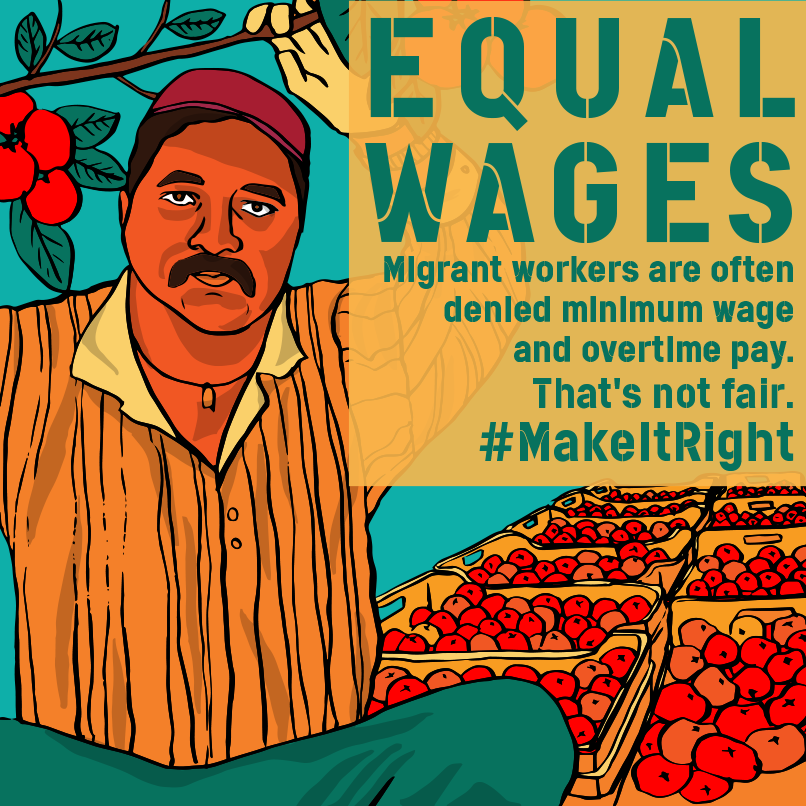
MWAC - Equal WagesDownload a flyer here and share it with your friends, and colleagues

Migrant workers are part of our communities, where they live, work, shop and build relationships.

They are not “foreigners”, they are part of Ontario’s work force, and they are part of our labour market. Their participation in our decent work movement is crucial to our ability to win.

Unfortunately, bad employers and some journalists have pitted migrant workers against unemployed and underemployed Ontario workers. But instead of fighting at the bottom of the barrel for bad jobs, we must unite to increase rights for everyone and improve all our working conditions.

Most migrant workers are in jobs that they have done for generations. Domestic workers have been coming to Canada since the 1800s, and this is the 50th year of the Seasonal Agricultural Workers Program. This isn’t about a short-term labour shortage, migrant work is permanent, and it is time they have the same rights as everyone else.

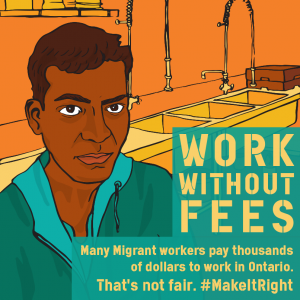
MWAC - Work Without Fees 2Migrant workers work some of the most dangerous and difficult jobs in Ontario, with some of the lowest wages and protections.

It’s no accident that many of the industries that are primarily made up of migrant workers are exempted from the Employment Standards Act. As a result, migrant workers are denied basic protections under the law, such as minimum wages, hours of work and more. When one industry is exempted from providing basic minimum standards, other employers want similar exemptions and loopholes.
This helps explain why today less than 25% of all workers are fully protected by the minimum standards in the ESA. This is a vivid example of how an injury to one becomes and injury to all.

The vast majority of Ontarians agree that we need rules that protect us all. We need specific changes in Ontario for migrant workers so that they can raise their voice and get the rights they deserve.

The Migrant Workers Alliance for Change has identified the following needed changes to Ontario’s labourMWAC - A Strong Voice laws

  1. Migrant workers deserve the same rights as everyone else. There should be no special rules and exemptions by occupation.
  1. Labour laws must be proactively enforced and community members must be able to complain about bad bosses.
  1. Migrant workers need special anti-reprisal protections including their staying in the country while their complaints are being processed.
  1. Agriculture workers and Caregivers must be able to unionize and bargain collectively and sectorally.
  1. There should be no fees for work. Recruiters need to be licenced and migrant worker employers registered. These registries need to be public. Employers and recruiters need to be jointly financially liable for all fees paid to work by migrant workers. Joint liability must include any fees paid at any point in recruitment process.

Policy Brief: Submission from CMWRC & MWAC to HUMA

Submission to the Standing Committee on Human Resources, Skills and Social Development and the Status of Persons with Disabilities

PLEASE DOWNLOAD HERE

These submissions are being jointly made by Coalition for Migrant Worker Rights Canada (CMWRC) and the Migrant Workers Alliance for Change (MWAC). CMWRC is the representative body of migrant workers in the country. Our members include Cooper Institute in Prince Edward Island, Caregiver Connections Education and Support Organization (CCESO), Migrant Worker Solidarity Network in Manitoba, Migrante Canada, Migrant Workers Alliance for Change in Ontario, Radical Action with Migrants in Agriculture in Okanagan Valley, Temporary Foreign Workers Association in Quebec, Temporary Foreign Workers Coalition in Alberta, Vancouver Committee for Domestic Workers and Caregiver Rights in Vancouver and West Coast Domestic Workers Association in Vancouver.

The Migrant Workers Alliance for Change (MWAC) includes Alliance of South Asian Aid Prevention, Asian Community Aids Services, Caregivers Action Centre, Fuerza Puwersa, Industrial Accident Victims’ Group of Ontario, Justicia for Migrant Workers, Legal Assistance of Windsor, Migrante Ontario, No One Is Illegal – Toronto, Parkdale Community Legal Services, Social Planning Toronto, South Asian Legal Clinic of Ontario, Unifor, United Food and Commercial Workers, Workers’ Action Centre and Workers United.

These recommendations have been endorsed by AIDS Committee of Durham Region, Jesuit Refugee Service, Retail Action Network BC, Refugees Welcome Fredericton, SAME Brock Chapter, MigrantWorkersRights Canada, BC Employment Standards Coalition, Migrante BC, PINAY Quebec, People’s Health Movement Canada/Mouvement populaire pour la santé au Canada, Maritimes-Guatemala Breaking the Silence Network, Migrant Worker Health Project (International Migration Research Centre), Gabriella Ontario, AAFQ (association des aides familiales du Québec/Caregivers Association of Quebec) and Inter Pares.

Re: Caregivers Program – Federal and provincial regulated companies

Letter regarding possible changes to the Caregivers Program by

  • Caregivers Action Centre (Toronto)
  • Caregiver Connections Education and Support Organization CCESO (Toronto)
  • Coalition for Migrant Worker Rights Canada (Cross-Canada)
  • Committee for Domestic Workers and Caregivers Rights
  • Gabriela (Ontario)
  • Migrant Mothers Project
  • Migrant Workers Alliance for Change (Cross-Canada)
  • Migrante (British Columbia)
  • OCASI – Ontario Coalition of Agencies Serving Immigrants (Ontario)
  • PINAY (Quebec)
  • Thorncliffe Neighbourhood Office (Toronto)
  • West Coast Domestic Workers Association (British Columbia)
DOWNLOAD HERE