Migrant Workers deserve decent work

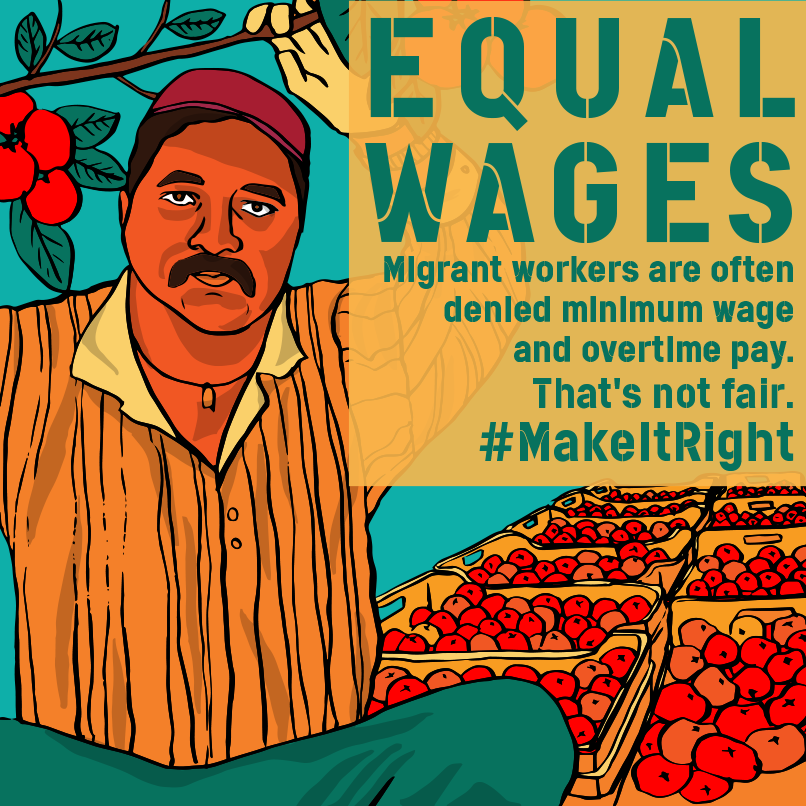
MWAC - Equal WagesDownload a flyer here and share it with your friends, and colleagues

Migrant workers are part of our communities, where they live, work, shop and build relationships.

They are not “foreigners”, they are part of Ontario’s work force, and they are part of our labour market. Their participation in our decent work movement is crucial to our ability to win.

Unfortunately, bad employers and some journalists have pitted migrant workers against unemployed and underemployed Ontario workers. But instead of fighting at the bottom of the barrel for bad jobs, we must unite to increase rights for everyone and improve all our working conditions.

Most migrant workers are in jobs that they have done for generations. Domestic workers have been coming to Canada since the 1800s, and this is the 50th year of the Seasonal Agricultural Workers Program. This isn’t about a short-term labour shortage, migrant work is permanent, and it is time they have the same rights as everyone else.

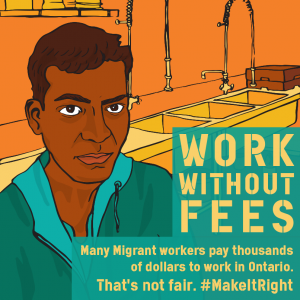
MWAC - Work Without Fees 2Migrant workers work some of the most dangerous and difficult jobs in Ontario, with some of the lowest wages and protections.

It’s no accident that many of the industries that are primarily made up of migrant workers are exempted from the Employment Standards Act. As a result, migrant workers are denied basic protections under the law, such as minimum wages, hours of work and more. When one industry is exempted from providing basic minimum standards, other employers want similar exemptions and loopholes.
This helps explain why today less than 25% of all workers are fully protected by the minimum standards in the ESA. This is a vivid example of how an injury to one becomes and injury to all.

The vast majority of Ontarians agree that we need rules that protect us all. We need specific changes in Ontario for migrant workers so that they can raise their voice and get the rights they deserve.

The Migrant Workers Alliance for Change has identified the following needed changes to Ontario’s labourMWAC - A Strong Voice laws

  1. Migrant workers deserve the same rights as everyone else. There should be no special rules and exemptions by occupation.
  1. Labour laws must be proactively enforced and community members must be able to complain about bad bosses.
  1. Migrant workers need special anti-reprisal protections including their staying in the country while their complaints are being processed.
  1. Agriculture workers and Caregivers must be able to unionize and bargain collectively and sectorally.
  1. There should be no fees for work. Recruiters need to be licenced and migrant worker employers registered. These registries need to be public. Employers and recruiters need to be jointly financially liable for all fees paid to work by migrant workers. Joint liability must include any fees paid at any point in recruitment process.

Policy Brief: Submission from CMWRC & MWAC to HUMA

Submission to the Standing Committee on Human Resources, Skills and Social Development and the Status of Persons with Disabilities

PLEASE DOWNLOAD HERE

These submissions are being jointly made by Coalition for Migrant Worker Rights Canada (CMWRC) and the Migrant Workers Alliance for Change (MWAC). CMWRC is the representative body of migrant workers in the country. Our members include Cooper Institute in Prince Edward Island, Caregiver Connections Education and Support Organization (CCESO), Migrant Worker Solidarity Network in Manitoba, Migrante Canada, Migrant Workers Alliance for Change in Ontario, Radical Action with Migrants in Agriculture in Okanagan Valley, Temporary Foreign Workers Association in Quebec, Temporary Foreign Workers Coalition in Alberta, Vancouver Committee for Domestic Workers and Caregiver Rights in Vancouver and West Coast Domestic Workers Association in Vancouver.

The Migrant Workers Alliance for Change (MWAC) includes Alliance of South Asian Aid Prevention, Asian Community Aids Services, Caregivers Action Centre, Fuerza Puwersa, Industrial Accident Victims’ Group of Ontario, Justicia for Migrant Workers, Legal Assistance of Windsor, Migrante Ontario, No One Is Illegal – Toronto, Parkdale Community Legal Services, Social Planning Toronto, South Asian Legal Clinic of Ontario, Unifor, United Food and Commercial Workers, Workers’ Action Centre and Workers United.

These recommendations have been endorsed by AIDS Committee of Durham Region, Jesuit Refugee Service, Retail Action Network BC, Refugees Welcome Fredericton, SAME Brock Chapter, MigrantWorkersRights Canada, BC Employment Standards Coalition, Migrante BC, PINAY Quebec, People’s Health Movement Canada/Mouvement populaire pour la santé au Canada, Maritimes-Guatemala Breaking the Silence Network, Migrant Worker Health Project (International Migration Research Centre), Gabriella Ontario, AAFQ (association des aides familiales du Québec/Caregivers Association of Quebec) and Inter Pares.

Re: Caregivers Program – Federal and provincial regulated companies

Letter regarding possible changes to the Caregivers Program by

  • Caregivers Action Centre (Toronto)
  • Caregiver Connections Education and Support Organization CCESO (Toronto)
  • Coalition for Migrant Worker Rights Canada (Cross-Canada)
  • Committee for Domestic Workers and Caregivers Rights
  • Gabriela (Ontario)
  • Migrant Mothers Project
  • Migrant Workers Alliance for Change (Cross-Canada)
  • Migrante (British Columbia)
  • OCASI – Ontario Coalition of Agencies Serving Immigrants (Ontario)
  • PINAY (Quebec)
  • Thorncliffe Neighbourhood Office (Toronto)
  • West Coast Domestic Workers Association (British Columbia)
DOWNLOAD HERE

Submissions to Gender Wage Gap Strategy Committee

Read in full HERE.

To understand how the gender wage gap affects women migrant workers it is important, first, to understand who women migrant workers are and what are the social dynamics that characterize their precarity in Ontario. Second, it is important to understand the legal frameworks that institutionalize their precarity in ways that very predictably leave them subject to intense gender discrimination, wage theft and other rights violations that deepen the wage gap. Third, it is important to recognize that these dynamics of systemic discrimination demand a response that is equally systemic and multi-dimensional. A wide range of changes need to be made and need to work together to eliminate the precarity that enables and sustains employer behaviour that impoverishes migrant women workers.

In the case of agricultural workers, research and anecdotal evidence from our member organizations has shown that many women participating in the program are single mothers from rural regions who have limited economic opportunities in their home communities. (Encalada Grez, 2011). In the case of domestic workers, research and anecdotal evidence from our member organizations has shown that women are single mothers, or married but in either case are primary caregivers.

Women migrant workers that we work with see labour migration as a survival strategy that provides opportunities to support themselves and their families that are impossible to access in their home contexts which are often characterized by unemployment, underemployment, underdevelopment, civil unrest and/or home governments that have actively adopted labour export policies as their dominant economic strategy. This effectively forces women into migration for work and produces a precarity that means women can be coerced into enduring profoundly discriminatory treatment because of their need to maintain the employee relationship while in Canada. Research found that women in agriculture try to keep their jobs in Canada by increasing their productivity, attempting to outperform men and sometimes acquiescing to exploitative and sub-standard working and living conditions (Encalada Grez, 2011).

While in Canada, employers exert an astonishing intrusive degree of surveillance and supervision over women migrant workers’ non-working time. This surveillance and supervision exceeds even that imposed on male migrant workers and includes imposing stricter curfews, asserting greater control over their living conditions, and controlling social interactions. Romantic relationships are sometimes explicitly prohibited via contracts, and often implicitly prohibited. Pregnancy may result in termination or preclude a worker from being invited back in to the program. Harassment and violence by male co-workers and male employers often goes unreported. Harassment and violence as a result of the joint nexus of gender, racialization, and lack of permanent immigration status in towns, cities and communities where migrant workers are is also largely unreported.

The cumulative effects of these constraints gravely impacts women migrant workers wages that are often paid below or at minimum wage, lower than both their male counterparts and Canadian citizens. As the Closing the Gender Wage Gap: A Background Paper notes, racialized women face a gender wage gap of 36.8%. Additionally, we are aware that migrant workers, most of whom are restricted to working in low-waged industries or unable to assert their rights as a result of being undocumented, earn the absolute least amount of wages. While we have not been able to do a comprehensive analysis of the wages of migrant workers vis-à-vis the broader workforce, it is certain that racialized women with temporary or no immigration status earn even less than racialized women in general.

When looking at the legal frameworks, it is clear that the gender wage gap for women migrant workers is driven by a number of systemic dynamics that subject women migrant workers to low pay and that subject them to widespread practices of wage theft and other violations of workplace rights which deepen their wage disparity and isolation in the labour market.

Read in full HERE.

MWAC Response to Ontario Immigration Act proposed regulations

Proposed Ontario Immigration Act regulations set out prescribed criteria for categories of individuals who may be eligible to receive a certificate of nomination for permanent residence. These regulation exclude migrant workers in occupations deemed low-skilled from access to Permanent Residency. MWAC believes that the Ontario Immigration Act, and future Canada-Ontario Immigration Act regulations must include access to permanent residency for migrant workers. This step should be taken in parallel to ensuring permanent resident immigration status upon arrival for migrant workers.

Read in full HERE

Migrant worker policy submissions to the Changing Workplace Review

Across Ontario migrant worker allies issued recommendations to the Special Advisors of the Changing Workplaces Review calling for swift reforms to the Employment Standards Act and the Ontario Labour Relations Act.

Download and read them here.

  • Submissions from the Migrant Workers Alliance for Change HERE
  • Submissions from Justice for Migrant Workers HERE
  • Submissions from the Caregivers Action Centre HERE
  • Submissions from Fuerza Puwersa HERE
  • Submissions from Toronto Workers Health and Safety Legal Clinic HERE
  • Submissions from Dr. Jenna Hennebry, Dr. Janet McLaughlin and Dr. Kerry Preibisch HERE
  • Submissions from Erinn Burke, Northumberland County HERE

Ontario Immigration Act – Submission to Standing Comittee

Submission by Migrant Workers Alliance for Change to Standing Committee on Justice Policy of the Legislative Assembly of Ontario

April 16, 2015

A comprehensive recruiter regulation system in Ontario requires legislation that is designed with a view to ending the practice of migrant workers paying fees to work in Ontario. Specific measures to this end include:

  1. Require compulsory licensing of all recruiters working in Ontario with a financial bond: Currently anyone can recruit migrant workers in Canada or abroad, charge them large fees, and either put them in contact with a Canadian employer or walk away without actually providing the job they promised. To counter the abuses inherent in this system, all recruiters in Ontario must be licensed, the list of licensed recruiters should be easily accessible online to migrant workers around the world, and the licensing should include a financial bond.
  2. Require compulsory registration of all migrant worker employers in Ontario: Employers choose which recruiters they work with, and are often aware of the fees being paid by migrant workers overseas or in Ontario. As such, as effective recruitment regulation process requires knowing which employers hire migrant workers in the province. Currently, Ontario depends on the federal government’s willingness to share information about employers that hire migrant workers. A compulsory and robust employer registration system is required for effective recruiter regulation.
  3. Hold recruiters and employers jointly financially liable for violating labour protections: This practice is already the law in Manitoba and other provinces and ensures that responsibility for violations is not passed to recruiters abroad. Instead, employers should be held accountable for working with appropriate recruiters (who should be licensed in Ontario) to ensure that migrant workers do not face abuse. This practice ensures predictability and certainty for employers, recruiters and migrant workers.

Click HERE to read our full submissions.

Migrants and allies “plant justice” at Immigration offices

Sunday, March 29th, 2pm
Citizenship and Immigration Canada Toronto headquarters
55 St. Clair East. 

Toronto – Over a 100 migrant workers and supporters in Toronto will be planting seedlings and food at Immigration Canada headquarters to insist that migrant workers are rooted in communities. The “plant-in”, part of actions taking place in 8 cities across the country, calls for an end to the so-called “4 and 4 rule”, and for permanent immigration status for migrant workers. A live band will accompany the planting on Sunday afternoon.

Over 3,000 people have also signed a petition.

“Many of the people who are being forcibly uprooted on April 1st have lived in the country for longer than 4 years. They have families, friends, and relationships,” says Liza Draman from the Caregivers Action Centre. “Workers already face abuse from employers and recruiters because of bad provincial and federal laws, Pulling them away from their communities on top of that is unjust, inhumane and arbitrary.”

Approximately 70,000 low-waged workers in the Temporary Foreign Workers Program and Live-In Caregiver program are impacted by the 4 and 4 regulations, which bars the renewal of work permits past four years. The clock on the first 4 years started on April 01, 2011, but many workers have been in Canada for years prior to that.

“These laws aren’t good for workers or employers,” says Syed Hussan of the Migrant Workers Alliance for Change. “It doesn’t serve anyone’s purpose to remove a trained workforce, and replace it with new workers that are less aware of their rights. Why does growing roots in Canada and holding down a job for four years result in deportation?  This mass deportation is classic economic mismanagement and is frankly irrational.”

People working low-wage jobs in service, retail, caregiving, manufacturing and agriculture among others are not able to immigrate to Canada permanently under existing federal law. At the same time, the Parliamentary Budget Officer recently noted that the number of Canadian citizens in “low-skilled” jobs has dropped by 26% between 2002 and 2013, highlighting the need for permanents immigrants in these sectors.

###

The Migrant Workers Alliance for Change (MWAC) is Canada’s largest migrant worker rights coalition with 15 national and community groups.

www.migrantworkersalliance.org

MWAC is part of the Campaign Against the 4 Year Limit on Migrant Workers which is made up of 19 organizations across Canada. Its demands have been endorsed by nearly a dozen major national groups.

www.no4and4.tumblr.com

Parliamentary Budget Officer adds note of reason to TFW debate. Time to re-focus on migrant worker needs.

Media Contact:
Syed Hussan, Cell: 416 453 3632, Email: hussans@migrantworkersalliance.org

Toronto — The Migrant Workers Alliance for Change, Canada’s largest coalition of migrant worker rights groups, is pleased with the Parliamentary Budget Officer’s (PBO) report released today entitled: Temporary Foreign Workers in Canada: A look at regions and occupational skill which adds a note of reason to debates around Temporary Foreign Workers in Canada.

“This report is resounding evidence that the hysteria around migrant workers stealing jobs from Canadian citizens is misplaced,” says Syed Hussan, Coordinator of MWAC. “In fact, there is a great need for low-skilled migrant workers to come to Canada, lay roots and settle permanently. It’s time to shift the dialogue to ensuring migrant workers are accorded rights to permanent residency by the Federal government as well as simultaneous provincial reforms where migrant workers are provided with equal access to provinicial labour rights and social entitlements The first step to this is ending the unjust 4 and 4 rule that uproots migrant workers who have worked in Canada for four years.

The PBO found:

  • At their peak, Temporary Foreign Workers make up 1.8% of the entire Canadian labour force.
  • Between 2002 and 2013, Canada’s low-skilled workforce declined by 26%
  • While low-skilled citizen workers experienced a large increase in unemployment following the recession, their number was essentially back at its pre-recession low by 2013.
  • Most low-skilled temporary foreign workers are in smaller cities where the number of low-skilled Canadian workers is often lower than the national average.
  • In general, there is insufficient data to show the relationship between foreign workers and labour shortages.

Important background:

  • The reported unemployment rate in Canada is 6.6%
  • At the end of 2013, there were over 1.3 million unemployed Canadian citizens and only 53,953 low-skilled foreign workers in the country.
  • Migrant workers pay all taxes into the system, but are denied full employment insurance, pensions; and access to subsidized housing, post-secondary education, and skills training.

Massive “Stop Mass Deportations” sign to be delivered to Joe Oliver’s office

March 4th. 1pm.
MP Joe Oliver’s Office. 511 Lawrence Ave. West.

Toronto – Migrant worker groups across Canada are speaking out against arbitrary time limits on low-waged workers. Mass deportations are expected as controversial regulations passed in 2011 start their impact on April 1st, 2015. Temporary Foreign Workers and Live-In Caregivers in low-waged jobs that have worked in Canada for four years will no longer be able to extend their permits and have to leave; those that stay will become undocumented.

“These regulations impose an artificial deadline on worker’s lives and relationships in Canada and enforce a revolving door immigration system,” says Tzazna Miranda Leal, Migrant Worker Organizer with the Migrant Workers Alliance for Change. “The fact that these workers could hold down a job for four years, working 40-60 hours a week, proves that their labor is needed and that their jobs aren’t temporary. They deserve permanent status, not deportation.”

Liza Draman, a Live-In Caregiver organizer with the Caregivers Action Centre adds, “This 4 and 4 rule is a secretive backdoor to excludep Caregivers that are raising Canadian children and taking care of seniors. Its unfair, unjust and cruel.”

Approximately 60,000 caregivers are awaiting their permanent residency because of Immigration Canada’s backlog. As a result, many Caregivers, especially those who may have troubles at work, may not be able to get their open work permits within four years and may face deportation.

Senthil Thevar worked under the Temporary Foreign Workers Program in Canada and is deeply worried about these changes. “Workers like me paid thousands of dollars to come work in Canada. We work long hours, and often don’t even get minimum wage. Now they want to keep us for just four years, and then replace us. We are not chewing gum to be chewed and spat out.”

At least 70,000 workers currently in Canada, and approximately 50,000 entering each year will be impacted.

Deena Ladd from the Workers Action Centre adds, “This is not a solution for workers, employers or the economy. Workers lives will be less stable. Employers will be able to hire a new set of workers every four years who will know less about their rights, and will have to be trained at great cost. Together, this means an economy with greater turn-over, more temporary work and fewer rights.”

Actions are also taking place in Charlottetown, Edmonton, Guelph, Hamilton, Okanagan valley, Vancouver, Victoria. See full list: http://no4and4.tumblr.com/. Over 2,000 people have signed a petition athttps://www.change.org/p/stop-the-mass-deportation-of-thousands-of-immigrants-on-april-1st

###

Source:
Migrant Workers Alliance for Change
www.migrantworkersalliance.org

Campaign Against the 4 Year Limit on Migrant Workers is comprised of migrant worker groups and organizations that work directly with migrant workers across Canada. Members as of February 21, 2015 include Fuerza Puwersa (Guelph), Migrant Workers Alliance for Change*, Migrante Alberta, No One Is Illegal – Vancouver, Radical Action with Migrants in Agriculture (Okanagan Valley) and Sanctuary City Hamilton.

*Migrant Workers Alliance for Change includes Alliance of South Asian Aid Prevention (Toronto), Asian Community Aids Services (Ontario), Caregivers Action Centre (Ontario), Industrial Accident Victims’ Group of Ontario, Justicia for Migrant Workers (Ontario), KAIROS Canada, Legal Assistance of Windsor, Migrante Ontario, No One Is Illegal – Toronto, Parkdale Community Legal Services, Social Planning Toronto, UNIFOR (Canada), United Food and Commercial Workers (Canada), Workers United and the Workers’ Action Centre (Toronto)

Endorsers of Campaign Against the 4 Year Limit on Migrant Workers

  • Canadian Labour Congress
  • Cooper Institute – PEI
  • Council of Canadians
  • MigrantWorkerRights – Canada
  • OCASI – Ontario Council of Agencies Serving Immigrants
  • OPIRG – McMaster
  • No One Is Illegal – Vancouver, Coast Salish Territories