Release: Migrant Student Workers Call for Renewable Work Permits; Ability to Work to Pay Bills & Get Permanent Residency
Toronto, March 10, 2022 – Labour, immigration and student advocates joined current and former international students (Migrant Student Workers) today to raise the alarm about challenges faced by the 778,560 migrant student workers in Canada.
“Migrant student workers in and out of school face a crisis, they can’t work more than 20 hours while on study permits even as tuition fees are high; and once they’ve graduated they can’t renew their work permits or get the few jobs that allow them to apply for permanent residency,” says Sarom Rho, organizer at the Migrant Workers Alliance for Change. “The federal government should be making their work permits renewable, removing the 20 hour work limit and ensuring permanent resident status for all, but instead they have cut in half the number of spots available to get permanent residency.”
Post-graduate work permits were made renewable in 2021 but the short-term policy change ended in July 2021 leaving thousands in the lurch.
This includes Minzi, a former international student in Toronto, and member of Migrant Students United who has been in Canada for fourteen years. “It was hard to find a job that qualifies for permanent residency because of the pandemic. I worked as a server for two years just to make ends meet, I was an essential worker who kept working when others didn’t, and now my permit is expiring and I may be forced to leave the country after all these years. Everyday I wake up with crippling anxiety, we are being exploited for economic interest, it’s almost as if we are not allowed to breathe.”
In a surprising move, the federal government slashed the Express Entry (Federal High Skilled) path from 110,500 to 55,900 spots in February for 2022 and 2023. This stream most commonly used by migrant student workers means that tens of thousands will be forced to leave Canada or become undocumented.
Jennifer Scott, President, Gig Workers United organizes app-based gig workers in the GTA, many of whom are migrant student workers. She says, “Gig workers are denied basic employment rights by our uber-rich employers, and to make matters worse, this work experience is not considered good enough to get permanent residency in Canada. Workers need to have the power to speak and protect themselves, but without permanent residency many fear asserting their rights, permanent resident status is necessary for workers to have an equal voice.”
Challenges faced by migrant student workers begin even earlier while they are still in school. Migrant student workers are also calling for removal of the 20 hour work limit.
“International tuition has gone up seven time higher than domestic tuition, even as COVID-19 has meant that families around the world have less money to support their loved ones. Migrant student workers want to work to pay the bills but are limited to 20 hour of work per week,” explained Bipin Kumar, International Students’ Commissioner, Canadian Federation of Students – National. “As a result, many students are either facing immense poverty and stress; or they are working more than 20 hours and then being exploited by bad bosses.”
Savitri Sinanan is a student at George Brown College. She says, “I’ve been doing menial jobs, earning minimum wage with no benefits or paid sick days, being abused, exploited, and disrespected by employers and employees in order to survive and pay these fees. Right now, my heart is like a freezer, I am numb to pain and I question everything. Most of the time I feel confused, frustrated, neglected, unwanted, by just existing. We should get permanent residency, or at least renewable work permits, all our work must be counted, and we should be able to work as many hours as we need to pay our bills – this is the bare minimum.”
Thousands of migrant student workers have already signed a petition directed at Prime Minister Trudeau calling for fairness: https://migrantworkersalliance.org/msufairness/.
BACKGROUND
- As of December 31, 2020, there were a total of 778,560 study permit holders and post-graduate work permit holders in Canada – making them the largest group of temporary migrants in the country.
- To qualify for permanent residence through this program, migrant student workers must complete at least 1 year of high-waged work.
- This work must be completed before their non-renewable permits expire. Permits vary in length from 8 months to 3 years.
- In 2021, in light of COVID-19, the federal government made these post-graduate work permits renewable, a move that stopped the deportation of 52,000 people but the temporary program has expired. However, with the economy just re-opening, many thousands of others have not been able to complete their requirements.
- International student tuition increased 7.25% in 2020, while domestic student tuition increased by 1.65%.
- Migrant student workers in public institutions face restrictions on their study permits and can only work 20 hours per week off-campus.
- With high tuition fees and limited income, many international students work past the 20 hour limit, forcing them to work under the table, which opens them up to labour exploitation.
- 60% of study permit holders worked and paid taxes according to StatsCan.
Media Liaison:
Sarom Rho, 416-887-8315, sarom@migrantworkersalliance.org, Migrant Students United
Advisory: Graduated International Students Sound the Alarm As Canada Slashes Immigration Program in Half
Media Advisory
Migrant Students United – Migrant Workers Alliance for Change
Graduated International Students Sound the Alarm As Canada Slashes Immigration Program in Half
Toronto – Current and former international students (Migrant Student Workers) are speaking out after Canada slashed the Express Entry program in half for 2022 and 2023. The Express Entry program is the only pathway to permanent residence for most of the 778,560 migrant student workers in Canada. To qualify, migrant student workers must have completed at least 1 year of high-waged work, which was impossible for many due to the pandemic. With half as many spots, many tens of thousands will not be able to complete the increased requirements and will be forced to become undocumented or leave the country. Immigration rules limit the number of hours that migrant student workers can work, even as COVID-19, and now the war in Ukraine, has created a global economic crisis and many migrant student worker families are unable to support them. International student tuition increased seven times more than domestic tuition in 2020. With Canada facing a labour shortage, Migrant Students Workers are calling for renewable Post-Graduate Work Permits, an end to the 20 hour work limit on study permits, and access to permanent resident status so that they can live and work in Canada with equal rights.
WHEN: 10am EST, Thursday March 10, 2022
WHERE: Online via Zoom, register in advance for the link: https://us02web.zoom.us/webinar/register/WN_nKzlovfiTPaSRMgjk7K4Ig
WHAT: Migrant Student Workers call for renewable Post-Graduate Work Permits, an end to the 20 hour work limit on study permits, and access to permanent resident status.
WHO: Jennifer Scott, President, Gig Workers United; Bipin Kumar, International Students’ Commissioner, Canadian Federation of Students – National; Syed Hussan, Executive Director, Migrant Workers Alliance for Change; and migrant student workers who are in crisis.
BACKGROUND
- As of December 31, 2020, there were a total of 778,560 study permit holders and post-graduate work permit holders in Canada – making them the largest group of temporary migrants in the country.
- The Express Entry (Federal High Skilled) path was cut down to 55,900 for 2022, down 50% from the previously announced 110,500 spots.
- To qualify for permanent residence through this program, migrant student workers must complete at least 1 year of high-waged work.
- This work must be completed before their non-renewable permits expire. Permits vary in length from 8 months to 3 years.
- In 2021, in light of COVID-19, the federal government made these post-graduate work permits renewable, a move that stopped the deportation of 52,000 people but the temporary program has expired. However, with the economy just re-opening, many thousands of others have not been able to complete their requirements.
- International student tuition increased 7.25% in 2020, while domestic student tuition increased by 1.65%.
- Migrant student workers in public institutions face restrictions on their study permits and can only work 20 hours per week off-campus.
- With high tuition fees and limited income, many international students work past the 20 hour limit, forcing them to work under the table, which opens them up to labour exploitation.
- 60% of study permit holders worked and paid taxes according to StatsCan.
What do migrants need to know about the new immigration levels plan?
PM Trudeau announced his government’s “targets” for immigration yesterday. Headlines around the world are cheering Canada’s decision to welcome 1.3 million new immigrants over the next three years.
But there is not much to celebrate for working class migrants.
Here’s what you need to know. If you have a question that is not answered below, please email us at info@migrantworkersalliance.or
- What is Immigration Level Plan?
The Immigration Level Plan is the annual targets set by Canada on the number of people that will be granted permanent resident status. It is divided into categories: economic, family and humanitarian.
- Does it include temporary residents (study permit, work permits, super visas)?
No. The Immigration Levels Plan is only for permanent residents.
- Is the Immigration Level Plan just for people in Canada?
No. The Immigration Level Plan is for permanent resident status that will be granted in 2022, 2023 and 2024 both from inside the country and outside the country.
- Is the Immigration Level Plan fixed?
No. Historically, the Immigration Level Plan has not been met. Sometimes there is more in one category than the other.
In 2021, for example, Canada created the Temporary Resident to Permanent Resident pathway. This was not part of the plan that was announced. So if we raise our voices with others like us, we can change anything.
This is just an announcement. The government must table these numbers again on November 1st of each year.
That means, if we organize and speak up, we can change this decision.
- I am an international student – what does this announcement mean for me?
Most international students apply for permanent resident status through the Canada Experience Class, or the Federal Skilled Workers Program, both of which are through the Express Entry system. The target for this has been reduced by half from previous years. This likely means that there will be fewer draws, and the CRS score required to qualify may go up.
If you are concerned about this decision, get in touch with us so we can work to change the rules. Click here to RSVP to our upcoming meeting of Migrant Student Workers.
- I am a migrant caregiver in the backlog – what does this mean for my application?
According to some reports there are over 16,000 caregiver applications in the backlog as of February 1, 2022. If you applied through the Live-In Caregiver Program or the Pilot Programs – you are included in the Pilot Program target of 10,250 – but this also includes programs for agricultural workers, refugees, and rural immigration. If you applied through the TR to PR program, you are included in the target of 40,000 (in 2022). The Interim Pathway applicants are also included in this number. The government has said that it will clear the backlog by the end of 2022. But it is unclear how that will happen considering the low target set for caregivers.
If you are a migrant caregiver concerned about this decision, Call, text, or WhatsApp us at 647-782-6633 to unite with others like you.
- I applied through the TR to PR program – what happens to me?
The government says it will process 40,000 TR to PR applications this year and another 32,000 next year. This means you may be waiting until the end of 2023 to get a decision.
If you are concerned about this, get in touch with us to take action.
> Migrant Care Workers (including healthcare): 647-782-6633
> Migrant Students: 647-858-2854
- I am a caregiver who wanted to apply through the HCCP Childcare stream but I could not because the program closed. What does this mean for me?
This announcement does not include any changes to the HCCP. That’s not fair! Many of us are waiting or cannot apply because of high requirements. Call, text, or Whatsapp us at 647-782-6633 to unite with others like you.
- I am a refugee or non-status person who worked in essential services during COVID-19, including in healthcare. Did the announcement include me?
While the Minister talked about essential workers in the media, the actual announcement does not include a clear target for essential workers.
We must organize and speak up! If you are a migrant in healthcare, call, text, or Whatsapp us at 647-782-6633 to unite with others like you.
- I am a refugee that has been waiting to have my application heard. Did the announcement include me?
There are only 24,500 spots available for refugee claimants but at the end of 2021, there were nearly 60,000 applicants in the backlog. But – Canada is not supposed to set targets for refugees. Everyone that has a valid claim should get PR.
- I am undocumented. Did the announcement include me?
The only pathway for non-status people is the Humanitarian and Compassionate application system but it has only 8,250 spots while there are over half a million non-status people in the country. Take action now, call on the federal government to ensure permanent resident status for all: https://migrantrights.ca/status-for-all/
Separated from your family? You can change that.
People across Canada will celebrate “Family Day” this month. But many migrants are either separated from our family for many years or are worried that we might be separated from them. Politicians keep making promises, but millions of migrants and families don’t have permanent resident status.
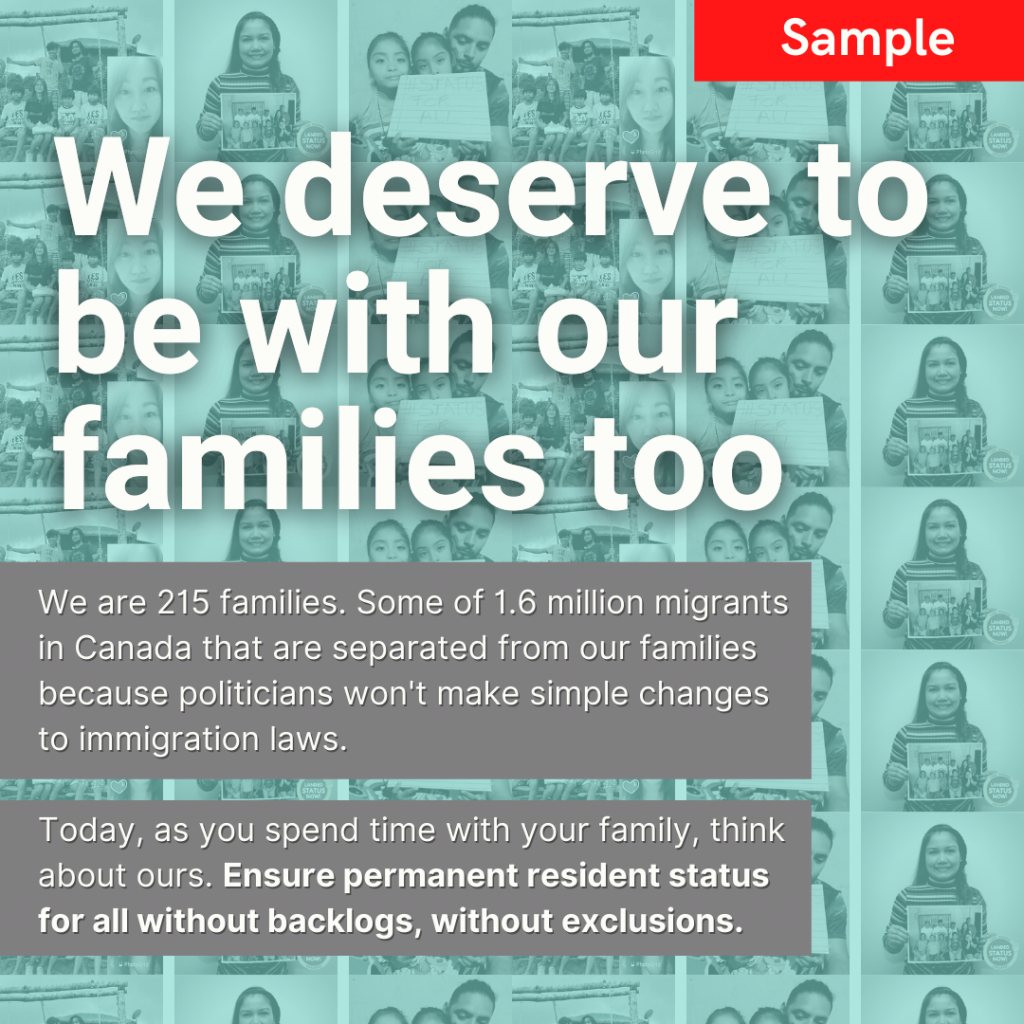
This February 21st, we will make sure that politicians cannot turn away. We at the Migrant Workers Alliance for Change will be sending every Member of Parliament (MP) a photo collage of hundreds of migrants with our families. We will be taking out ads in social media so that they have to look into your eyes and think about the laws they have made.
For this to work, you need to act. Already hundreds of migrants have sent us photos with their families, now its your turn! Send us a photo with you and your family to add to the photo letter.
By email: info@migrantworkersalliance.org
By WhatsApp: 647-858-2854
There’s no time to lose. We need your photo by February 14th so that we can get the photos to every MP by Family Day.
Here are some photos we have received already!
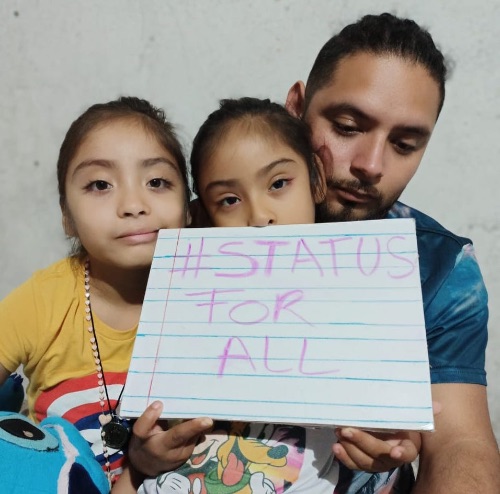
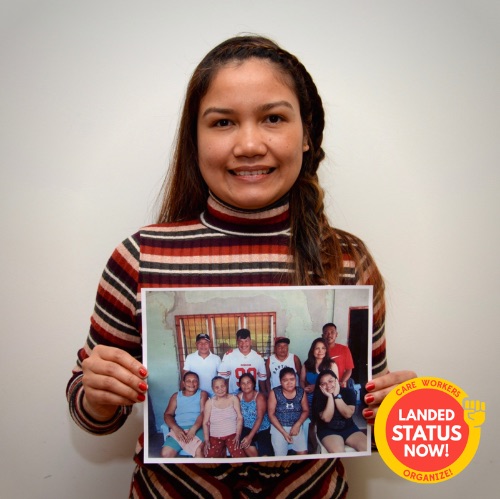

Here’s what the photo letter to MPs will look like
My permit is expired or expiring. What can I do?
Last updated January 14, 2022 – Get in touch with us for the most recent information
During COVID19, the federal government changed rules around restoration of status because migrants like you organized! There was an extension of the restoration period, which meant that migrants who had valid status on or before January 2020 could apply for restoration until August 31, 2021.
Now, the extension has ended and you only have 90 days after your permit expires to apply for restoration. For many of us, 90 days have already passed since we lost status, and we cannot apply. That’s not fair.
If you are in this situation, you are not alone! Contact us so we can discuss your options and continue to organize for changes to immigration rules.
Can I apply for a Bridging Open Work Permit?
A bridging open work permit (BOWP) lets us continue to work while waiting on a decision on our permanent residence applications. Previously, migrants could apply for BOWPs only if our permits were set to expire within four months.
Now, the four month rule has been removed, and you can apply for a BOWP if you meet the eligibility requirements. Click here for more information.
If you cannot apply for a BOWP or have questions, contact us!