What do I need to know about HCCP & HSWP if I am a refugee or undocumented?

The Home Child Care Provider Pilot (HCCP) and Home Support Worker Pilot (HSWP) are temporary pathways to permanent residency for temporary residents who have provided in-home care to children or the elderly and/or people with disabilities.

There are two categories you can apply under for HCCP and HSWP: 

  1. Direct to permanent residency category
  • This option is for temporary migrants who gathered the required work experience in in-home care to children, the elderly and/or people with disabilities while on valid temporary work authorization. 
  • That means work experience while you were a refugee claimant without temporary status or undocumented cannot be counted. 
  1. Gaining work experience category
  • This option is for temporary migrants who have not gathered the required work experience yet, but have a job offer with an employer to provide in-home care to children, the elderly and/or people with disabilities. You must maintain your valid immigration status while waiting for a decision on your HCCP or HSWP application. 
  • If you have a pending refugee application, you may have valid status, but make sure to get legal help to verify this. If your refugee application has been denied, you do not have valid status. If you lose temporary status or receive a negative decision on your refugee claim while waiting for a decision on your HCCP or HSWP application, your application may be denied unless you restore your immigration status.

Can refugee claimants or undocumented people apply under HCCP or HSWP?

  • If you are a refugee claimant with valid temporary status and a job offer in in-home care for children, the elderly and/or people with disabilities – and you meet all the other criteria – technically you can apply. But make sure you meet all the criteria first! Read below for more information!
  • Because you must maintain temporary status throughout the application process, you cannot apply if you do not have temporary status, are undocumented, your refugee claim was denied, you are appealing at the RAD or under judicial review, or you have or are waiting for a removal order.

What type of work experience do I need to have or get to be eligible to apply for HCCP or HSWP?

Direct to permanent residency category

You must have completed two years (at least 30 hours per week) of valid, full-time work experience in the last three years as an in-home care worker to children, the elderly and/or people with disabilities. 

This means work in a hospital, nursing home or long-term care home does not count. However, if you are hired by an agency to provide care to one or multiple clients inside their house or residence, this work can be counted.

“Valid” means you did this work while on temporary status or with temporary work authorization (i.e. the work permit as a refugee claimant does not count because it is not considered to be valid temporary status).

Gaining work experience category

If you have a job offer from an employer for in-home care with children, the elderly and/or people with disabilities, they must complete this form: https://www.canada.ca/content/dam/ircc/documents/pdf/english/kits/forms/imm5983e.pdf. After this form is completed, you can use it to apply for an industry-specific work permit under HCCP or HSWP, so that you can complete the two years of work experience required to apply for permanent residency. 

What other requirements do I need to have to apply for HCCP or HSWP?

  • Outside of Quebec: You must declare that you will not live in Quebec if you get permanent residency.
  • Ability to do the job: You must show you have relevant work experience or training as a home child care provider (nanny, babysitter, live-in caregiver providing child care) or a home support worker (attendant for persons with disabilities, live-in caregiver for seniors, personal care attendant, home support worker). These jobs are described under the National Occupation Classification (NOC) code 4411 and 4412 under NOC 2016, or 44100 and 44101 under NOC 2021.
  • Education accreditation: You must provide proof of at least 1 year Canadian post-secondary education or its equivalent.
    • If you did not study in Canada, you must get an Educational Credential Assessment (ECA) from an approved organization to see if your completed degree, diploma or certificate from back home is equivalent to 1 year of post-secondary education in Canada.
  • Language test: You must provide valid English or French language test scores for a minimum of CLB Level 5. The test results must be valid and less than two years old. Read more here.
    • Any migrant with valid identification, including refugee claimants, can take the IELTS or CELPIP test. Just type “IELTS or CELPIP test centres” in google, find the closest location to you, and book your test online. The cost for each test is usually around $300!

Is there a cap or limit to how many applications IRCC will receive per year under HCCP and HSWP?

  • Yes. HCCP and HSWP programs have only 2,750 spots EACH per year, and this year they broke it down into these categories:
    • Gaining experience category:
      • 1,650 applications, including 1,500 online applications & 150 alternate format applications
    • Direct to permanent residence category:
      • 1,100 applications, including 1,000 online applications & 100 alternate format applications
  • Once IRCC receives 2,750 applications in a year, they stop accepting more applications. This is not fair!

Is this a new program?

  • The HCCP and HSWP programs were created in 2019. It was created because migrant workers like you in Migrant Workers Alliance for Change (MWAC) campaigned under the call of “Landed Status Now”. 
  • But these temporary programs have existed in one way or another since the 1950s making it the longest running temporary foreign worker program in Canada. We have been fighting to improve it, and were successful at making partial changes before. But now the increased requirements, including the education accreditation and language tests, have blocked many of our care worker members on work permits from being able to apply – just like what many of you are going through right now!
  • We must continue to fight for regularization and status for everyone, and make sure no one is excluded because of racist and discriminatory requirements like English skills, education or caps!

MWAC Solidarity & Holiday Party

Join us on Sunday, December 18, 2022 from 12pm to 4pm in Toronto to celebrate our unity, solidarity and victories together! We will have food, fun, and games. Feel free to also bring your own favourite dishes to share with others.

PLEASE NOTE: This event is only for MWAC members, families and friends. Space is limited, sign up now!

Online Migrant Meeting: What happened in Ottawa & What’s next?

On Saturday, November 26, 2022, join online to hear from Migrant Workers Alliance for Change members who recently went to Ottawa to demand regularization and status for all!

ONLINE AT 7PM TO \ 4PM VAN on Zoom: Watch and listen live to the migrant leaders themselves! A Zoom link will be sent by email after you register below.

Migrant Care Workers: What immigration rules do you want changed? Fill out our survey!

Create your own user feedback survey

New Parliament, Same Crisis: Tell your MP the Crisis is Now!

A new parliament starts in Ottawa this week. Yesterday, the federal government laid out its priorities for the next year including increasing immigration levels, reducing wait times, and family reunification. But they failed to mention how migrants like us are living and working in crisis right now without permanent residency. 

From December 3-5, migrant groups from across the country will be organizing meetings, postering offices, holding rallies, caravans, and public outreach events at Member of Parliament offices. Our message is clear: We live here. Our crisis must be a priority. Click below to sign up for an action near you!

I want to join an action near me on Dec 3-5!

I want to join an action in Toronto on Dec 5!

Migrants are in crisis. In British Columbia, our fellow migrant farmworkers have been displaced due to flooding. Many are being temporarily housed in shelters, while others have yet to be evacuated. Because farmworkers are on employer-specific work permits, they are unable to find other work or access EI benefits. Their lives and livelihoods are at serious risk. 

For us care workers, we know how it feels to be suddenly displaced without a place to live and unable to access work or benefits because of our closed work permits. We are tired of going through crises after crises! We demand full and permanent immigration status for all now! Join an action near you from December 3rd to the 5th:  https://migrantrights.ca/decmpactions/

Raise your voice for migrant rights during this federal election

On September 20, Canadian citizens will vote for representatives. These representatives, called Members of Parliament, will decide laws that impact the lives of 1.6 million migrants like us. 

Migrant farmworkers, care workers, students, refugees and undocumented people cannot vote on September 20th. But there are a lot of things we can do and should do.

Between now and September 20th, Canadians are debating the future of this country. This is why now is an opportunity for migrants to raise our demand for full and permanent immigration status for all.

The Migrant Rights Network is organizing actions you can join: 

  • Want to put up posters and talk to neighbours as a group? Join Migrant Rights Network actions if you are nearby:
  1. ST. CATHARINES: Sunday, September 5th, Skyzone plaza on Ontario St. The politician in this seat is Chris Bittle, a Liberal. For many years farmworkers have been going to him (check out these photos).
  2. TORONTO: Sunday, September 12th, 12pm at Eglinton Park (Eglinton Ave W and Lascelles Blvd). The politician in this seat is Marco Mendicino, the Minister of Immigration. Look at the last time we did an action there.
  3. BRAMPTON: Sunday, September 12th, 4pm at Brampton Public Library, Four Corners Branch (Queen St. E and Main St. S). The politician in this seat is Sonia Sidhu, a Liberal. 

No matter who wins on September 20th, our job stays the same. We have to get as many migrant care workers as possible to unite together as one organization so that no one can treat us unfairly. Together, we will win!

We marched to Ottawa to demand our rights!

On July 25, almost 1000 migrant care workers, farmworkers, migrant students, undocumented people, refugees and supporters united and marched on the streets of Ottawa to demand full and permanent immigration status for all. See below for photos of this historic moment!

8-0

Watch this Global TV coverage where migrants bravely speak about why we need status now!

We were also featured in the CBC NewsCanadian PressCapitol CurrentRadio CanadaJournal de MontréalLe DroitLa PresseTVA Nouvelles, and Ming Pao.

We went to Ottawa to make it loud and clear for Prime Minister Trudeau that we want our rights NOW! Permanent immigration status means that we have access to equal rights like everyone else. It means we can leave our employers if being abused or are able to study in school. It also means we can reunite with our families! 

We know that when migrant care workers come together, we have the power to make change. And with the federal election around the corner, we must be ready to raise our voices and demand that the government do more. Sign this petition to make sure your voice is heard!

TR for PR program closes after only 10 weeks. Here’s what to do next!

After just 10 weeks of opening, the new TR for PR program for Essential Workers (Stream B) officially closed on Thursday, July 15. This means that many of us who were trying to get our applications together to apply on time, are now shut out. 

While many of us are upset, now is the time to connect with other migrant workers and speak up! In 2019, migrant care workers won the Interim Pathway Program, but it closed after being open for only three months. So care workers, like you, continued to demand more and the Interim Pathway was reopened. At that time, the Minister of Immigration said the program was only extended because care workers spoke up. Do you want to speak up with other migrant care workers? Contact us at 647-782-6633 and we will connect you.


Here’s what to do next!  

Did you already apply under the TR for PR program? You may be eligible for a bridging open work permit. Applications and more information will be shared by the government on July 26, 2021 and we will let you know. 

Did you apply for PR previously and are waiting for a decision? The federal government has promised to process 6,000 applications this year, and another 6,000 next year. 

Are you a child care worker? You will be able to apply for permanent residency under the Home Child Care Provider pilot program when it reopens on January 1, 2022, if you meet all the requirements.  

Are you an elderly care worker? You can apply under the TR for PR program: Essential Worker (Stream A) or under the Home Support Worker Program pilot program, if you meet all the requirements. 

Are you non-status? You may be eligible for permanent resident status under the Humanitarian and Compassionate application process. 

If you have more questions, contact our free, confidential hotline at 647-782-6633!


SPEAK UP!

For many of us these options aren’t good enough. We are tired of waiting. We don’t want to be separated from our families. We don’t want to be exploited. The language tests and educational requirements are simply too difficult. We work here, we live here, we deserve equal rights and permanent immigration status for all. 

Here’s what you can do immediately:

  1. Sign this petition to demand: www.landedstatusnow.ca
  2. Leave a message for Prime Minister Justin Trudeau RIGHT NOW and demand that he give full and permanent immigration status for ALL! https://migrantrights.ca/callforstatus/

Click here to watch a video of Care Worker Yamz calling the PM Trudeau and leaving a message!


We are going to Ottawa! Watch us live this Sunday, July 25 at 2pm as migrants take to the streets in Ottawa to demand Status for All! Join the livestream on Facebook @MigrantRightsCA

66 years of organizing and winning!

Migrant domestic workers have been coming to Canada without full immigration status – which means without full rights – since 1955. We have been exploited and excluded for 66 years. But it also means we, and the care workers before us, have been organizing and winning for 66 years! 

Today on International Domestic Workers Day, we reflect on the history of migrant care worker organizing: 

  • Black Caribbean women, along with many other workers, led the fight to create a path to permanent residence (PR) for migrant care workers in the 1980s. 
  • In the 1990s, workers’ struggles forced the removal of a number of exclusionary requirements, but care workers were forced to live in employer homes.
  • In 2010, migrant care workers won the Juana Tejada law, removing the requirement for a second medical exam to get PR. 
  • In 2014, migrant care workers won an end to the live-in requirement. But a cap of 2,750 per year was put on PR applications, and unfair requirements for English and education were put in place. 
  • In 2017, migrant care workers led the fight to remove medical inadmissibility rules, which led to them being significantly reduced, though they remain in place. 
  • In 2019, migrant care workers won an Interim Pathway to allow many workers in Canada to get PR without the exclusionary requirements introduced in 2017. 
  • And during COVID-19, migrant care workers are organizing across the country for vaccine access, mobility and immigration and labour rights.

WE hold up the Canadian economy – temporary foreign workers like all of us make up 10% of private household workers in Canada. Thousands of undocumented mostly racialized women are doing in-home domestic work, and even more are working in long-term care homes and as personal support workers. 

But unfair immigration rules push us into abusive jobstie us to our employers for health care and housing; restrict us from being able to study freely; put us at risk of exploitation from recruiters and consultants, and for deportation; and separate us from our families for YEARS! 

We know the rules only change if migrant care workers come together and fight for our rights. Join us!

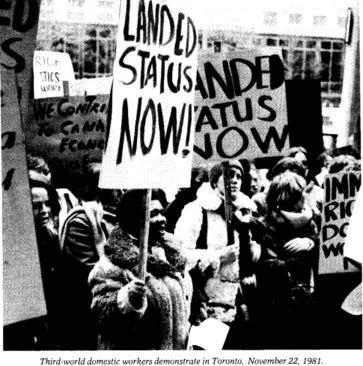
November 22, 1981: Care Workers from the Philippines, Caribbean and the UK gather in a protest of thousands in downtown Toronto. Four days later, on November 26, then-Immigration Minister Lloyd Axworthy, bowing to nearly a decade of mobilizing by immigrant women, created a path for domestic workers to gain permanent residency.