Watch this video about our right to free movement.
Have questions? Send us a WhatsApp message: 905-324-2840
United, we are stronger!
Watch this video about our right to free movement.
Have questions? Send us a WhatsApp message: 905-324-2840
United, we are stronger!
We took action for Full and Permanent Immigration Status for All!
Have questions or need support? Send us a WhatsApp message: 905-324-2840
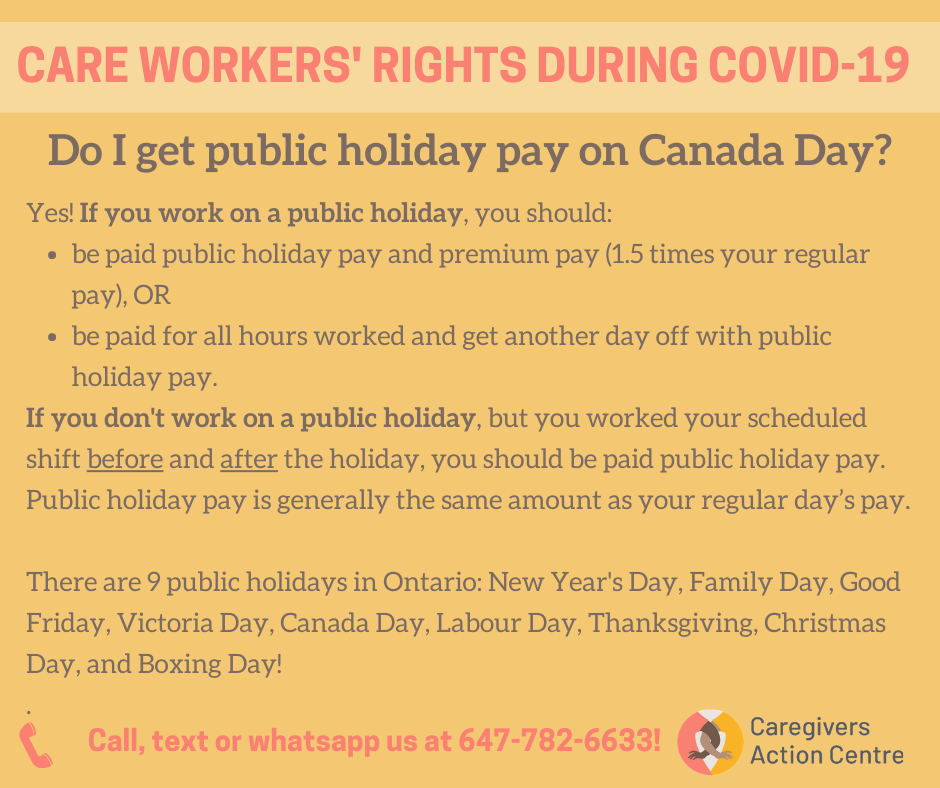
Is the first Monday in August a PUBLIC holiday in Ontario? No, the first Monday in August is a CIVIC Holiday in Ontario. This means that under the Employment Standards Act, Ontario employers are NOT required to offer paid vacation on a Civic Holiday. Read below for more information!
 SHARE this post with your friends and other Care Workers!
JOIN our friends at the Fight for $15 & Fairness on August 11th for a cross-country phone ZAP where we will ALL call Prime Minister Trudeau, cabinet ministers, and MPs to demand fairness at work and #incomeforall! Sign up here: https://www.15andfairness.org/phone_zap_aug11_2020
If you are a Care Worker with questions about your rights, call, text or WhatsApp the Caregivers’ Action Centre at (647) 782-6633. 
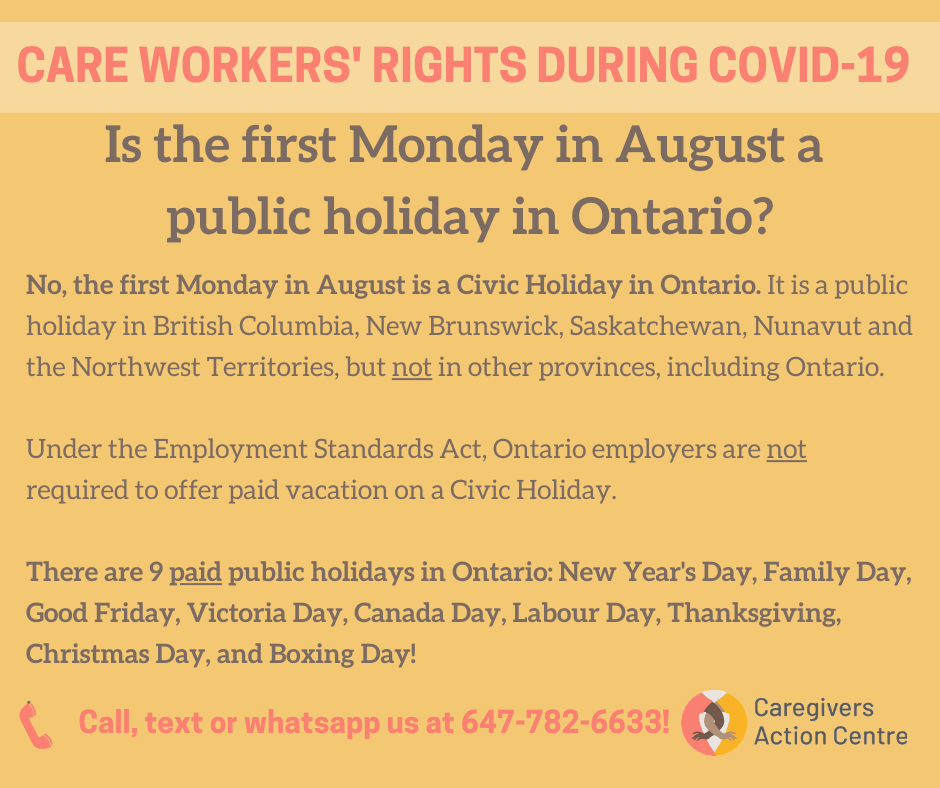
If I’m applying for temporary residence in Canada, do I have to give my biometrics? No! Read more below!
This new policy applies to you if you are applying for:
– an extension of a work permit, or a new work permit
– an extension of a study permit, or a new study permit
– a visitor visa, or a visitor record to allow you to stay in Canada as a temporary resident
– restoration (extension) of temporary resident status, or a temporary resident permit
 IMPORTANT INFORMATION
 DO NOT pay the biometric fee, even if IRCC’s online system asks you to pay it when you submit your application.
  If you do pay the biometric fee and you receive a biometric instruction letter, you DO NOT have to give your biometrics if you’re in Canada and applying for temporary residence. A refund will be given to you later.
 Read here for more information: https://www.canada.ca/…/biometrics-exemption-temporary…
If you are a Care Worker with questions about your rights, call, text or Whatsapp the Caregivers’ Action Centre at (647) 782-6633!
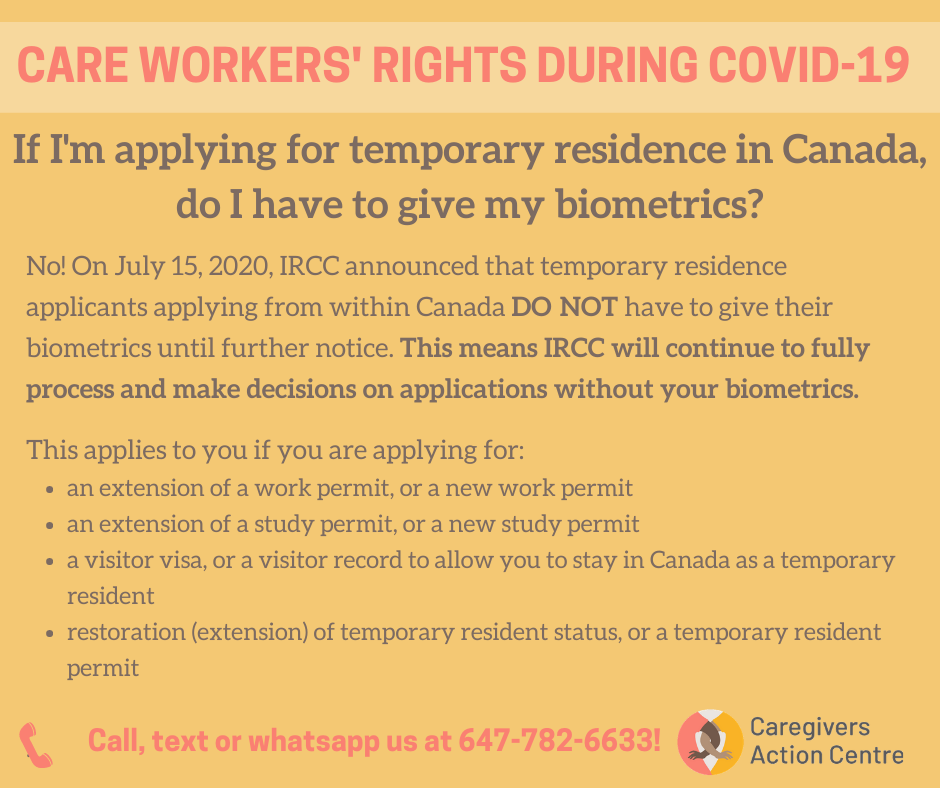
Do I get public holiday pay on Canada Day? Yes! Read more below!
SHARE this post with your friends and other Care Workers!
JOIN US on Saturday, July 4th at 3pm for an in-person #StatusForAll rally outside Minister Immigration Mendocino’s office! Facebook event: https://www.facebook.com/events/586168448996016/
If you are a Care Worker with questions about your rights, call, text or WhatsApp the Caregivers’ Action Centre at (647) 782-6633.
Since the 1800s, racialized women have been coming to Canada to raise children and take care of the sick and elderly. Despite being the backbone of the economy, Care Workers are treated like we are temporary! COVID-19 has shown that without the essential work of Care Workers, Canadian society does not function. Care Workers are humans too, we deserve respect and dignity!
We demand FULL & PERMANENT immigration status for ALL! STATUS FOR ALL means:

Status for All is NOT the same as a “pathway to permanent residency”. Care Workers already have a pathway to permanent immigration status, but because of unfair English language and education requirements, many of us cannot apply for it and will lose our immigration status! We need FULL immigration Status for All NOW!
Care Workers are joining with farmworkers, refugees, migrant sex workers, international students, undocumented people and all migrants to call for Status for All. At least 1 in 23 people in Canada (over 1.6 million) are non permanent residents. We are building a migrant justice movement. Together, we are stronger!
While fighting for Status For All, we also demand for:
Our communities cannot wait! Click here to sign our petition for landed status now!
MEDIA RELEASE
Media Contact: Sarom Rho, 647-858-2854, Migrant Students United; Geneviève Charest, g.charest@cfs-fcee.ca, Canadian Federation of Students
Ottawa & Toronto, April 30, 2020 – Migrant Students United, a cross-Canada organization of international students, and the Canadian Federation of Students, Canada’s largest and oldest national student organization, are calling on Prime Minister Justin Trudeau to expand income supports, including the Canada Emergency Response Benefit (CERB) and the Canada Emergency Student Benefit (CESB) to all students, regardless of immigration status or active Social Insurance Number (SIN). Migrant students have taken to social media today calling for emergency supports, using #MigrantStudentsUnited. Follow students speaking out online by clicking here.
“Approximately 1 in 5 postsecondary students in Canada are migrants and excluding them from the CESB is unfair and puts many of these students at risk of hunger and homelessness. We urge the federal government to extend the CESB and CERB to all migrant students, including those without valid SIN or stuck outside the country, and ensure $500 per week in income supports,” says Sarom Rho, Coordinator of Migrant Students United.
“Welcoming students into Canada must be paired with the necessary support mechanisms to ensure that their health, safety, and income security are being prioritized; that is the responsible thing to do. Most importantly, migrant students are people, just like anyone else, who feel scared at a time of uncertainty and who are being overlooked by the government,” said Sofia Descalzi, National Chairperson of the Canadian Federation of Students.
BACKGROUND
MEDIA RELEASE
MIGRANT STUDENTS UNITED
Contact: Sarom Rho, Migrant Students United Organizer, 647-858-2854, sarom@migrantworkersalliance.org
A million students potentially excluded from emergency income support
Toronto, April 22, 2020 – Migrant Students United is calling on the federal government to expand Canada Emergency Student Benefit (CESB) and Canada Emergency Response Benefit (CERB) to migrant students. Already, CERB is inaccessible to migrants without a valid Social Insurance Number, which impacts hundreds of thousands of students who cannot renew their work or study permits because of COVID-19 related delays. Now CESB seems to excludes migrant students on a study permit. Over 7,000 migrant students have signed a petition for income supports, worker protections, healthcare and permanent resident status on arrival.
“Approximately 1 in 5 postsecondary students in Canada are migrants. Excluding them from emergency income supports is unfair. In a pandemic, it is a public health imperative to ensure everyone can stay at home safely, but if migrant students are left out, they are forced to work or face hunger and homelessness. Migrant students pay incredibly high tuition fees and are in the country without their families – they need more support, not less. Everyone, regardless of immigration status must get income supports!” – Sarom Rho, Organizer, Migrant Students United!
BACKGROUND
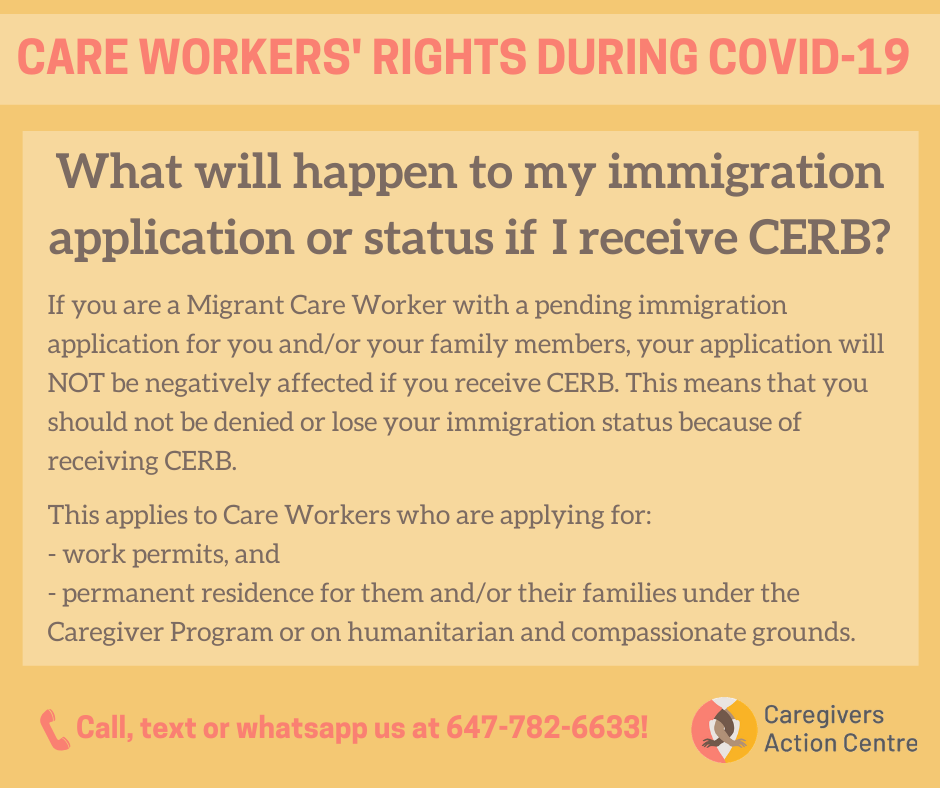
Care Workers, receiving CERB will not affect your immigration application or immigration status. Read below for more information!
SHARE this post with your friends and other Care Workers!
JOIN US on Sunday, May 3rd at 1pm for our first online social, Care Workers Connect during COVID-19, to learn more about how to make your voices heard!
If you are a Care Worker with questions about your rights, call, text or WhatsApp the Caregivers’ Action Centre at (647) 782-6633.
Watch this update about how much you should be paid during quarantine.
Have questions or need support? Send us a message on WhatsApp: 905-324-2840