Please wait a moment for the petition to load, enter your contact details and hit Send Message
Job Posting: Outreach Workers, Migrant Students United
Migrant Workers Alliance for Change (MWAC) is a member-led organization that is building racialized, low-waged, worker power to win migrant justice. Our areas of focus include current and former international students in low-waged work through our Migrant Students United campaign (MSU).
We are seeking two outreach workers to join the MSU team. Outreach workers will make contact with migrant student workers in the Greater Toronto Area, and bring them into the MSU campaign so they can be part of winning changes to immigration and labour policy.
We are no longer accepting applications for this position.
Sigamos luchando por justicia migratoria durante las elecciones federales
El 20 de septiembre, los ciudadanos canadienses votarán por representantes. Estos representantes, llamados miembros del Parlamento, decidirán las leyes que impactarán la vida de 1.6 MILLONES de migrantes como nosotros.
Trabajadores agrícolas migrantes, trabajadores cuidadores, trabajadores estudiantes, refugiados y las personas indocumentadas no pueden votar el 20 de septiembre. Pero hay muchas cosas que podemos y debemos hacer.
Desde ahora hasta el 20 de septiembre, los canadienses están debatiendo el futuro del país. La Red de Derechos de l@s Migrantes cree que esta es una oportunidad para que los migrantes elevemos nuestra demanda de Estatus Migratorio Completo y Permanente para Tod@s.
Acciones organizadas por La Red de Derechos de l@s Migrantes a las que puede unirse:
- Haga clic aquí para enviar un correo electrónico a los partidos políticos ahora mismo Puede agregar su propia historia o comentarios sobre porque la justicia es importante para usted.
- Es importante lograr que los canadienses presionen a los políticos para que apoyen los derechos de los migrantes. Haga clic aquí y le enviaremos volantes y carteles que pegue en postes o fuera de las áreas electorales, o le daremos información a sus vecinos.
- ¿Quiere pegar carteles y hablar con los vecinos en grupo? Únase a las acciones de la Red de Derechos de l@s Migrantes si está cerca:
- ST. CATHARINES: Domingo, 5 de septiembre, Skyzone plaza en Ontario St. El político en este asiento es Chris Bittle, un liberal. Durante muchos años los trabajadores agrícolas han estado acudiendo a él. (ver fotos aquí).
- TORONTO: Domingo 12 de septiembre a las 12 pm en Eglinton Park (Eglinton Ave W y Lascelles Blvd). El político en este asiento es Marco Mendicino, el ministro de migración. Mira la última vez que hicimos una acción allí.
- BRAMPTON: Domingo 12 de septiembre a las 4 pm en la biblioteca pública de Brampton, sucursal de Four Corners (Queen St. E y Main St. S). La política en este asiento es Sonia Sidhu, una liberal.
No importa quién gane el 20 de septiembre, nuestro trabajo sigue siendo el mismo. Tenemos que conseguir que la mayor cantidad posible de trabajadores agrícolas migrantes se unan como una sola fuerza para que nadie pueda tratarnos injustamente. ¡Unid@s somos más fuertes!
Raise your voice for migrant rights during this federal election
On September 20, Canadian citizens will vote for representatives. These representatives, called Members of Parliament, will decide laws that impact the lives of 1.6 million migrants like us.
Migrant farmworkers, care workers, students, refugees and undocumented people cannot vote on September 20th. But there are a lot of things we can do and should do.
Between now and September 20th, Canadians are debating the future of this country. This is why now is an opportunity for migrants to raise our demand for full and permanent immigration status for all.
The Migrant Rights Network is organizing actions you can join:
- Click here to send an email to all political parties right now. You can add your own story or comments about why fairness is important to you.
- It’s important to get Canadians to push politicians to support migrant rights. Click here and we will send you flyers and posters that you tape up on poles or outside election areas, or give information to your neighbours.
- Want to put up posters and talk to neighbours as a group? Join Migrant Rights Network actions if you are nearby:
- ST. CATHARINES: Sunday, September 5th, Skyzone plaza on Ontario St. The politician in this seat is Chris Bittle, a Liberal. For many years farmworkers have been going to him (check out these photos).
- TORONTO: Sunday, September 12th, 12pm at Eglinton Park (Eglinton Ave W and Lascelles Blvd). The politician in this seat is Marco Mendicino, the Minister of Immigration. Look at the last time we did an action there.
- BRAMPTON: Sunday, September 12th, 4pm at Brampton Public Library, Four Corners Branch (Queen St. E and Main St. S). The politician in this seat is Sonia Sidhu, a Liberal.
No matter who wins on September 20th, our job stays the same. We have to get as many migrant care workers as possible to unite together as one organization so that no one can treat us unfairly. Together, we will win!

We marched to Ottawa to demand our rights!
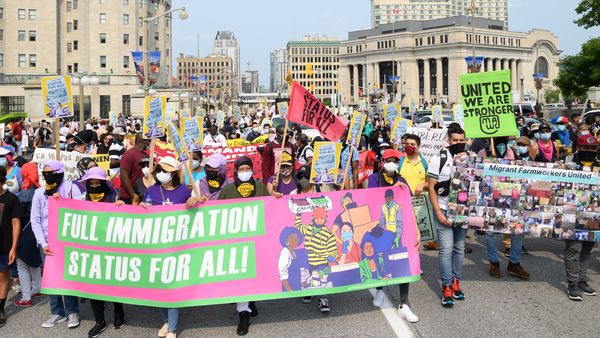
On July 25, almost 1000 migrant care workers, farmworkers, migrant students, undocumented people, refugees and supporters united and marched on the streets of Ottawa to demand full and permanent immigration status for all. See below for photos of this historic moment!


Watch this Global TV coverage where migrants bravely speak about why we need status now!

We were also featured in the CBC News, Canadian Press, Capitol Current, Radio Canada, Journal de Montréal, Le Droit, La Presse, TVA Nouvelles, and Ming Pao.
We went to Ottawa to make it loud and clear for Prime Minister Trudeau that we want our rights NOW! Permanent immigration status means that we have access to equal rights like everyone else. It means we can leave our employers if being abused or are able to study in school. It also means we can reunite with our families!
We know that when migrant care workers come together, we have the power to make change. And with the federal election around the corner, we must be ready to raise our voices and demand that the government do more. Sign this petition to make sure your voice is heard!
TR for PR program closes after only 10 weeks. Here’s what to do next!
After just 10 weeks of opening, the new TR for PR program for Essential Workers (Stream B) officially closed on Thursday, July 15. This means that many of us who were trying to get our applications together to apply on time, are now shut out.
While many of us are upset, now is the time to connect with other migrant workers and speak up! In 2019, migrant care workers won the Interim Pathway Program, but it closed after being open for only three months. So care workers, like you, continued to demand more and the Interim Pathway was reopened. At that time, the Minister of Immigration said the program was only extended because care workers spoke up. Do you want to speak up with other migrant care workers? Contact us at 647-782-6633 and we will connect you.
Here’s what to do next!
Did you already apply under the TR for PR program? You may be eligible for a bridging open work permit. Applications and more information will be shared by the government on July 26, 2021 and we will let you know.
Did you apply for PR previously and are waiting for a decision? The federal government has promised to process 6,000 applications this year, and another 6,000 next year.
Are you a child care worker? You will be able to apply for permanent residency under the Home Child Care Provider pilot program when it reopens on January 1, 2022, if you meet all the requirements.
Are you an elderly care worker? You can apply under the TR for PR program: Essential Worker (Stream A) or under the Home Support Worker Program pilot program, if you meet all the requirements.
Are you non-status? You may be eligible for permanent resident status under the Humanitarian and Compassionate application process.
If you have more questions, contact our free, confidential hotline at 647-782-6633!
SPEAK UP!
For many of us these options aren’t good enough. We are tired of waiting. We don’t want to be separated from our families. We don’t want to be exploited. The language tests and educational requirements are simply too difficult. We work here, we live here, we deserve equal rights and permanent immigration status for all.
Here’s what you can do immediately:
- Sign this petition to demand: www.landedstatusnow.ca.
- Leave a message for Prime Minister Justin Trudeau RIGHT NOW and demand that he give full and permanent immigration status for ALL! https://migrantrights.ca/callforstatus/
Click here to watch a video of Care Worker Yamz calling the PM Trudeau and leaving a message!

We are going to Ottawa! Watch us live this Sunday, July 25 at 2pm as migrants take to the streets in Ottawa to demand Status for All! Join the livestream on Facebook @MigrantRightsCA.