Do you get paid minimum wage? Check to see if your wage goes up today

Minimum wages increased in Ontario on October 1, 2024. You should see $17.20/hour in your next two weeks of pay. See the wages in other provinces below. 

Check your pay stub to make sure you are getting paid the right amount for all the hours you work. If not, call us!

Migrant Care Workers:  416-897-4388
Migrant Student Workers:  647-858-2854
Migrant Fishery Workers: 506-251-7467
Migrant Farm Workers (ENG):  905-324-2840
Trabajador@s Agrícolas (ESP):  647-807-4722
Undocumented Workers: 647-782-6633

In 2019, Ontario Premier Ford cancelled a $15 minimum wage. The minimum wage only went up because workers like you demanded it!  

But minimum wage is not enough to live on. Some workers aren’t even allowed to get the minimum wage. You and your co-workers deserve more! Call us to join with others to improve wages for yourself and others.

Updated since Dec 13, 2024

ProvinceMinimum Hourly WageSince
Alberta$15.00October 1, 2018
British Columbia$17.40June 1, 2024
Manitoba$15.80October 1, 2024
New Brunswick$15.30April 1, 2024
Newfoundland & Labrador$15.60April 1, 2024
Northwest Territories$16.70September 1, 2024
Nova Scotia$15.20April 1, 2024
Nunavut$19.00January 1, 2024
Ontario$17.20October 1, 2024
Prince Edward Island$16.00October 1, 2024
Quebec$15.75May 1, 2024
Saskatchewan$15.00October 1, 2024
Yukon$17.59April 1, 2024

Release: Damning report by the Auditor General shows that Canada failed to protect migrant farmworkers despite warnings

Media contact: Syed Hussan, hussan@migrantworkersalliance.org, 416-453-3632

All migrants need permanent resident status now to protect themselves

Toronto, December 9, 2021 — “Since the pandemic hit, we have warned of the crisis facing migrant farm workers because they are denied permanent immigration status and therefore cannot assert the few rights they have, or complain about their crowded housing and dangerous working conditions. We have denounced the billions of dollars the federal government has doled out on employers who don’t protect workers and a sham inspections regime that fails to act on workers’ complaints. Our warnings remained unheeded, and as a result migrant workers lost their livelihoods and lives. The Auditor General’s report only confirms our concerns.

We reiterate our call to ensure full and permanent immigration status for all migrants, as it is the only mechanism through which migrants can protect themselves. When will the federal government finally act?

The problem is the system of temporary labour migration itself that produces the abuses and crises the Auditor General uncovered. It’s not just inspections, under federal policies migrant farmworkers do not have direct enforceable rights, there is no legislation that governs enforcement, no court or legal process to turn to for workers to denounce violations of their rights and there is no meaningful mechanism for ESDC to ensure workers receive reparations for violations of their rights. As a result, workers continue to live and work in unsafe and abusive conditions, and if they try to assert their rights, they face termination, homelessness, deportation and not being called back to work in future years for speaking up. This is not just a COVID-19 crisis, as we see in BC where migrant farmworkers are some of the worst affected and least supported following the floods.”

  • Syed Hussan, Executive Director, Migrant Workers Alliance for Change

BACKGROUND

No justice yet as first charges laid after deadly COVID outbreak

Migrant Workers Alliance for Change demands full and permanent immigration status for all as first ever pandemic charges laid against migrant farmworker employer in Canada

Toronto, September 27, 2021 – Ontario’s Ministry of Labour has laid 20 charges against Scotlynn SweetPac and owner Scott Biddle following last year’s outbreak where 199 workers tested positive for COVID-19, and Juan Lopez Chaparro died. This is the first time charges have been known to be laid for a COVID outbreak, despite thousands of migrant farmworker being infected across the country, and comes only after workers on the farms bravely spoke out and faced reprisals. With over a year since the outbreak, working and living conditions at Scotlynn and farms across Canada remain the same, and migrants continue to be denied rights because they do not have permanent immigration status.

The outbreak at Scotlynn Farms began in May 2020. One of the workers who fell sick at that time is Gabriel Flores. While in quarantine after COVID-19, Mr. Flores spoke about labour exploitation and substandard housing with the Globe & Mail and Toronto Star. He shared details of workers being denied testing despite being sick. One of Mr. Flores’ colleagues called a contact off the farm to send an ambulance when one worker was so ill he was unable to get out of bed. As a result of that ambulance call, 5 workers were hospitalized and testing was finally done at the end of May. A few days after speaking to the media, Mr Flores was fired. 

Responding to the news of charges being laid against Scotlynn, Mr Flores said, “These charges are not enough. There needs to be systemic changes to the laws to make sure workers can safely defend themselves against bad employers. That change begins with permanent status on arrival for all, so that migrants can access the same rights, protections and essential services as anyone else.” 

In November 2020, Mr. Flores won his historic case against Scotlynn for illegal reprisals at the Ontario Labour Relations Board (see details here). 

Mr. Chaparro’s widow, Agustina Galindo Segundo, agrees with Mr Flores. “Migrant workers deserve more attention, to not be forgotten, to work in decent conditions and know they will be reunited with their families,” she says.

Ad-hoc and one-off charges against bad employers is not enough. Without permanent resident status, 1.6 million people (1 in 23 residents) will continue to be denied access to the same rights that protect others in Canada, many will die. While Canada recovers from COVID-19, the migrants who grow food, care for loved ones and provide essential services to our communities during the pandemic continue to be left behind.

In his last government, PM Trudeau promised to ‘do better by migrant workers’. It is time for this new government to act, once and for all, and do the only thing that will prevent these tragedies – and that is ensure full and permanent immigration status for all immediately”, says Karen Cocq of the Migrant Workers Alliance for Change.

Read court documents about charges against Scotlynn here.
Read more in the Toronto Star here.

Media Contact:
Karen Cocq
647-970-8464
karen@migrantworkersalliance.org

My housing isn’t safe, what can I do about it?

Currently there are no national standards for farmworker housing, which means that bunkhouses may be different depending on where you work. And because of your temporary status in Canada, speaking up about housing conditions can be risky.

This isn’t fair! Everybody deserves housing that is clean, safe, and dignified. This is why farmworkers like you are organizing to win permanent status for all.

In the meantime, you have rights and options! Take pictures and videos to document your housing conditions and if possible, meet with coworkers you trust to talk about what you want to do together.

Fill out our private and confidential complaints form and contact us to talk about next steps.

Information about English test, for new Permanent Residency program

In May, the Canadian government launched a program called the Pathway to Permanent Residence for Essential Workers. This is a very small opportunity for only 30,000 workers in a number of essential sectors to apply for PR, but only if they can meet certain requirements. 

We know that these requirements are unfair and shut out most workers like us:

  • Having to pass an English exam, with a minimum of level 4, is unfair because English is not a requirement for farm workers to come to Canada to work. 
  • While working in Canada workers do not have time to study and the ones that have learned English are self-taught and it is English for work, so an English test where you have to read, write, speak and listen is not fair or realistic.
  • The vast majority of agricultural workers live in rural communities far from any center where they can take the test. 

Migrant Workers Alliance for Change has been supporting workers interested in taking the test to apply for permanent residence with a preparation course for the exam. So far, we know of 6 workers who have passed the exam after taking this course.

Many workers are reaching out to us with questions about how to apply for PR through this new program. Below is some information about the English test.  

Without the result of the English test workers will not be able to send the application for permanent residence. 

This is a general description of the language requirements for this Permanent Residence program:

  1. Test approved by the government of Canada are:

Only GENERAL is accepted

Only can be done on computer 

Approximate price $ 280 CAD

Only GENERAL is accepted

Available in two formats: On paper, due to COVID it was difficult to find a center to take the exam on paper, but for July and August there are more places and dates available. 

Paper exam $ 287.60 + tax 

Computer exam $ 300 + tax

Note: Prices change depending on the province and city where you are.

Recommendations:

  1. Migrant workers, who take the IELTS test, have the option of paper-based, oral section is done in person.
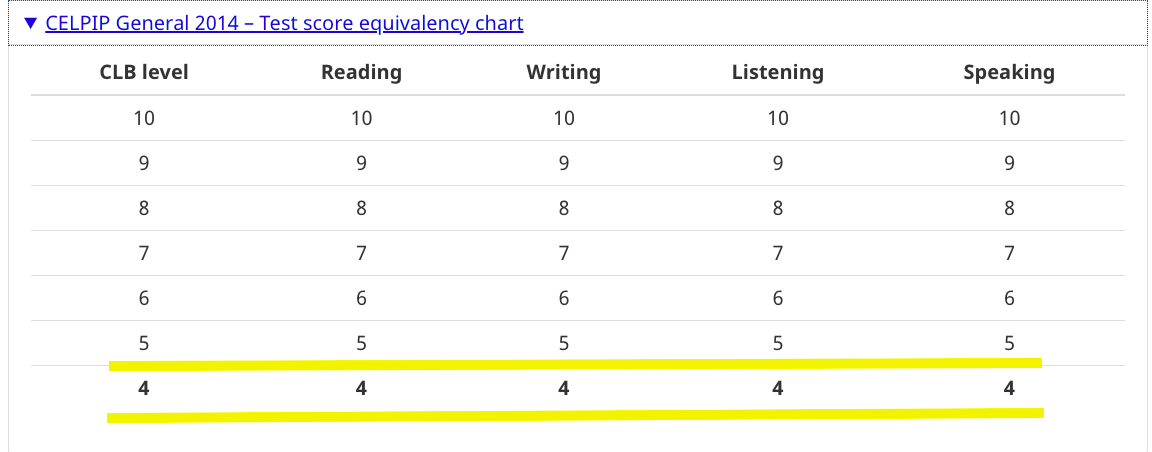
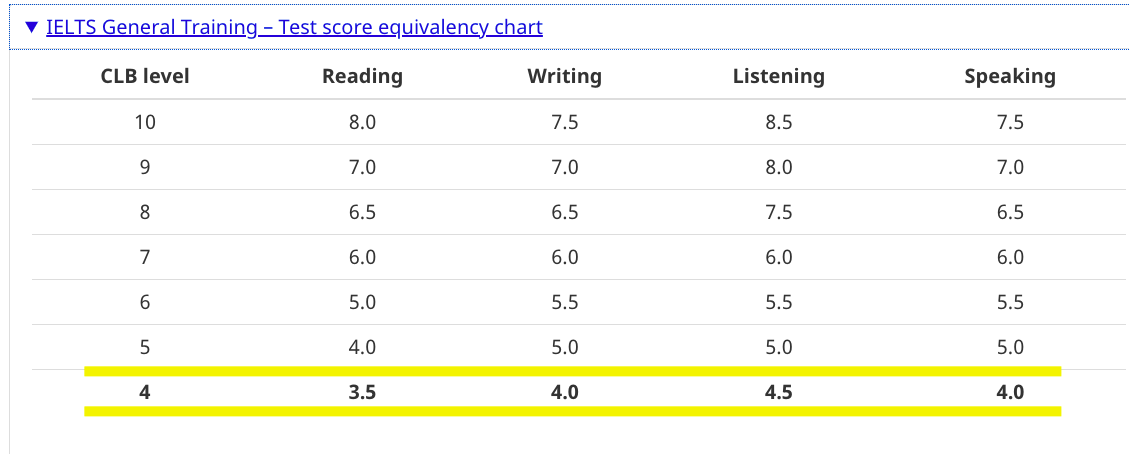
  2. Both exams are scored with a score of 1-9, for people who apply for permanent residence it is ONLY required that they obtain a minimum of 4 average points.

CELPIP required score by section:

IELTS required score by section:

  1. A score of 4 is less than 50% of the maximum grade which is 9 and is considered one level less than the intermediate level.
  2. Registering for the exam is somewhat complicated as at this time you can only book online.

Migrant workers who are in rural areas face the challenge that there are not always exam centers nearby. In addition to having to pay with a credit card, there is the option of buying a prepaid visa or mastercard, or if workers have a debit visa can be used.

We have consulted with English teachers who are dedicated to preparing students to take these exams and their conclusion is that the level that the government is asking for is something that even non-English speaking workers can achieve. 

Teacher tips: 

  • Learn the mechanisms of the exam
  • Learn the correct way to write an email: greeting, farewell, formally and informally. 
  • For the other sections the answers are in the questions or the text.
  • Both tests are NOT designed to measure your knowledge but your abilities.
  • For workers who speak Spanish it is advisable to take the IELTS test since they can present it written by hand, the reading section is not very difficult since most of the vocabulary has Latin roots. In addition, the oral section is a face-to-face conversation.
  • There are several videos on youtube where you can practice and learn the listening section. 

This program was created thanks to workers who have raised their voices. We must continue fighting for a permanent residence status for all, without leaving anyone behind, united we are stronger!

Study Materials:

  • Videos on Differences Between CELPIP and IELTS 
  • Practice Tests:
  • Videos to practice: