
Last year alone, Canada’s 3 largest grocery stores took $3.6 billion in profit. That money belongs to workers, including migrants like you – people who grow, harvest, transport, and sell food. Right now nearly 4,000 workers at Metro (which also owns Food Basics) are striking for better wages & work hours and job security – things that all of us deserve! Sign below to show your support for workers taking action to win a better life for all of us.
Seasonal Farmworkers: Do you know your rights?
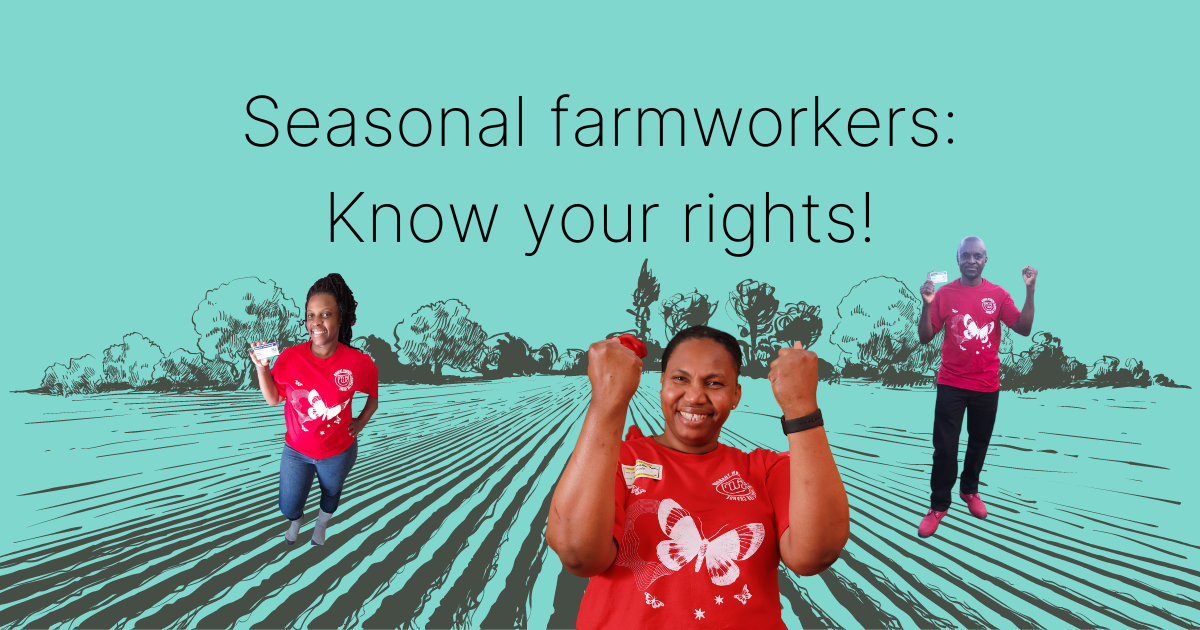
If you’re a seasonal migrant farmworker in Canada, it can be difficult and confusing to learn about your rights. This guide will help you and if you have any questions about your rights, send a WhatsApp message to 905-324-2840 with your issue and location.
As you read through this guide, you may see that you don’t have as many rights as you were promised. Farmworkers are excluded from many basic labour rights that workers in Canada have fought for and won. It’s not fair! Everybody deserves equal rights, fair treatment & wages, and safer workplaces. That’s why farmworkers like you are uniting together with other migrant workers to take action and win a better life for you and your family!
What are your rights and where can you find them?
For seasonal agricultural workers, there are 3 main places where you can read about your rights:
- Your contract (Federal)
- Labour laws (provincial)
- Housing guidelines (provincial + municipal)
Your contract gives you rights
If you came to Canada under the Seasonal Agricultural Workers Program through your home country’s Ministry of Labour, you have a contract that both you and your employer have signed. It’s your right to know what’s in your contract and to have your own copy. If you don’t have a copy of your contract, let us know. [Tap this link to view an online version.]
Here are some of your rights according to your contract:
- Clean, adequate living conditions (Section 2, Part A, #1);
- Access to adequate washing machines; or free transportation to a laundry facility (Section 2, Part A, #2);
- 1 meal break of at least 30 minutes after 5 consecutive hours of work, and 2 rest periods (10 mins each) in mid-morning and mid-afternoon (Section 2, Part C, #13);
- 1 day of rest after working 6 days in a row; if not possible, your boss must ask your permission to delay your day off to a later date (Section 2, Part C, #14);
- After working for the same boss for 5 years in a row, you are entitled to a recognition payment of $4.22/week for a maximum of $135, payable at the end of your contract (Section 3, #4);
- Health coverage (Section 6);
- Safety training and protective equipment at no cost to you (Section 9, #5);
- Free transportation to do your shopping once per week (Section 9, #7).
Labour laws give you rights
Canada has 10 provinces and 3 territories. Workers on the seasonal farmwork program mainly work in the provinces of BC, Ontario, New Brunswick, and Nova Scotia. The Canadian government is responsible for things like your work permit, contract, and other immigration-related matters, and the provincial government in the province where you work determines things like your labour rights. That means your rights may be different depending on what province you work in.
Farmworkers are generally excluded from basic labour standards – including the right to overtime pay and holidays & holiday pay. In Ontario, farmworkers are excluded from maximum hours of work and time off in between shifts. This is unacceptable! Reach out to us today to learn how farmworkers like you are pushing back against unfair labour laws.
Here are 3 of your rights under provincial labour law (Ontario):
- The right to work free from harassment and abuse (from your boss, supervisor, or coworkers);
- The right to regular payment of wages;
- The right to equal pay for equal work (your boss cannot discriminate against you and pay you less than somebody else on the farm for doing the same work)
[Tap this link to read more from the Ontario Ministry of Labour website]
If you are being treated unfairly at work or not being paid properly, message us on WhatsApp at 905-324-2840 for support.
Housing Guidelines Give You Rights
Like the labour laws, housing guidelines may be different depending on which province you live in and work. Your contract guarantees you the right to “clean, adequate living conditions”, and the housing guidelines go into more detail about what the government thinks that means.
These housing guidelines are used by the Public Health department in your area to inspect the bunkhouse and pass it. If you’re not sure where to find the housing guidelines, message us on WhatsApp with your postal code (a combination of letters and numbers that will be on your paystub or workplace address).
Using Ontario guidelines as an example, here are some of your rights:
- Safe, clean housing free from rodents;
- Clean blankets, sheets and pillow cases must be provided by your boss;
- Safe water supply for drinking, washing, and cooking;
- Employer must provide kitchenware (utensils, plates, bowls, etc), cookware (pots & pans), and cooking utensils
[Tap this link to view an online version of the housing guidelines in Ontario.]
Send us a message on WhatsApp at 905-324-2840 and we can walk through the checklist with you, or visit the farm at your request.
You Deserve More, Let’s Unite to Win!
As you can see, these options are not good enough. You deserve the power to protect yourself and fight for equal rights. That’s why migrant farmworkers like you and other migrant workers are uniting together to fight for permanent resident status for all. Without permanent status, the boss can threaten you with being fired, losing your housing, getting sent home, and being blacklisted from the farmwork program. Enough is enough!
On September 17, migrants and our supporters are taking to the streets across Canada to win permanent status for all, including people without papers. Invite your friends and family in Canada to take action with us by sending them this link: migrantrights.ca/events/sep17. United we are stronger!
Migrant Workers – You may be able to study now!
This information is up to date as for June 27, 2023. Please check back for updates
What was announced?
Temporary foreign workers with a “work permit” (see below for who may be excluded) that is valid on June 7, 2023, or temporary foreign workers with an expired work permit but who applied for an extension June 7, 2023, may be able to study for up to three years without a study permit.
What changed exactly?
Until now, if you were on a work permit, you could only study for a course of up to 6 months. For courses longer than 6 months, you would have to apply for a study permit. Now you will be able to study without a study permit until your work permit expires.
Does this change apply to refugees, post-graduate work permit holders or humanitarian applicants with valid work permits?
It is not clear at this time. Please fill in your information below and we will let you know when more information is provided by the federal government.
Can I study full-time?
Yes, you are allowed to study full time.
But the work experience you get while studying full time cannot be used for future immigration applications under Express Entry programs. If you study part-time, you will be able to count the full time work for your Express Entry applications.
If you are applying under the HCCP or HSWP or for the Agri-Food Immigraiton Pilot, it is not clear if you can count work while you are studying full time (but you can count work while you are studying part time). Please fill in your information below and we will let you know when more information is provided by the federal government.
What is part-time study?
Schools have different definitions. Usually anything less than 4 or 5 courses per semester is considered part-time. Check with the school before enrolling.
Can I start a full-year course if my work permit expires during the course?
We don’t know if you can start a course in September for one year (until September 2024), if your work permit expires in the middle (for example in November 2023). Please fill in your information below and we will let you know when more information is provided by the federal government.
Can I get accreditation for high-school equivalency or one-year post-secondary education in this way without applying for a study permit?
It is possible. However, you must make sure that the school you are applying to will provide you a certification that you can use. You must make sure that you choose part-time or full-time based on whether you need to count the work experience, and when your work permit expires.
Can I study online?
Yes, you can study online.
- For Post-Secondary education: The post-secondary education must be a “Designated Learning Institute”. Check here to see if the school is registered. Be careful, there are many “private colleges” that are not listed so make sure you check this list even if the school is large and you know other people that attend.
- For high-school accreditation: Make sure it is a provincial organization. For example, in Ontario, click here.
Do I have to pay international tuition fees?
Yes, you will have to pay international tuition fees, which is 3-4 times higher than domestic tuition fees.
What are the requirements to enroll at a college or university or to get a high school diploma?
Every college and university has different requirements. You should read their websites carefully to apply. Only trust the information that you read yourself. Do not trust the advice of education agents without checking yourself.
Fill Out This Form For More Information
Join the MWAC Members Annual Assembly and Renew Your Membership
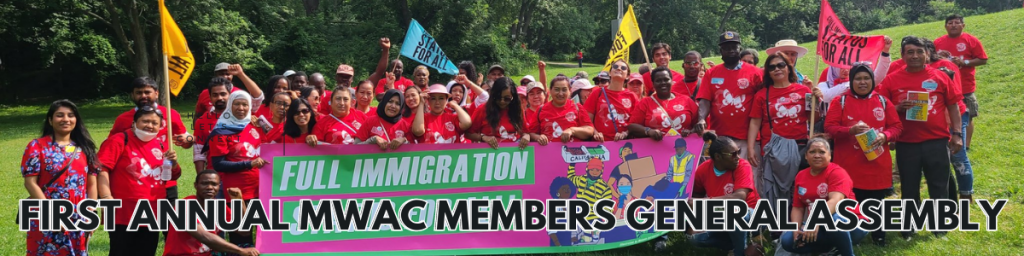
Are you a member of MWAC?
Join us in Toronto on July 9 as we gather together to
Re-ignite the fire. Celebrate our victories. Decide the future. Unite for power.
To register, fill out the form below:
Migrant Workers Alliance For Change Reiterates Calls For Regularization And Permanent Resident Status Following New Immigration Criteria
Media Contact: Sarom Rho, 416-887-8315, sarom@migrantworkersalliance.org
Migrant Workers Alliance For Change Reiterates Calls For Regularization And Permanent Resident Status Following New Immigration Criteria
Categories of “high-need” industries highlight the urgent need for permanent residency in low-wage sectors occupied by migrants, including undocumented workers.
Toronto, May 31, 2023 — Canada’s first-ever launch of category-based immigration selection today highlights the ongoing exclusion of migrants and undocumented people from permanent residency. Many of the occupations announced today as priorities for permanent resident status are currently filled by temporary foreign workers, international students, recent graduates, and undocumented workers. But most of them will be unable to apply due to parallel rules. Undocumented people are excluded based on their lack of immigration status; while other migrants are excluded because of language tests that do not correspond to their ability to communicate, excessively high educational accreditation requirements, and being labeled as low-skilled by employers despite performing highly skilled work. Additionally, aging migrants are subjected to punitive measures through point reductions.
The newly selected occupations for priority consideration include nurse aides, orderlies, patient service associates, as well as other low-wage health providers, contractors, supervisors, construction trades, installers, repairers, servicers, truck drivers, and agricultural workers.
“Migrants in low-wage sectors, including undocumented people, are essential to our communities and deserve the rights and protections that permanent resident status provides, irrespective of their employment status. However, this latest attempt to connect workers to jobs highlights the overwhelming evidence that jobs that need to be filled are being done by racialized working class migrants, and they are being excluded from equal rights only possible through permanent residency. We call upon Prime Minister Trudeau to acknowledge the facts, fulfill his promise, regularize undocumented individuals, and ensure permanent resident status for migrant students and workers.”
– Sarom Rho, Organizer, Migrant Workers Alliance for Change.
Background
- Details of today’s new announcement: https://www.canada.ca/en/immigration-refugees-citizenship/news/2023/05/canada-launches-new-process-to-welcome-skilled-newcomers-with-work-experience-in-priority-jobs-as-permanent-residents.html
- Prime Minister Trudeau’s mandate letter promise to regularize undocumented people and grant permanent resident status to migrant students and workers: https://pm.gc.ca/en/mandate-letters/2021/12/16/minister-immigration-refugees-and-citizenship-mandate-letter
- Migrant Rights Network proposal for changes to the immigration system: https://migrantrights.ca/wp-content/uploads/2023/05/Strategic-Immigration-Review-MRN-Submission-.pdf
Migrant Workers Alliance for Change
Migrant Workers Alliance for Change is a migrant-led, membership based organization of farmworkers, fishery workers, careworkers, undocumented people and current and former international students uniting for immigration and labour justice.
Current + Former Farmworkers: MAY WI TALLAWAH
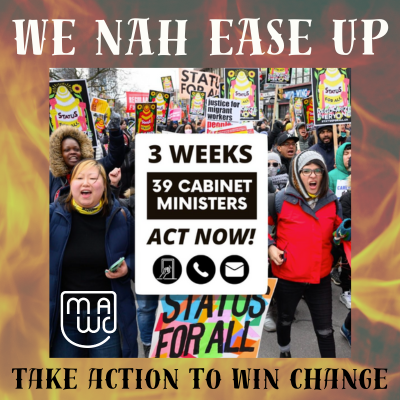
Prime Minister Justin Trudeau and his government are *finally* discussing status and equal rights for undocumented migrants (regularization), including former farmworkers, this month. We are close to winning equal rights, but we can’t cross the finish line without YOU!
Here are some action options – what are YOU willing to do to win? Choose an action below and invite a friend to join you!
In-person actions
- 1. Join a delegation visit to a Federal decision-maker’s office near you, or ask a friend to do so. Tap this link for the list of visits already planned.
- 2. Can’t join a visit? Put up posters around decision-makers’ offices near you, or ask a friend to do so. Tap here for posters to print.
Alternative actions
- 3. Sign the petition at StatusForAll.ca and ask a friend to do the same. Post the link regularly on Facebook or share on WhatsApp to remind your friends to sign and share. For every person who adds their name, an email is automatically sent to the Cabinet Ministers.
- 4. Call Prime Minister Justin Trudeau at 613-992-4211 and leave a message telling him to support an inclusive program to give permanent resident status to all undocumented people with no caps or exclusion. Tap here for script. Ask a friend to call with you!
- 5. Call Cabinet Ministers asking for the same thing and invite a friend to join you. Try to call them every day!
- To call directly: Tap here for a full list of Cabinet Ministers and their contact information, with script.
- 6. Outside of Canada and can’t make a call? Record a video or voice note, or take a photo, asking Cabinet Ministers to do the right thing. Use the same script as the phone calls. Send your video, audio, or photo on WhatsApp to 905-324-2840.
- 7. Do you have an idea for an action not listed? Share it with your organizer on WhatsApp at 905-324-2840 or through email at kit@migrantworkersalliance.org
We have just a few weeks to make sure each of the Cabinet Ministers hear from thousands of us, so that they are pressured to do the right thing. Let’s go!
Upcoming farmworker meetings
- May 7, 4-6pm – Vineyard workers organizing meeting
- Are you a grape farm worker? Tap here to vote for your priorities!
- May 10, 8pm Toronto time/7pm Jamaica time – Monthly members meeting for current & former farmworkers
- Not a member yet? Take an action above and WhatsApp “JOIN MWAC” to 905-324-2840 to learn more about our membership process.
Review of Bill 27: Working for Workers Act
Ontario’s Conservative government introduced the Working for Workers Act, 2023, saying that it would strengthen protections for foreign workers. Unfortunately, Bill 79, as currently drafted, will not benefit most migrant workers facing exorbitant recruitment fees and labour exploitation. We joined with Workers Action Centre and Parkdale Community Legal Services to make a submission to the Standing Committee on Finance and Economic Affairs Review of Bill 79. Read our recommendations in the full submission above.
Fairness for migrant vineyard workers!
Are you a wine grape farm worker who wants higher wages, fair treatment, better housing, and permanent status so you can be together with your family?
You’re not alone! Farm workers like you are uniting together to take action and win the change you deserve.
Will you join us? Use this private and confidential form to vote on the changes you want, then join the organizing meeting in July to learn more about how we can win together!
Want to take more action? Sign the petition at StatusForAll.ca
Everything you share is private and confidential. Your information will never be shared without your consent.
Assembly: Update on Regularization Campaign and What Comes Next!
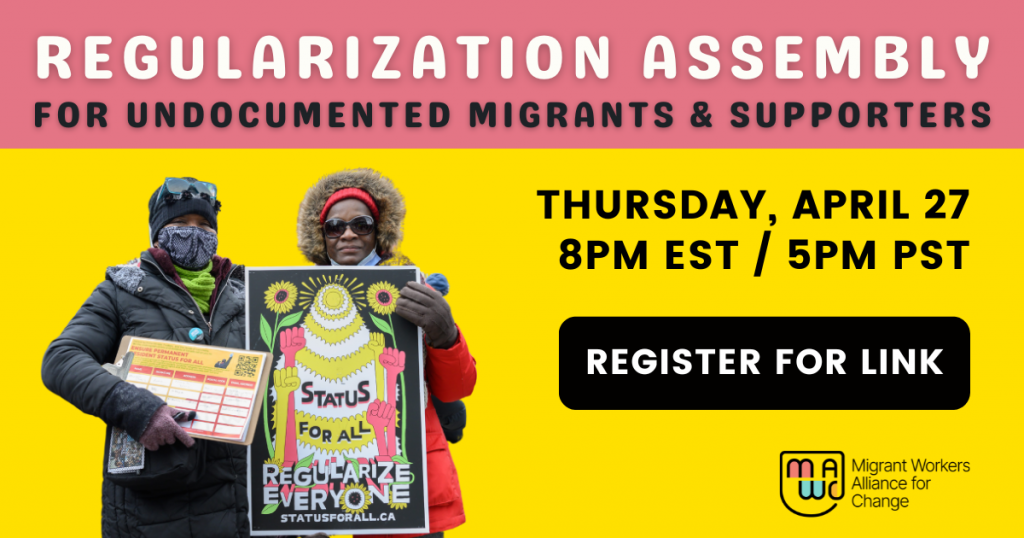
Join us online on Thursday, April 27 at 8pm (Toronto time) for an open and anonymous meeting for undocumented migrants and supporters across the country. We will provide an update on regularization, answer all your questions, and share what needs to be done for us to win!
REGISTER RIGHT NOW to get the Zoom link or come back to this registration page on April 27th and join in. Simultaneous interpretation will be available in Spanish and English.
Emergency Rally & Petition Delivery: No STCA! Status for All!
Join us in grief and rage.
If you can’t attend at 12pm, there is also a vigil at the same location at 4:30pm organized by the Toronto Refugee Rights Day organizing committee.
Refugees and other migrants were already dying crossing via Roxham Road because the Safe Third Country Agreement (STCA) and other immigration laws made it impossible to travel safely. Now, with STCA expanded, both the US and Canada have legislated a policy of turning away migrants. Any refugee crossing over will be able to be deported without due process within the first 14 days of arrival. This will force refugees to take even more dangerous routes and cause even more suffering and death. Prime Minister Trudeau says Canada welcomes migrants, even as he is slamming the door shut and putting migrants in danger.