There are limited options to make official complaints safely. We can support you to raise your concerns in other ways, and by joining with other workers to make change. Together we are uniting to win permanent status for all, so that we can have the power to speak up and protect ourselves!
Fill out our private and confidential complaints form below and message us to discuss next steps.
Current laws make it too easy for bosses to leave us without work. We are not a job placement agency and cannot help you find a job. We are a migrant worker rights organization led by migrants and together we’re working to change the laws so that nobody is treated like you were! You are not alone!
TAKE ACTION: There are many other workers in the same situation who shared their story with us. Share your experience here with this private and confidential form: https://migrantworkersalliance.org/not-called-back (Tap the blue letters)
Currently the Canadian government makes it nearly impossible for migrant farm workers like you to get permanent resident (PR) status. This is not fair! PR means equal rights, the power to protect ourselves and leave bad jobs, and the ability to be together with our families. Everybody deserves these things! Do you agree?
If you do not qualify for the programs below, you are not alone! The requirements for PR are too strict and shut out many of us. Farm workers like you are uniting together to push the Canadian government to give permanent status for all!
Current permanent resident options for farm workers:
Farmworkers in certain industries who met the requirements could apply for PR through the Agri-Food Pilot Program. NOTE: This program is now CLOSED as of February 13, 2025. This isn’t fair!
If you are employed as a Supervisor on the farm or greenhouse, and meet the other requirements (including language test, work experience, & job offer) you may be eligible for Express Entry under the Federal Skilled Trades Program.
Right now the Canadian government only gives temporary open work permits to farmworkers who can prove that they are experiencing abuse at their current workplace, or are at risk of abuse. If you are being abused or at risk of being abused at work and want to apply for this permit, contact us for support.
Everybody deserves the freedom to choose where they work and live free from abuse. This is why farmworkers like you are organizing together to win permanent status for all! Will you join us?
It’s not fair, you deserve to be together with your loved ones.
That’s why migrant workers across Canada are demanding status for all now so we can be with our families! Send a WhatsApp message to 905-324-2840 to learn how you can join the fight.
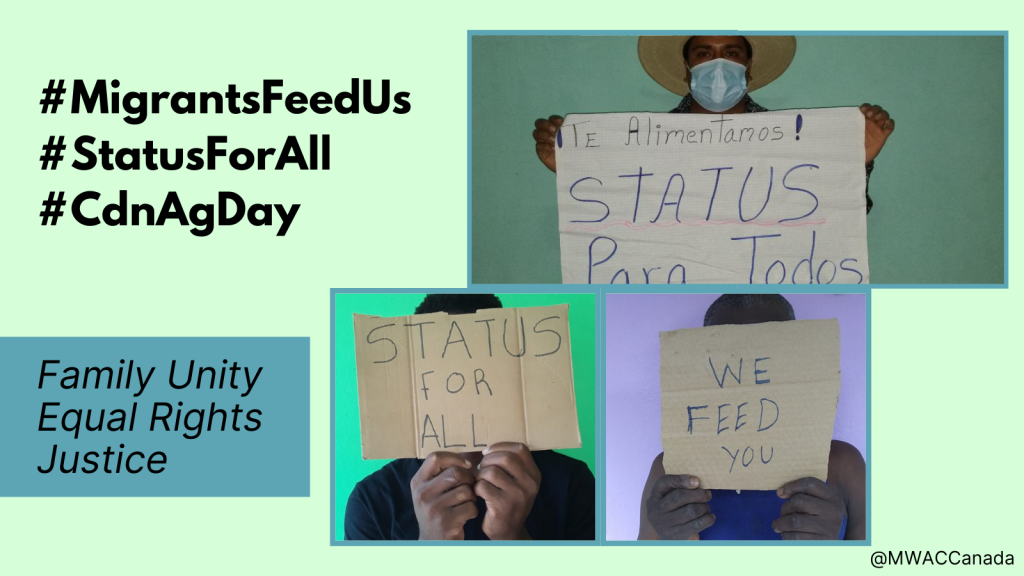
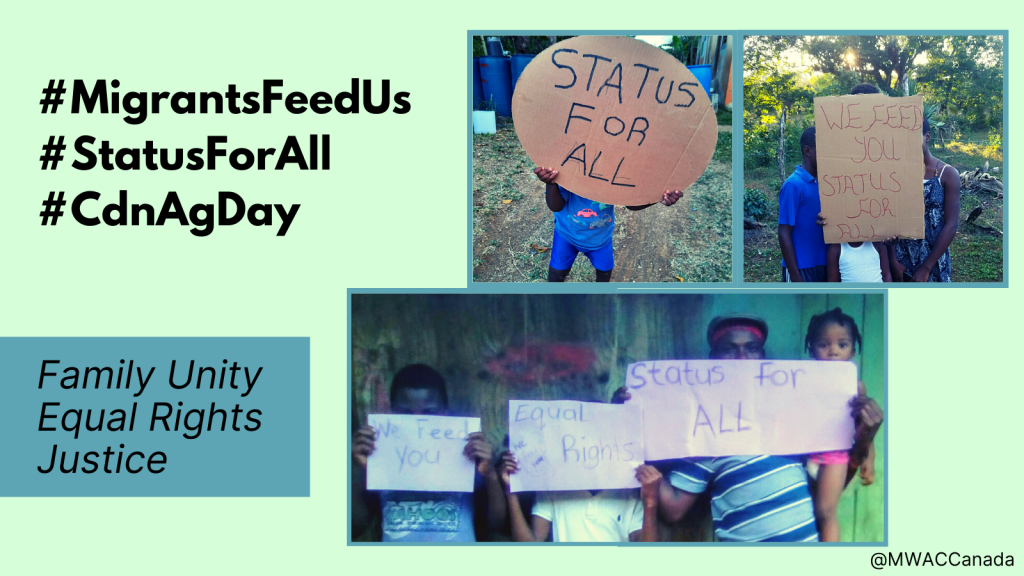
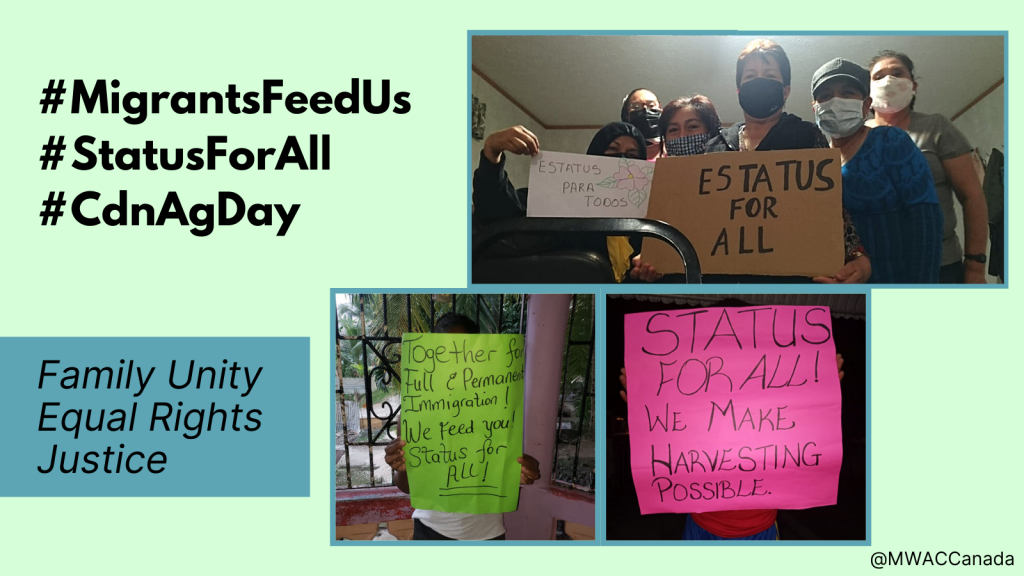
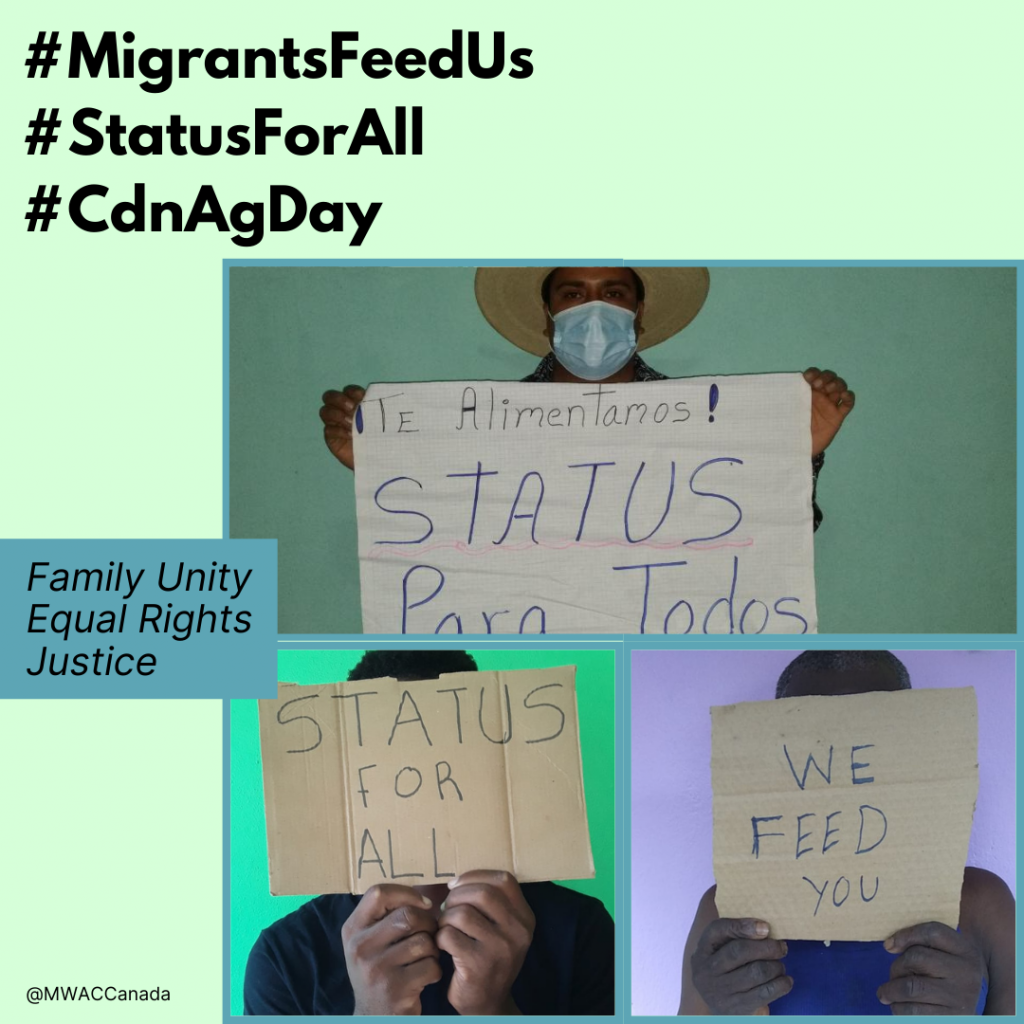
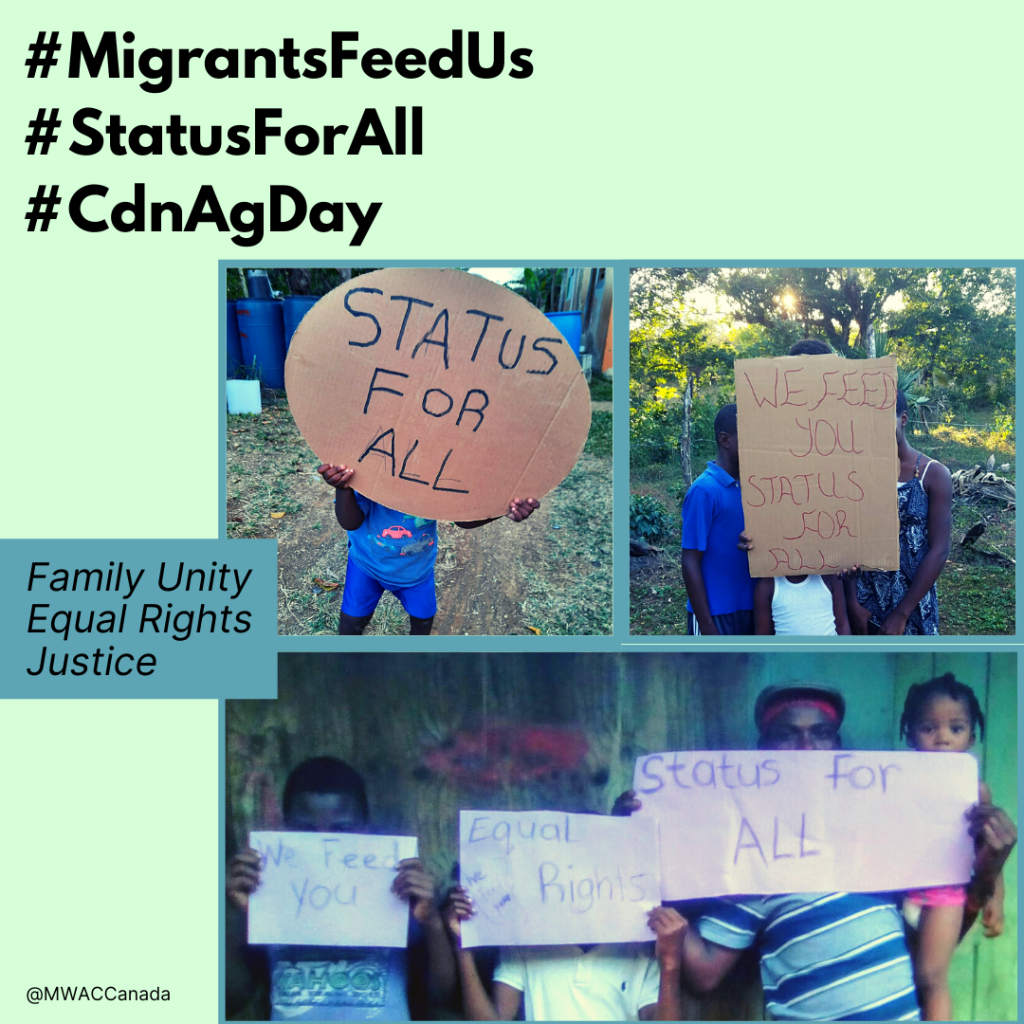
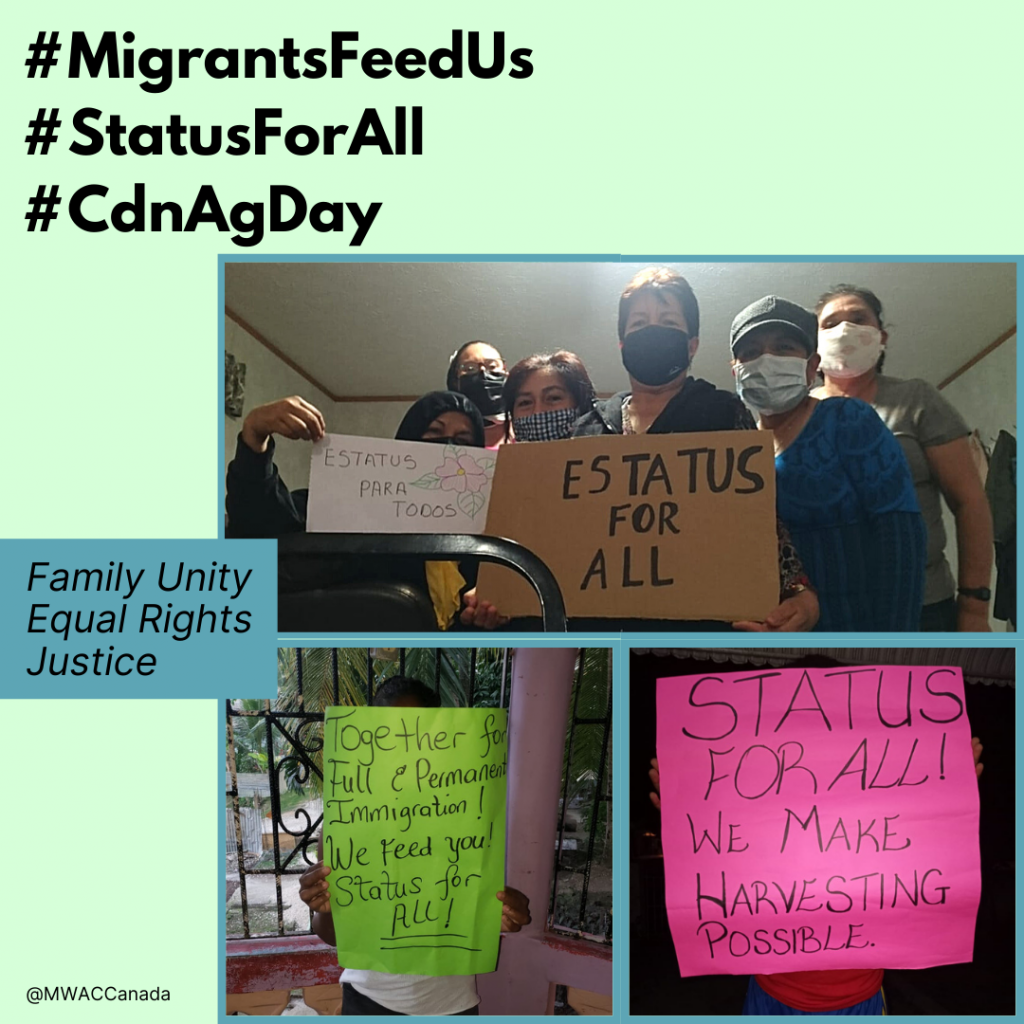
Every year the agri-food big business lobby, funded by the Canadian government, organizes Canadian Agriculture Day to celebrate “Canadian agriculture and food and the people who produce it”. But the celebrations leave out the racialized migrant agricultural workers without whom none of us could eat.
This year, the lobby day is on February 23, primarily on Twitter & Instagram using the hashtag #CdnAgDay. So migrant farm workers across Canada, as well as throughout Mexico and the Caribbean, are taking over the hashtag with their message: WE FEED YOU.
Show your support by posting online with pictures of food and forks, using #CdnAgDay + #MigrantsFeedUs + #StatusforAll. Let’s reveal the truth about who feeds us and join in migrant farm workers’ fight for equal rights and justice. Follow all day on February 23 at @MWACCanada and @MigrantWorkersAlliance.
You can also use these images to post on February 23rd.
Ontario has launched a consultation on Temporary Help Agencies is to improve compliance with the Employment Standards Act (ESA). Ministry of Labour, Training and Skills Development (MLTSD) inspections have exposed what temporary agency workers and migrant workers have known for years, that there is widespread non-compliance with the ESA and Employee Protection for Foreign Nationals Act (EPFNA). The deadline for written submissions to the consultation is Friday, January 29, 2021.
Migrant worker supporting organizations in Ontario are urged to submit letters in support of a joint proposal by Migrant Workers Alliance for Change, Parkdale Community Legal Services and Workers Action Centre.
We urge you to develop immediate and effective solutions to ensure workers are able to return in 2021, as you work towards long-term systemic changes to ensure workers can safely assert their rights, beginning with full and permanent immigration status for all. Immediate solutions can include:
Guaranteed re-entry process for migrant workers who have previously come to Canada, so that workers are not dependent on employers to be able to return to work;
Workers who are not invited back should be granted access to an expedited review and reassignment process such that they can return in time for the 2021 season;
Workers in sending countries should be able to raise concerns about farms and request a placement elsewhere before the 2021 season. These requests should be automatically granted, and must be accompanied by guaranteed protection against reprisals for having raised such complaints;
A mechanism must be established for workers to complain about employers that have reprised against them in the form of non-invitation. This complaints mechanism must trigger an investigation of those employers by the Canadian federal government. A list of employers found to have engaged in blacklisting must be made public in Canada, be shared with sending country governments and made publicly available to workers before they begin their applications for the upcoming season.
Watch this video on farmworkers speaking out for the decent and dignified living conditions we deserve, and read the executive summary of our submission to the government’s housing consultations.
Decent Dignified Housing for Migrant Farmworkers
Migrant Rights Network – Food & Farmworkers Working Group Submissions to Consultations on Mandatory Requirements for Employer-Provided Accommodations in the TFW Program, 2020
Executive Summary
Housing Cannot Be Improved Without Full and Permanent Immigration Status for All
Bonifacio Eugenio Romero Rogelio Muñoz Santos Juan Lopez Chaparro
Migrant farmworkers that died from COVID-19. Each infected in an outbreak on their farm because of their housing and working conditions. Each infected because they were not able to protect themselves because of their lack of permanent immigration status.
For over half a century now, migrant farmworkers have been coming to Canada growing and packaging food and feeding communities. Despite the permanent need for their work, their immigration status in Canada is temporary.
Lack of permanent immigration status is not simply about denying migrants the security and stability of being able to stay in Canada permanently. Access to basic rights and the ability to enforce them is determined by immigration status. This is especially true for those on tied permits, like migrant farm workers.
When speaking out results in termination, homelessness, being forced to leave the country, and not being able to return, asking for fair wages, decent housing, or a safe workplace becomes simply impossible.
At least one in 23 people in Canada today are migrant or undocumented, without full immigration status. The immigration system has created a category of person – the migrant – who is excluded from existing legal rights and protections at the provincial and federal level. It is not feasible to change discrete labour, education, housing, health, policing and other laws at both the federal level and in 13 provinces and territories to include this category of person without addressing the fundamental instrument of their exclusion. We must create a society where all residents have equal rights and access, and that means full and permanent immigration status.
It is neither effective nor just to simply amend laws and policies that emerge from this temporary immigration system. The current housing consultations are only necessary because migrant farmworkers do not have the power to assert their rights under existing landlord-tenant protections in provinces and territories because of their immigration status.
Rather than perpetuate a system where the people that grow our food and feed us continue to be indentured to their employers – in which employer-provided housing is a central tool of that subjugation – we must envision a just food system where those that sustain it are treated with the dignity, respect and appreciation they deserve.
The first step in this is creating a single-tier immigration system where all residents of the country have the same and equal rights and status. Only then can farm workers assert their rights to dignified and decent housing.
Top Migrant Farmworker Priorities for Decent Housing
Despite significant challenges and limitations in the consultation processes (outlined below), migrant worker-led organizations reached out to and spoke with hundreds of migrant farmworkers between November 1st and 21st through a number of different mechanisms outlined in the methodology section. We received input from 453 migrant farmworkers across the country. This submission summarizes their demands for decent housing.
The worker feedback presented in this report must be understood in the context of the extreme power imbalance between workers and employers and the long history of abuse and exploitation of migrant farm work programs. Migrant farmworkers are wary of speaking their whole truths. Their experiences are worse than what is detailed here, and their demands are much greater.
Yet even with these downward pressures on workers’ demands, the results of our consultations reveal two core guiding principles that underpin workers’ demands.
These principles are:
Worker self-determination: Workers want the autonomy to make decisions about their lives as every human being deserves. They do not want employers or governments making decisions for them. It is workers’ needs and wants that should guide all decisions about workers’ housing.
Humanity, dignity and respect: Workers want to live and work in conditions that respect their full humanity and not be treated as machines or worse, ‘slaves’, as many stated in their responses to this consultation. Migrant workers deserve homes , not just housing.
Further, we insist that the guidelines must prioritize:
Urgency: Housing is indecent, inhumane and unlivable today. There is no time to lose. Illness has spread and cost lives and rights have been trampled. Robust and enforceable guidelines must be put into place immediately.
Enforceable Rights:Migrant workers want rights that are real, which means rights they can enforce. The proposed guidelines must be coupled with proactive enforcement, anti-reprisal protections, and full and permanent immigration status for all.
The top five priorities identified by migrant workers in our consultation process are:
Privacy: Over half (51%) of the respondents identified privacy as the priority for decent housing. Migrant farmworkers see this as a matter of basic human dignity. Being warehoused with many others or crowded together in small houses makes it impossible for workers to take care of their physical and mental health and well-being.
Space: Nearly half the respondents (43.43%) highlighted space as their key priority. Workers want communal as well as private space, both indoor and outdoor, where they can relax during their spare time, watch TV, play sports, host guests, socialise and grow food. They want storage space for their personal belongings. They need separate change rooms to be able to keep dirty work clothes away from living spaces for cooking and resting. Many workers spoke specifically about the mental and physical toll from living in crowded housing, and the need for no more than 1 or 2 people per bathroom and kitchen.
Quality of life: Nearly one in three workers (28.1%) identified quality of life needs as key priorities. They want their housing to include laundry, kitchen, shower and bathroom facilities under one roof so they don’t have to travel large distances between them. They want to have clean drinking water, hot water for showers, heating in winter, and cooling in the summer. They want furniture and basic amenities (such as blenders, coffee makers, etc) to be in good condition, and have access to phones and free internet. They want less social isolation: workers want their homes away from their workplaces and employers’ homes, and closer to grocery stores, remittance services and health facilities.
Family unity: More than one in four (26.28%) workers said they want their families here with them. Many migrant workers spend 8 months of the year in Canada, others spend 2 or more years at a time. Migrant workers want homes where their families can live with them, but the majority said they don’t want their families living in conditions like their current housing. Demands for family are demands for full and permanent immigration status.
Worker Control: A quarter of respondents (25%) noted worker control and autonomy as a key priority. Migrant workers want the freedom to choose when to be alone or in social spaces; to be quiet or loud; when to cook and where to eat; to live without employer surveillance or control over their movement or visitors; to choose when to eat or shower without having to negotiate with others. Migrant workers want the freedom to make choices in their housing, not live under the current institutionalized conditions.
The results of our survey are very clear:
79.9% of workers don’t want a bunk bed;
62% of respondents want their own room;
84.9% want to share a bathroom with no more than one person;
84.3% want to share a kitchen with no more than one person;
46% of respondents believe their housing should be improved “A LOT”;
85.6% of respondents believe they should have full and permanent immigration status on arrival; and
65% are unsatisfied with the building structure of their homes; 78% are unsatisfied with common spaces, 70.6% are unsatisfied with furniture; 74.3% are unsatisfied with sleeping areas; 63.3% are unsatisfied with laundry areas, 66.1% are unsatisfied with bathroom areas; and 48.6% are unsatisfied with internet and phone access.
We also received significant feedback on the experiences and worker satisfaction with current housing, including data on room-sharing, which is detailed graphically below.
We call on the federal government to create enforceable national standards for dignified housing for all migrants in employer controlled homes (including migrant care workers) immediately and ensure full and permanent immigration status for all migrant and undocumented people.
Limitations of these Housing Consultations
On July 31, 2020, the federal government finally made an announcement about migrant farmworkers. Instead of changing any laws or creating new policies, $52.6 million were allocated to employers. The announcement also promised to “work to develop mandatory requirements to improve employer-provided accommodations, focusing on ensuring better living conditions for workers.” This was in response to recommendations by us calling for a “national housing standard so that workers can live safely and with dignity,” as part of a package of reforms starting with full and permanent immigration status for all.
The government’s announcement followed multiple communications by migrant worker led organizations including (but not limited to):
March 16, 2020: Letter by Migrant Rights Network on healthcare, immigration, worker rights, emergency income and offering our support to ensure migrants were at the table to create a response to COVID-19.
March 26, 2020: Letter by Migrant Rights Network on income support for migrants in Canada.
April 1, 2020: Letter by Migrant Rights Network migrant farmworkers and housing.
May 12, 2020: Public statements in response to the Agri-Food Immigration Pilot Program, which continues to exclude most farmworkers outlining policy mechanisms to ensure migrant rights and protections.
June 15, 2020: Migrant Workers Alliance for Change released a damning report showing immense migrant worker exploitation during COVID-19 and lack of supports for migrants outlining 17 recommendations.
The consultations announced in July were effectively launched on October 28th. In the call for feedback, the federal government identified that the purpose of this consultation is “not to pursue short-term changes for the 2021 season or to address the current pandemic”.
That is, eight months into a pandemic, with over 1,600 migrant farmworkers infected across Canada, with at least 125 infected as we write this just in Ontario, with three workers dead, absolutely no laws and policies have been created that will even come into force in 2021, much less deal with the crisis at hand in 2020.
Neither the consultation process nor the guiding documents were created by migrant workers and their organizations. As a result, they suffer several critical weaknesses, including:
These consultations completely leave out migrant care workers who live in employer-controlled housing;
The consultations are open to employers, provincial governments and even the general public. No mechanism has been outlined to prioritize migrant farmworker input over that of others despite the massive power imbalance that exists and the fact that migrant workers are the ones that live in these houses;
The regulations proposed do not include an enforcement strategy;
The consultation documents were circulated in English as PDFs on October 28th to migrant supporting organizations and employers. Migrant workers speak multiple languages, but may not have high levels of reading and writing literacy. Most are unable to give input in response to emailed documents in English;
The consultations were launched at a time that most migrant farmworkers are unable to participate. Most workers start leaving Canada after Thanksgiving, the end of harvest. Those that remain are at the end of the season and working overtime. Those that have returned home are often in regions without reliable telephone or internet access;
Almost all farmworkers have had their mobility restricted by their employers who are refusing to let them leave the farms or have visitors. Workers have limited access to the internet and telephone on farms in Canada;
No resources were provided to migrant worker supporting organizations to facilitate worker participation in these consultations; and
The guidelines largely do not treat migrants as full human beings with social lives, collective and individual needs, and with differing opinions from farm to farm.
Migrant workers want their housing to ensure privacy, space, family unity, quality of life, and worker control. They want decent housing that provides them with a sense of home, a dignified place to rest and live like the whole human beings that they are. They want enforceable guidelines and full and permanent immigration status for all. Help amplify these voices by making a submission.